Benchmarks GLM-5.3-Flash vs Claude Opus 4.8: Every Benchmark Explained GLM-5.3-Flash nearly matches Claude Opus 4.8 on Terminal-Bench 2.1 and leads it on DeepSWE in Z.ai's published tests. Here is what each score means in real work.
AI Benchmarks How to Read AI Benchmark Scores: A Beginner Cheat Sheet Learn what AI benchmark scores, pass@1, Elo ratings, tools, reasoning effort, contamination, and benchmark versions mean before comparing models.
GLM-5.3 GLM-5.3 Found Bugs Hiding Since 1981: What Its Benchmarks Actually Mean GLM-5.3 did more than raise a coding score. Its largest gains appeared after a bug was found: reproducing it, building exploit primitives, and finishing long technical jobs.
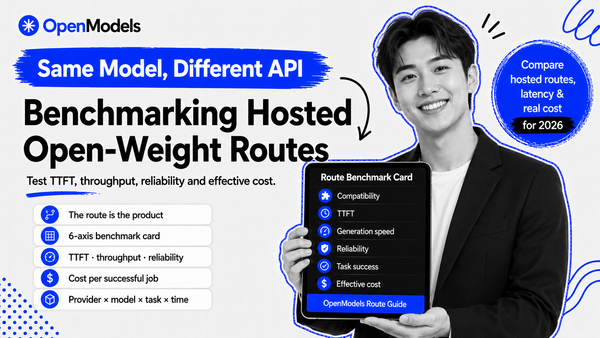
OpenModels Same Model, Different API: Benchmarking Hosted Open-Weight Routes One model name can hide several different services. Here is a reproducible six-axis test for route latency, reliability, compatibility and effective cost.
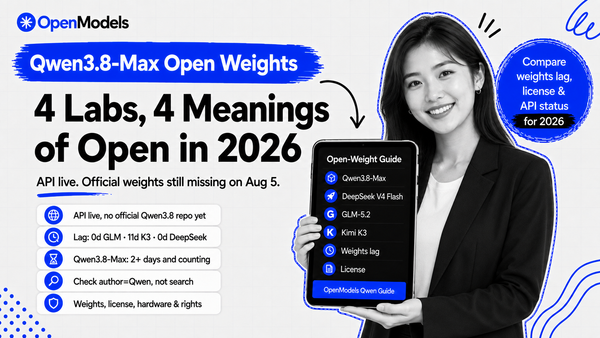
Open Weights Qwen3.8-Max Open Weights: 4 Labs, 4 Meanings of Open in 2026 Alibaba announced Qwen3.8-Max with open weights next week. Two days later there is no repo, no license, no date. We measured the gap between API and download across four labs: 0 days, 11 days, and counting.
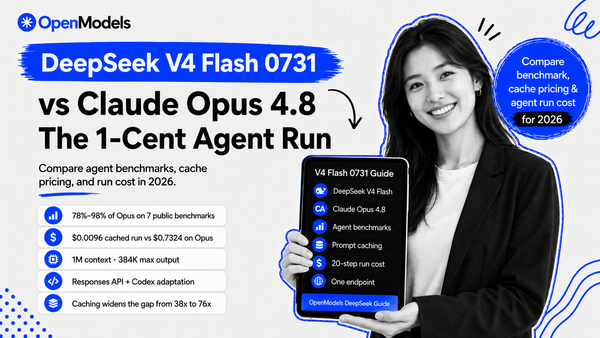
OpenModels DeepSeek V4 Flash 0731 vs Claude Opus 4.8: The 1 Cent Agent Run DeepSeek shipped V4-Flash-0731 on July 31 with the same architecture and 7.4x the DeepSWE score. We priced the benchmark table nobody prices: one cached agent run costs $0.0096 against $0.73 on Claude Opus 4.8.
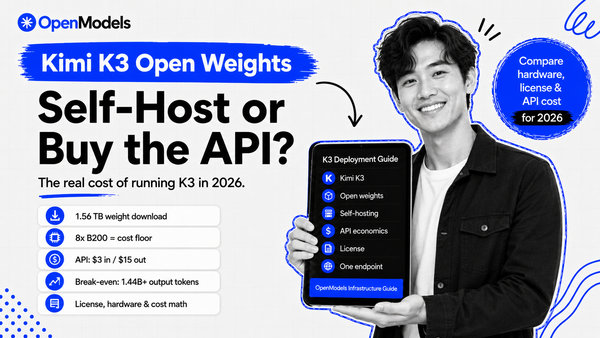
OpenModels Kimi K3 Open Weights: Self-Host or Buy the API in 2026? Moonshot published 1.56 TB of Kimi K3 weights on July 27. Running them yourself starts at $21,600 a month for one node, and the API break-even sits at 1.44 billion output tokens. The math, and the license.
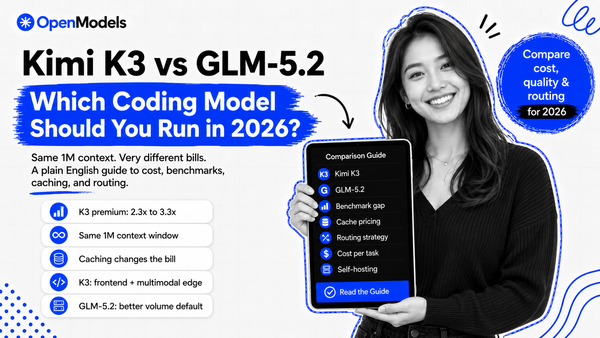
OpenModels Kimi K3 vs GLM-5.2: Which Coding Model Should You Run in 2026? Same 1M context, same agent loop, very different bills. GLM-5.2 runs $114 a month where Kimi K3 runs $300, but the premium swings from 2.3x to 3.3x depending on how much your workload generates.
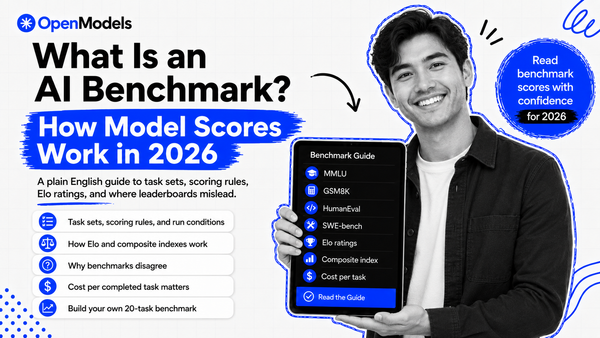
AI Benchmarks What Is an AI Benchmark? How Model Scores Work in 2026 Kimi K3 placed first on one leaderboard and behind two rivals on another in the same month. Both were correct. A plain English guide to what AI benchmarks measure, how Elo scores work, and where they mislead.
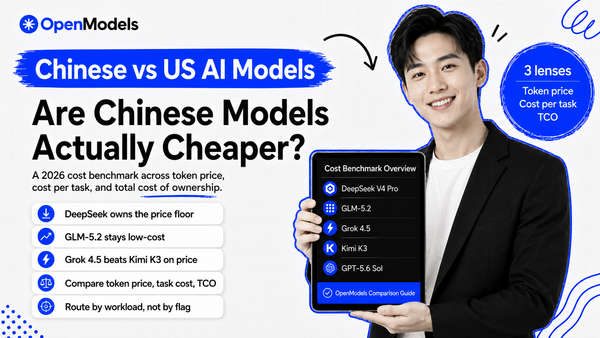
AI Cost Chinese vs US AI Models in 2026: Are China's Models Actually Cheaper? Are Chinese AI models cheaper than US models in 2026? DeepSeek, GLM-5.2 and Qwen own the price floor, but Kimi K3 costs more than Grok 4.5, and a US model leads cost per task. A three-lens cost benchmark.
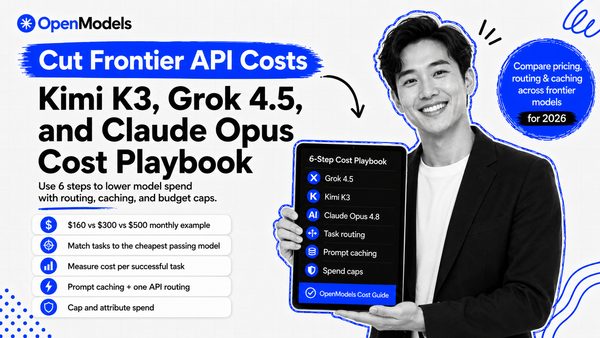
AI Cost How to Cut Kimi K3, Grok 4.5, and Claude Opus API Costs in 2026: A 6-Step Playbook Same tokens, $200 to $500 depending on which levers you pull. The frontier-cost playbook for Kimi K3, Grok 4.5, and Claude Opus: price the work, match the task, cache, route behind one API, then cap the spend.
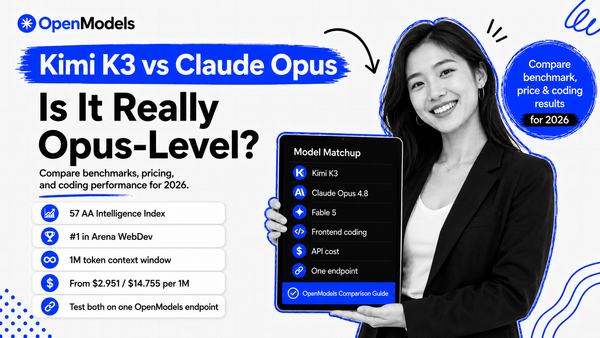
Kimi K3 Kimi K3 vs Claude Opus: Is It Really Opus-Level? See whether viral Kimi K3 is really Claude Opus-level, compare benchmarks and price, and test its API through OpenModels.
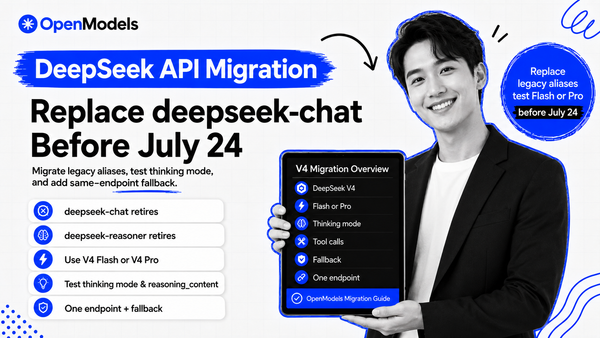
DeepSeek DeepSeek API Migration: Replace deepseek-chat Before July 24 Replace DeepSeek's retiring API aliases, choose V4 Flash or Pro, test thinking-mode behavior, and add a fallback through one OpenModels endpoint.
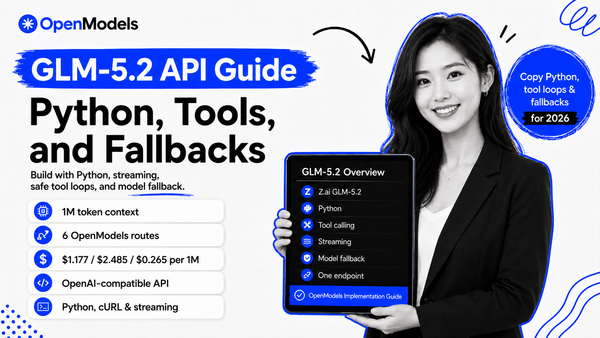
GLM-5.2 GLM-5.2 API Guide: Python, Tools, and Fallbacks Call GLM-5.2 with Python or cURL, stream responses, build a safe tool loop, estimate token cost, and add model fallback through one OpenModels endpoint.
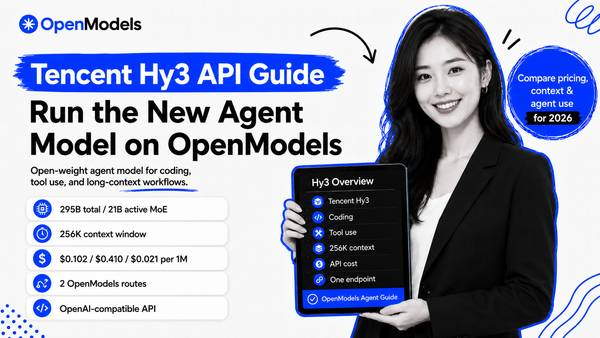
Hy3 Tencent Hy3 API Guide: Run the New Agent Model Learn what Tencent Hy3 changes for AI agents, compare it with Hy3 Preview, and call Hy3 through one OpenAI-compatible OpenModels API.
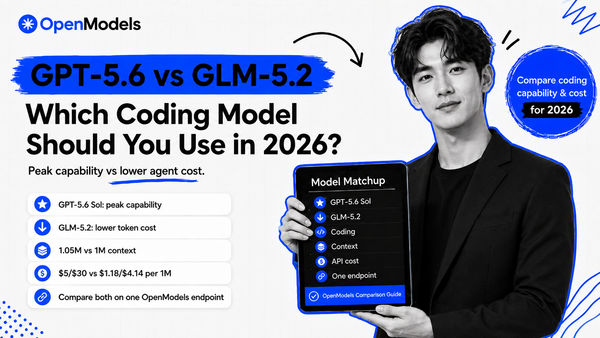
GPT-5.6 GPT-5.6 vs GLM-5.2: Which Coding Model Should You Use in 2026? GPT-5.6 leads on peak capability; GLM-5.2 leads on checked token economics. Compare coding, context and cost, then use both through one OpenModels endpoint.
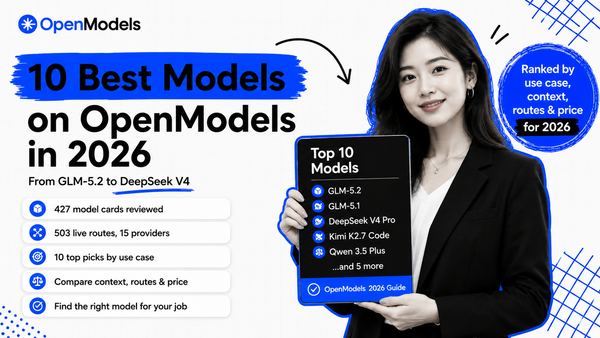
OpenModels 10 Best New Models on OpenModels in 2026 OpenModels now lists 427 models across 503 live routes. We ranked 10 standout choices by use case, with GLM-5.2 leading for long-context coding.
GLM-5.2 GLM-5.2 vs Claude Code: Best Model for Long-Horizon Coding Agents in 2026 GLM-5.2 is a model. Claude Code is a harness. That distinction decides your architecture, your bill, and whether you can even point one at the other. A protocol-level comparison for developers building coding agents.
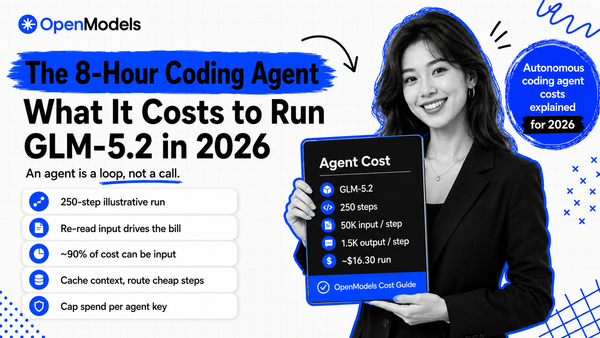
GLM-5.2 The 8-Hour Coding Agent: What It Costs to Run GLM-5.2 Autonomously in 2026 GLM-5.2 can code unattended for hours, and the first invoice surprises people. An autonomous agent is a loop, not a call: it re-reads its context every step, so input can be 90% of the bill.
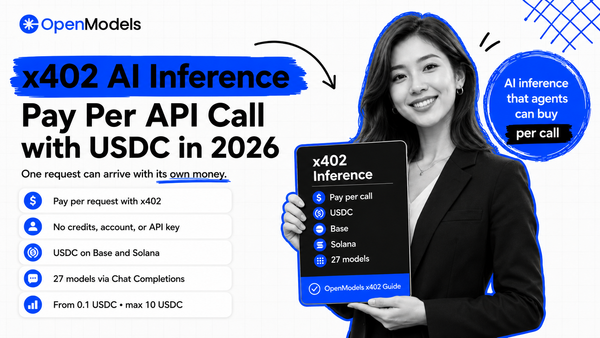
x402 x402 AI Inference: The API Call That Pays for Itself An API request can now arrive with its own money. OpenModels uses x402 to let agents buy AI inference per call in USDC, without credits, an account, or an API key.
AI Agent Finance Gateway Best AI Agent Finance Gateways in 2026: Alephant vs LiteLLM, Portkey, Helicone, LangSmith and OpenRouter Every gateway routes requests. Few tell you what each agent run cost, and fewer let the agent earn. Six tools scored on run-level cost, pre-execution budgets, paid endpoints, and per-agent P&L.
GLM-5.2 Best GLM-5.2 API Providers in 2026: Z.ai, OpenRouter and OpenModels Compared GLM-5.2 is cheap. The layer you buy its tokens through is what sets your bill. Here is how OpenModels, Z.ai, OpenRouter and Together AI compare for GLM-5.2, with live token pricing and a use-case guide.
Open-Source LLM 9 Best OpenRouter Alternatives for Open-Source LLM APIs in 2026 The model is not what makes your open-source LLM bill expensive. The layer you buy through is. Nine OpenRouter alternatives for 2026, sorted by the job each one is built for, with live GLM-5.2 token pricing.
Open-Source LLM OpenModels vs OpenRouter, Together AI, Fireworks and DeepInfra (2026) The open-weight models are already cheap. What makes your GLM-5.2 and Qwen bill expensive is the layer you buy through. Here is how OpenModels, OpenRouter, Together AI, Fireworks and DeepInfra compare.
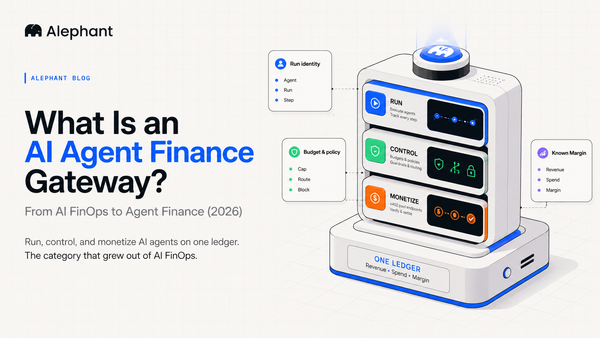
AI Agent Finance Gateway What Is an AI Agent Finance Gateway? From AI FinOps to Agent Finance (2026) 98% of FinOps teams now manage AI spend. The next layer is the AI Agent Finance Gateway: run, control, and monetize agents on one ledger, where an agent's spend and its revenue finally meet.