
Qwen3.8-Max Open Weights: 4 Labs, 4 Meanings of Open in 2026
Alibaba announced Qwen3.8-Max with open weights next week. Two days later there is no repo, no license, no date. We measured the gap between API and download across four labs: 0 days, 11 days, and counting.

By the OpenModels team. OpenModels is an open marketplace for LLM tokens, so we sell access to three of the four models below and have an interest in you buying tokens rather than renting GPUs. Read the conclusion with that in mind. Every price is the lab's own published list price. Every weights-availability claim was checked against the lab's own Hugging Face organisation on 2026-08-05, and the check is reproducible: the method is in the post. Nothing here is legal advice, and the license readings are readings, not substitutes for the text. For the deep read of one license, see Kimi K3 Open Weights: Self-Host or Buy the API. This post is about the label.
TL;DR: Is Qwen3.8-Max Open Weights?
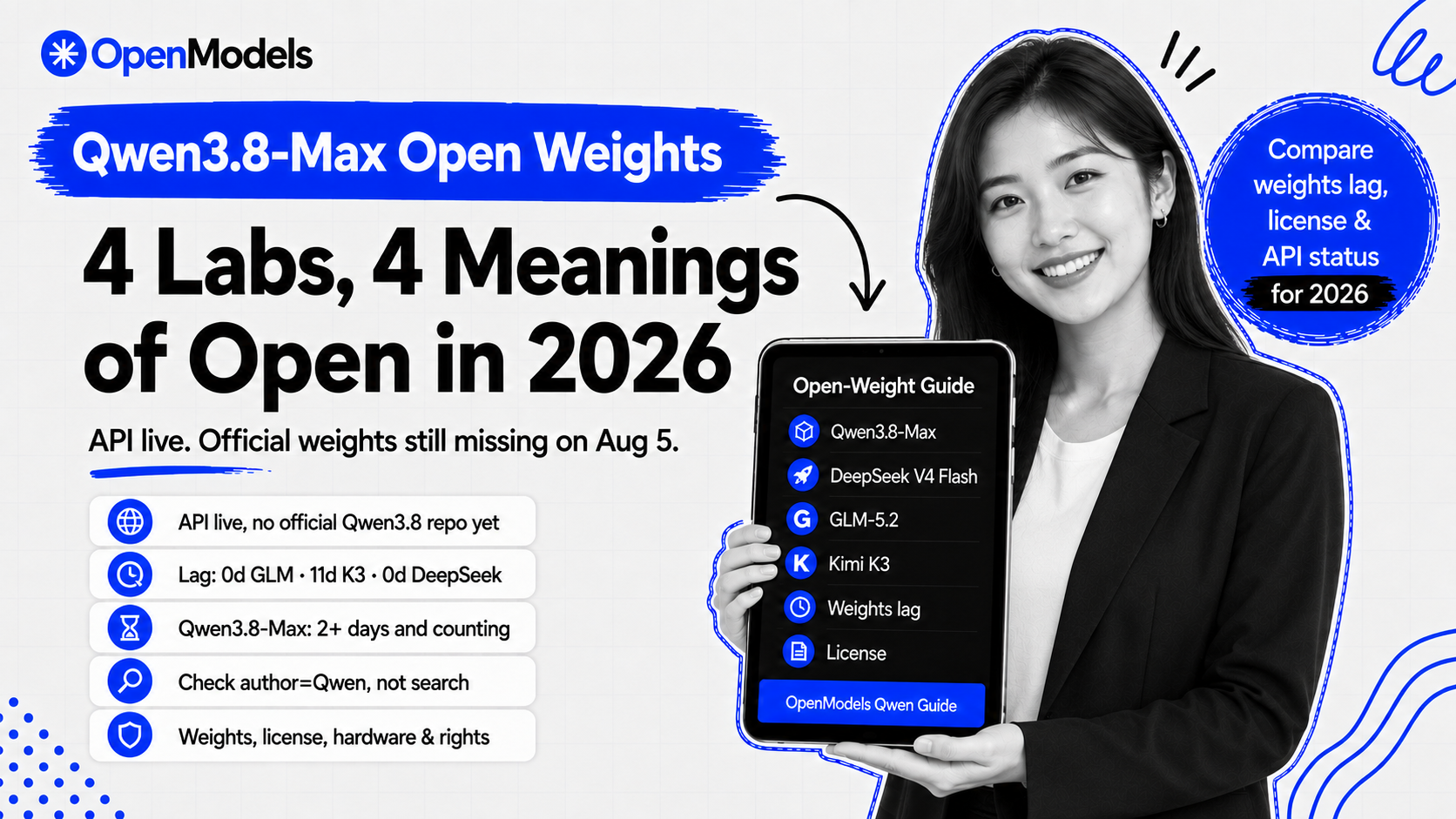
Not yet. Alibaba announced Qwen3.8-Max on 2026-08-03 with open weights promised "next week," and as of 2026-08-05 there is no Qwen3.8 repository of any kind on the official Qwen Hugging Face organisation, no published license, and no firm date. The API is live at $2.00 per 1M input and $6.00 per 1M output. That gap has a size, and nobody measures it, so we did: across the four flagship open-weight releases since mid-June, the lag between public API availability and the weights appearing runs 0 days (DeepSeek V4 Flash, GLM-5.2), 11 days (Moonshot Kimi K3), and counting (Qwen3.8-Max). Same two words on the announcement. Four different products.
Alibaba may well ship the weights this week, and if it does, the lag becomes 9 or 10 days rather than an open question. The number is the point either way. "Open weights" is being used to describe a file you can download today, a file you can download under conditions, and a file that does not exist yet.
What Alibaba Announced on August 3
| Property | Value |
|---|---|
| Announced | 2026-08-03 |
| Total parameters | 2.4T (Mixture-of-Experts) |
| Active parameters per token | not published |
| Context window | 1,048,576 tokens |
| Max input | 991K tokens (983K with thinking enabled) |
| Max output | 131,072 tokens |
| Weights | promised "next week"; no repo, no license, no date |
| Benchmark table | not published |
| API price per 1M | $2.00 input / $6.00 output / $0.25 cached input |
| Explicit cache | $2.50 write / $0.17 read |
Three of those rows are blanks, and the blanks are the story. A 2.4-trillion-parameter model shipped without an activated-parameter count means nobody outside Alibaba can estimate what it costs to serve. Without a license, nobody can tell you whether they are allowed to serve it. A companion model, Qwen3.8-27B, was announced as going open-weight in the same wave and has also not shipped.
Where the Weights Actually Are
Here is the check, because you should run it yourself rather than trust a headline:
curl -s "https://huggingface.co/api/models?author=Qwen&sort=lastModified&direction=-1&limit=10" \
  | jq -r '.[] | "\(.modelId)\t\(.lastModified)"'
On 2026-08-05 the most recent uploads to the official Qwen organisation are Qwen/Qwen3-ASR-0.6B-hf and Qwen/Qwen3-ASR-1.7B-hf, both dated 2026-07-22. There is no Qwen3.8 repository. Searching Hugging Face's web UI for "Qwen3.8" returns results, which is what trips people up: those are community fine-tunes and distills of earlier checkpoints uploaded by third-party accounts, not weights from the lab.
The last open-weight general-purpose model Qwen published is Qwen3.6-27B, dated 2026-04-22 under Apache 2.0, shipped alongside the Qwen3.6-35B-A3B MoE checkpoint. That is 103 days before the Qwen3.8-Max announcement.
Use the
author=filter, not the search box. Searching by name tells you what the community has uploaded. Filtering by author tells you what the lab has shipped. Only the second one answers a licensing question.
The Open-Weight Lag
This is the number we could not find published anywhere, so here is our count. Four flagship releases since mid-June, measured from the day the model became publicly available through an API to the day the weights appeared on the lab's own Hugging Face organisation.
| Model | Lab | API live | Weights published | Lag | License |
|---|---|---|---|---|---|
| GLM-5.2 | Z.ai | 2026-06-16 | 2026-06-16 | 0 days | MIT |
| Kimi K3 | Moonshot | 2026-07-16 | 2026-07-27 | 11 days | Kimi K3 License (bespoke) |
| DeepSeek-V4-Flash-0731 | DeepSeek | 2026-07-31 | 2026-07-31 | 0 days | MIT |
| Qwen3.8-Max | Alibaba | 2026-08-03 | not published | 2+ days, open | not announced |
One caveat on the GLM-5.2 row, because it cuts against us: Z.ai rolled the model out to paying GLM Coding Plan subscribers on 2026-06-13, three days before the MIT weights and the release blog landed together on 2026-06-16. We count the lag from the public release rather than the subscriber rollout, which is the reading most favourable to the argument that a 0-day lab exists. Score it the other way and Z.ai's lag is 3 days, and the finding is unchanged.
Two of the four labs treat the weights and the public launch as the same event. One treats the weights as a follow-up it dates publicly and then beats by a day. One treats them as a roadmap item.
The lag matters for a practical reason that has nothing to do with ideology. A model you cannot download is a model you cannot evaluate offline, cannot quantize for your own hardware, cannot audit, and cannot fall back to if the vendor changes the route. During the lag window, an "open-weight model" is operationally identical to a closed one, and the only thing you can do with it is buy tokens.
Four Labs, Four Meanings
Set the four side by side on what you can actually do with them, and the single label pulls apart.
| Model | Total params | Active | Input $/1M | Output $/1M | Cached input $/1M |
|---|---|---|---|---|---|
| DeepSeek V4 Flash | 304B | 13B (reported) | $0.14 | $0.28 | $0.0028 |
| GLM-5.2 | 753B | not distinguished on card | $1.40 | $4.40 | $0.26 |
| Qwen3.8-Max | 2.4T | not published | $2.00 | $6.00 | $0.25 |
| Kimi K3 | 2.8T | 104B | $3.00 | $15.00 | $0.30 |
Total parameter counts are read off each lab's own Hugging Face model card, except Qwen3.8-Max, which has no card and whose 2.4T comes from the announcement. Active counts appear only where the card distinguishes them: the zai-org/GLM-5.2 card states 753B without splitting out an active figure, and DeepSeek's 13B is widely reported rather than stated on the -0731 card.
DeepSeek: open means all four boxes. MIT license, weights the same day as the API, OSI-approved terms, and at 304B total, V4 Flash is the only model in this table that a single well-equipped node can realistically serve. It is also the cheapest by a distance that is easy to miss. Against Qwen3.8-Max it is 14x cheaper on input, 21x on output, and 89x on cached input, which is the token type an agent workload spends most of its budget on.
Z.ai: open means the license, not the hardware. GLM-5.2's weights went up with the release under MIT, no conditions, no thresholds. The model card goes out of its way to describe the terms as "Pure Open" with "no regional limits, technical access without borders," which is a claim worth noting given what is currently unresolved about Qwen's terms. At 753B parameters you still need a cluster. The freedom is legal and real; the deployment is a procurement question.
Moonshot: open means downloadable, with conditions. Kimi K3's weights landed 11 days after the API under a bespoke Kimi K3 License that Artificial Analysis classifies as Commercial Use Restricted, carrying a $20M Model-as-a-Service revenue threshold and a 100M-MAU attribution requirement. The download is 1.56 TB, which needs more memory than an 8x B200 node has. We took that license and that hardware floor apart in Kimi K3 Open Weights: Self-Host or Buy the API.
Alibaba: open means scheduled. The commitment is public and Qwen has a long history of honouring this kind of commitment, which is why most coverage repeated "first open-weight Max-class model" without qualification. It is still a commitment rather than an artifact, and the license that will govern it has not been published.
The Four Questions Worth Asking
The label compresses four independent properties. Ask them separately, in this order, because a "no" at any step changes what you are allowed to do:
- Are the weights published today? Check the lab's own Hugging Face organisation with the
author=filter above. Not a news headline, not a search result, not a promise with a date. - Is the license OSI-approved? MIT and Apache 2.0 have decades of case law and no thresholds. A license named after the model is a license you have to read.
- Does it bind you, or your provider? See below. This is the one most teams get backwards.
- Can your hardware hold it? A Mixture-of-Experts model needs every expert resident, because routing picks which ones fire only after the token arrives. The memory floor is total parameters, not active ones. 2.4T and 2.8T models are not self-hosting candidates for almost anyone.
If you only buy tokens, whose problem is the license?
Your provider's, in every case we have read.
A weights license governs the act of possessing and serving the weights. Buying tokens from an API is neither. When Moonshot's license sets a $20M Model-as-a-Service threshold, it is describing an obligation for whoever runs the inference, and its exemption for "certified inference partners" describes that operator's relationship with Moonshot, not your relationship with the resulting endpoint. The same logic applies to whatever Alibaba publishes for Qwen3.8-Max, whenever it publishes it.
Two practical consequences. If you are calling an API, a restrictive weights license is close to irrelevant to you and should not knock a model off your shortlist. If you are reselling model access at scale, or serving weights inside a product, it is the first thing to read and the thresholds are where your lawyers start. We are not asserting any certification status of our own here, and a vendor who asserts one without documentation deserves the same scepticism.
One Claim We Are Not Repeating
On 2026-08-03, OstrisAI publicly read the draft Qwen3.8-Max terms as prohibiting use, and possibly even download, from the USA, EU, UK, and Korea. That reading circulated widely.
We cannot confirm it and neither can anyone else right now, because Alibaba has published no license text for this model. A geographic restriction of that shape would be a significant departure from Apache 2.0, which is what Qwen3.6-27B shipped under in April, and it would matter a great deal to most people reading this. It is currently one person's reading of terms that are not public. Treat it as a question to resolve when the license appears, and do not build a procurement decision on either the rumour or its denial.
If You Are Buying Tokens Instead
The models above all speak the standard OpenAI-compatible shape, so there is nothing bespoke to integrate. On OpenModels the base URL is https://api.getopenmodels.com/v1, one API key and one credit balance covers the catalog, and the 2026-07-11 snapshot carries 427 models across 503 live routes, including a long tail of earlier Qwen checkpoints (qwen3.6-27b, qwen-3-7-max, qwen3-coder and others). Copy the exact model ID from the live listing rather than from this post, because near-identical route names bill differently and the catalog turns over faster than we republish.
Qwen3.8-Max is two days old and we are making no claim that any route on any marketplace serves it, ours included. Check the live model page before you plan around it.
Marketplace prices are directional. Route prices on OpenModels are "from" figures representing the lowest available verified route, and they move. None of the arithmetic above uses them. Every number in this post is a lab's own list price.
FAQ
Is Qwen3.8-Max open source?
No, and as of 2026-08-05 it is not open-weight either. Alibaba announced the model on 2026-08-03 and said open weights would follow "next week," but no Qwen3.8 repository exists on the official Qwen Hugging Face organisation, and no license has been published. "Open source" would additionally require an OSI-approved license, which no lab in this comparison has committed to for a flagship except through MIT (DeepSeek, Z.ai).
Where can I download the Qwen3.8-Max weights?
Nowhere, at the time of writing. Filter Hugging Face by author=Qwen rather than searching for the model name: the search box returns community fine-tunes of older Qwen checkpoints uploaded by third parties, which are easy to mistake for an official release. The most recent official Qwen uploads are the Qwen3-ASR models from 2026-07-22.
How much does the Qwen3.8-Max API cost?
$2.00 per 1M input tokens and $6.00 per 1M output tokens on QwenCloud, with cached input at $0.25 per 1M. An explicit cache costs $2.50 per 1M to write and $0.17 per 1M to read. That places it between GLM-5.2 ($1.40/$4.40) and Kimi K3 ($3.00/$15.00), and roughly 14x above DeepSeek V4 Flash ($0.14/$0.28) on input.
What is the difference between open weights and open source?
Open weights means the parameter file is published and you can download it. Open source, used strictly, means the license is OSI-approved, which permits commercial use, modification, and redistribution without conditions. MIT and Apache 2.0 qualify. A bespoke license with revenue thresholds or attribution mandates does not, even when the download is free and public. Moonshot is consistent about saying "open weight" rather than "open source" for Kimi K3, and that precision is worth copying.
Which 2026 flagship models have MIT-licensed weights?
Among the four flagships released between June and August 2026: DeepSeek V4 Flash and V4 Pro are MIT, and GLM-5.2 is MIT. Kimi K3 ships under a bespoke Kimi K3 License rather than MIT. Qwen3.8-Max has no published license.
Does an open-weight license affect me if I only call the API?
Generally no. A weights license governs possessing and serving the weights, which is your inference provider's activity, not yours. Revenue thresholds, attribution mandates, and Model-as-a-Service clauses attach to the operator. If you are reselling model access or serving weights inside your own product, the position reverses and the license text is the first thing to read.
The Bottom Line
Qwen3.8-Max is a 2.4T model with a live API, a $2/$6 price sheet, and a promise. Three of the four labs that shipped flagships this summer published weights at the same time as the endpoint or within 11 days, two of them under MIT. Whether Alibaba's arrive next week or later, the useful habit is the same: check the lab's own Hugging Face organisation before you write "open-weight" into an architecture document, and check which side of the license you are standing on before you let it disqualify a model you were only ever going to call over HTTP.
Sources
- Qwen3.8-Max announcement coverage, MarkTechPost, 2026-08-03: parameter count, context window, price sheet, and the unpublished activated-parameter count and benchmark table.
- Hugging Face models API,
author=Qwen: the weights-availability check reproduced above, run 2026-08-05. - AINews digest on the Qwen3.8 wave, 2026-08-04: the "open weights next week" commitment with no repo, license, or firm date, the Qwen3.8-27B companion, and the OstrisAI geographic-restriction reading.
- Qwen's open-weight release cadence: Qwen3.6-27B, 2026-04-22, Apache 2.0, as the last open-weight general-purpose Qwen release.
deepseek-ai/DeepSeek-V4-Flash-0731model card: the 304B parameter count and the MIT license, verified 2026-08-05. Release framing from DeepSeek open-sources V4-Flash under MIT, 2026-07-31.- Kimi K3 model card, Hugging Face and Artificial Analysis on the K3 license: the 2026-07-27 publication date, the bespoke license, and the Commercial Use Restricted classification.
zai-org/GLM-5.2model card: the 753B parameter count, the MIT license, and the "Pure Open, no regional limits" framing, verified 2026-08-05. The release timeline is from Nathan Lambert's GLM-5.2 write-up on Interconnects, which records the 2026-06-13 GLM Coding Plan rollout and the MIT weights plus release blog landing together on 2026-06-16.- Model list prices: DeepSeek, Moonshot, and Z.ai's GLM-5.2 model card, all as recorded in our own Kimi K3 vs GLM-5.2 and DeepSeek V4 Flash vs Claude Opus 4.8 posts.