
OpenModels vs OpenRouter, Together AI, Fireworks and DeepInfra (2026)
The open-weight models are already cheap. What makes your GLM-5.2 and Qwen bill expensive is the layer you buy through. Here is how OpenModels, OpenRouter, Together AI, Fireworks and DeepInfra compare.

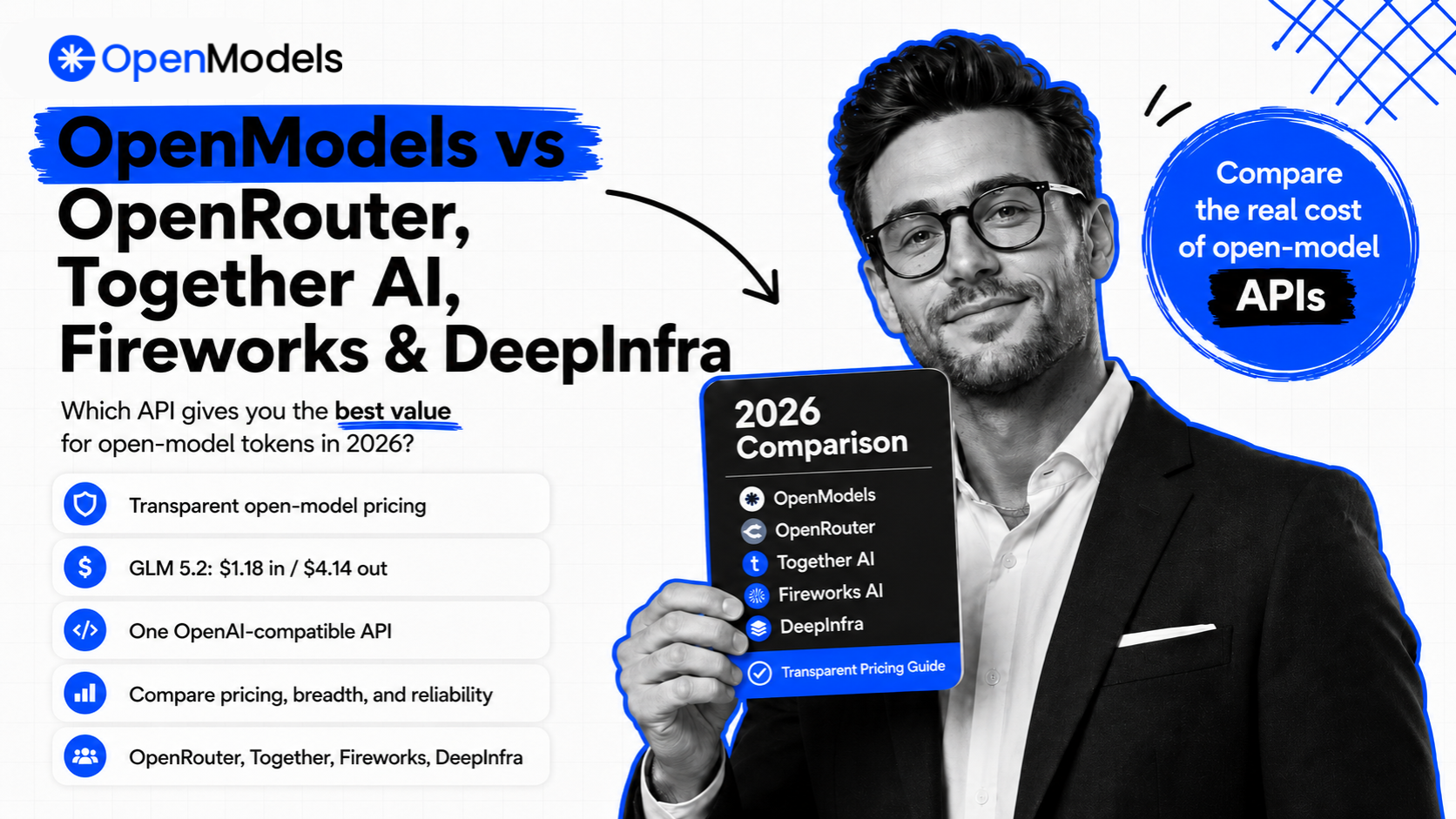
By the OpenModels team. OpenModels is an open marketplace for LLM tokens, accessible through one OpenAI-compatible API that runs on Alephant gateway infrastructure, so this comparison ranks our own marketplace first for one specific buyer: the developer who wants low-cost open-model tokens through a single API key. Every other platform is credited where it is genuinely stronger. OpenRouter wins on total model breadth. Together AI and Fireworks AI win on owned GPU inference and fine-tuning. OpenModels prices are taken from the live pricing feed dated 2026-06-18; competitor per-token prices move often, so verify each vendor's current pricing page before you commit.
You are not overpaying for GLM-5.2 because the model is expensive. You are overpaying because of two line items that never show up on the invoice: the markup an aggregator adds on every routed request, and the downtime a reseller proxy charges you in retries when a shared account gets rate-limited at 2am.
The open-weight models are already cheap. A million Qwen qwen3.5-flash input tokens cost three cents. The question is no longer which model. It is who you buy the tokens from, and how much of your spend leaks into routing fees and supply you cannot see.
This guide compares the five places a developer actually buys open-source LLM tokens in 2026: OpenModels, OpenRouter, Together AI, Fireworks AI, and DeepInfra. It is scored for one job: getting Qwen, DeepSeek, Kimi, MiniMax and GLM tokens at a transparent price, through one OpenAI-compatible API, without a proxy chain in the middle.
TL;DR. OpenModels is an an open marketplace for LLM tokens: one OpenAI-compatible key buys Qwen, DeepSeek, GLM, Kimi, MiniMax, MiMo and Doubao tokens from a prepaid credit balance, with input and output prices published per model. As of the 2026-06-18 feed it lists 27 live routes and advertises 0 proxy chains. Against OpenRouter it trades total model breadth (OpenRouter lists 500+ models including closed ones) for transparent open-model pricing with no routing markup. Against Together AI and Fireworks AI, which run their own GPU inference and offer fine-tuning, it trades dedicated SLAs for a multi-family marketplace on one key. On the 2026-06-18 feed, GLM-5.2 runs $1.18 per 1M input tokens and $4.14 per 1M output.
What Is OpenModels?
OpenModels is an open-source LLM token marketplace. One OpenAI-compatible API key and a prepaid credit balance buy tokens for open-weight models like Qwen, DeepSeek, GLM-5.2, Kimi, MiniMax and MiMo, with input and output prices published per model and billed on actual token usage. It runs on Alephant gateway infrastructure, exposes a POST /chat/completions endpoint at https://api.getopenmodels.com/v1, and issues keys in the ale-... format. Product version is v0.1.0.
That places it in a different lane from the two categories developers usually conflate with it:
- Aggregating routers (OpenRouter) put one API in front of many upstream providers, including closed models, and add a platform fee on routed traffic.
- First-party inference providers (Together AI, Fireworks AI, DeepInfra) run open models on their own GPUs and sell their own capacity, often with fine-tuning and dedicated endpoints.
OpenModels sits between them: a marketplace focused on open-weight families, priced transparently per token, billed from credits, with the product's own positioning being "verified direct supply, no opaque proxy chains." That last claim is OpenModels' framing of its supply model, not an audited certification; the public-facing signal is the "27 live routes, 0 proxy chains" counter on the 2026-06-18 feed.
Why Open-Source Tokens Cost More Than They Should
Open-weight models undercut frontier closed models by an order of magnitude on raw token price. So when an open-model bill runs high, the leak is rarely the model. It is one of two structures around it.
The platform fee. Aggregators fund the routing layer with platform fees on top of inference. OpenRouter is transparent about its current structure: buying credits carries a 5.5% fee (minimum $0.80), and bring-your-own-key usage past the first 1M requests a month carries a 5% fee, while inference itself is passed through at the underlying provider's rate (OpenRouter fees). Funding $10,000 of usage by buying credits costs around $550 in purchase fees. The convenience is real; so is the line item.
The proxy chain. A second pattern is worse. Reseller proxies (the "sub2api" pattern) wrap shared or scraped provider accounts and resell them as an API. Pricing is opaque, availability is unstable, and your production traffic depends on a key the reseller does not actually own. When the upstream account gets rate-limited or shut down, your app eats the failures.
Neither tax is the model's fault. The fix is to buy open-model tokens from a supply path you can see, at a price published per token, without a markup skimmed off every call. That is the argument for a transparent token marketplace, and it is the one axis where a first-party inference provider and a clean marketplace both beat an opaque proxy.
The leak is structural, not per-model. A million
qwen3.5-flashinput tokens cost $0.03 on the OpenModels 2026-06-18 feed. If you are paying meaningfully more for the same open weights, audit the layer between you and the GPU before you audit the model.
How We Ranked These Platforms
This is a scored rubric, weighted for one persona: a developer or small team buying low-cost open-model tokens through one API, not an ML org standing up fine-tuned weights. Each platform is rated 1 to 5 on seven axes; the in-persona axes (transparent pricing, one-key breadth, credit billing) carry a ×2 weight, and the two axes where this persona's needs are secondary (owned inference / fine-tuning, and total catalog including closed models) carry ×1. The weighting is stated so you can re-score for your own job.
Methodology. Every OpenModels capability maps to the live product (27 live routes, v0.1.0, pricing feed 2026-06-18). Every competitor rating is an architectural assessment against that vendor's public pricing and documentation, linked inline, not a claim about a number we measured. Exact per-token competitor prices change frequently, so treat the price cells as "check live," and confirm each vendor's current pricing page before committing a workload.
| Axis (weight) | What it measures |
|---|---|
| Transparent input + output pricing (×2) | Are per-token prices published per model, split by input and output, before you route? |
| One-key open-model breadth (×2) | How many open-weight families on a single key (Qwen, DeepSeek, GLM, Kimi, MiniMax, MiMo)? |
| Prepaid credit billing, no routing markup (×2) | Spend from a balance on actual tokens, without a per-request aggregator fee? |
| OpenAI-compatible drop-in (×1) | Does existing OpenAI SDK code work after a base-URL + key swap? |
| Supply reliability vs reseller proxies (×1) | Verified routes / first-party capacity, not a shared-account proxy chain? |
| Owned GPU inference + fine-tuning (×1) | Does the vendor run its own inference and offer tuning / dedicated endpoints? |
| Total catalog incl. closed models (×1) | Breadth beyond open weights, including frontier closed models? |
OpenModels vs OpenRouter, Together AI, Fireworks and DeepInfra
1. OpenModels: the transparent open-model token marketplace
OpenModels is built for the developer who wants the lowest-friction path to cheap open-model tokens. One ale-... key reaches every supported family (Qwen, DeepSeek, GLM from Zhipu, Kimi from Moonshot, MiniMax, MiMo from Xiaomi, and Doubao video from ByteDance) through an OpenAI-compatible endpoint, so most existing OpenAI SDK code works after changing two lines:
from openai import OpenAI
client = OpenAI(base_url="https://api.getopenmodels.com/v1", api_key=os.environ["OM_API_KEY"])
resp = client.chat.completions.create(
    model="qwen3.5-flash",
    messages=[{"role": "user", "content": "Hello"}],
)
Pricing is the differentiator. Every model on the OpenModels catalog publishes input and output price per 1M tokens, so you compare real cost before routing traffic, not after the invoice. Spend comes out of a prepaid credit balance, consumed on actual input/output usage, with per-key USD spend limits you can set per environment. There is no per-request routing markup in the product's billing model.
Two cautions, stated plainly because they are real. First, OpenModels is v0.1.0 and lists 27 live routes, a focused open-weight catalog rather than a 500-model superstore, and not a home for closed models. Second, "verified direct supply" is the product's own positioning, evidenced by the "0 proxy chains" counter, not a third-party audit. What it is not: a hidden proxy chain, a shared-account reseller, or an unlimited subscription.
Best fit: developers and small teams who want Qwen / DeepSeek / GLM / Kimi tokens at a transparent published price through one OpenAI-compatible key, billed from credits, with no routing markup.
2. OpenRouter: the breadth leader
OpenRouter is the right tool when model variety is the priority. One API reaches 500+ models across many providers, including closed frontier models that an open-weight marketplace will never carry, plus a bring-your-own-key tier spanning 60+ providers. For prototyping across model families without onboarding at each vendor, nothing removes more friction.
The cost story is where it slips for a token-cost-focused buyer. OpenRouter passes inference through at the provider's rate, but funding the account carries a 5.5% credit-purchase fee (minimum $0.80) and bring-your-own-key usage past the first 1M monthly requests carries a 5% fee (OpenRouter fees). That is the honest target of the phrase "stop overpaying": for the same open weights, you pay the provider price plus OpenRouter's fee to fund or route them. OpenRouter is not a proxy chain, since it routes to real upstream providers, but it is an aggregation layer with a fee.
Best fit: developers who need the widest model menu, including closed models, on one key, and accept a routing fee for that reach.
3. Together AI: first-party inference with fine-tuning
Together AI runs open models on its own GPU cloud. This matters for honesty: it is a direct source, not a middleman, so the "no proxy chain" argument does not apply to it. Together's strengths are exactly the ones a marketplace cannot match, namely serverless inference on owned infrastructure, dedicated endpoints, and fine-tuning of open-weight models, with published per-token pricing on its pricing page (Together AI docs).
For the narrow job of "cheapest open-model tokens on one key across many vendors," it is a single-provider catalog rather than a multi-family marketplace, and the value of owned inference (tuning, reserved capacity, SLAs) is wasted on a developer who just wants pay-as-you-go tokens. For an org that will fine-tune and deploy, that same owned infrastructure is the reason to choose it.
Best fit: teams that will fine-tune open models or need dedicated, SLA-backed inference on owned GPUs.
4. Fireworks AI: speed-tuned first-party inference
Fireworks AI is the other strong first-party inference provider, optimized for low-latency serving of open models on its own stack, with fine-tuning and dedicated deployments and published per-token rates (Fireworks AI pricing). Like Together, it is a direct source, so credit it for owned inference and throughput rather than penalize it on a proxy axis that does not apply.
The trade-off mirrors Together's. You are buying one provider's optimized inference, not a transparent menu across Qwen, DeepSeek, GLM, Kimi and MiniMax on a single marketplace key. If your bottleneck is tokens-per-second on a specific open model in production, that focus is the feature.
Best fit: production workloads that need fast, reliable serving of a specific open model, with fine-tuning available.
5. DeepInfra: the low-cost serverless baseline
DeepInfra serves open-source models from its own infrastructure at simple, low per-token rates, published on its pricing page (DeepInfra docs). It is a clean, cheap serverless baseline and, like Together and Fireworks, a first-party source rather than a proxy. For a developer who wants one provider's cheap serverless endpoint and does not need a multi-family marketplace or transparent side-by-side input/output pricing across vendors, it is a sensible default.
Where a marketplace pulls ahead is breadth-on-one-key and the published input-vs-output split per model that makes cost modeling exact before you commit.
Best fit: developers who want a single, low-cost serverless provider for open models and value simplicity over a multi-vendor menu.
The honest dividing line. "No proxy chain" is a real advantage of OpenModels over OpenRouter's fee layer and over reseller-proxy wrappers. It is not an advantage over Together AI, Fireworks AI, or DeepInfra, which run their own inference and are themselves the direct source. Against those three, OpenModels competes on multi-family breadth on one key and transparent published pricing, not on "directness."
Scored Comparison
Scores are 1 to 5 per axis (our assessment, per the methodology above). In-persona axes carry ×2 weight; secondary axes carry ×1. Max weighted total is 50.
| Axis (weight) | OpenModels | OpenRouter | Together AI | Fireworks AI | DeepInfra |
|---|---|---|---|---|---|
| Transparent input + output pricing (×2) | 5 | 3 | 4 | 4 | 4 |
| One-key open-model breadth (×2) | 5 | 5 | 4 | 4 | 3 |
| Prepaid credit billing, no markup (×2) | 5 | 3 | 3 | 3 | 3 |
| OpenAI-compatible drop-in (×1) | 5 | 5 | 4 | 4 | 4 |
| Supply reliability vs reseller proxies (×1) | 4 | 4 | 5 | 5 | 4 |
| Owned inference + fine-tuning (×1) | 1 | 1 | 5 | 5 | 4 |
| Total catalog incl. closed models (×1) | 2 | 5 | 3 | 3 | 3 |
| Weighted total / 50 | 42 | 37 | 39 | 39 | 35 |
Read the table honestly: OpenModels leads for this persona (cheapest open-model tokens on one transparent key), but the race is close. Together AI and Fireworks AI sit one tier back at 39 and win the owned-inference and fine-tuning row outright, so if you need tuning or dedicated SLAs, pick them. OpenRouter wins total catalog because it carries closed models a token marketplace will not. A table where one tool swept every row would be a marketing artifact, not a comparison.
GLM-5.2 API Pricing on OpenModels
GLM-5.2 (from Zhipu, released 2026-06-17) is the headline coding-and-agent model in this batch, with high performance on complex coding and long-horizon tasks and a 1M-token context window. Here is what it costs on the OpenModels catalog, per the 2026-06-18 feed:
| Route ID | Input / 1M | Output / 1M | Context | Notes |
|---|---|---|---|---|
glm-5.2 |
$1.180 | $4.140 | 1M | tool calling, reranking, content caching |
zhipu/glm-5.2 |
$1.180 | $4.140 | 1M | tool calling, reranking, audio input |
Two things to carry into production:
- Output tokens cost ~3.5x input. GLM-5.2 at $1.18 in / $4.14 out means a generation-heavy workload is dominated by output price. A model that looks cheap on input can be expensive on long output, so model your real input:output ratio, not just the input number.
- Prefixed and unprefixed route IDs are different routes.
glm-5.2andzhipu/glm-5.2happen to share a price here but differ in capabilities (audio input on the prefixed route). Elsewhere the prices diverge sharply: on the same feed,deepseek-v4-prois $1.773 in / $3.545 out, whiledeepseek/deepseek-v4-prois $0.333 in / $0.666 out. Copy the exact route ID from the live catalog before you launch.
To compare against another provider's GLM-5.2 endpoint, pull that vendor's current pricing page directly. Token prices move, and a number from last month is not a quote you can budget against.
How to Choose by Use Case
If your priority is seeing and verifying the lowest open-model price across families on one key. A transparent marketplace is the cleanest fit. OpenModels publishes input and output price per model across Qwen, DeepSeek, GLM, Kimi and MiniMax on one OpenAI-compatible key, billed from prepaid credits with no routing markup, so you can compare real cost before you route. A single first-party provider can still undercut it on one specific model, so confirm the per-token number for your exact workload. Start at qwen3.5-flash ($0.03 / $0.296 per 1M) for dev and high-volume classification, move up only when reasoning or context demands it.
If your priority is the widest model menu. OpenRouter, for 500+ models including closed frontier models, accepting its credit-purchase and bring-your-own-key fees as the cost of that reach.
If your priority is fine-tuning or dedicated SLAs. Together AI or Fireworks AI. They run their own GPUs, so tuning and reserved capacity are first-class, which a token marketplace does not offer.
If your priority is one cheap serverless provider. DeepInfra, for low per-token rates on open models without a multi-vendor layer.
If you are evaluating a reseller proxy (sub2api) to save money. Reconsider. Opaque supply and shared accounts trade a slightly lower sticker price for production instability. A transparent marketplace or a first-party inference provider is the safer floor.
Frequently Asked Questions
What is the best OpenRouter alternative for open-source LLMs?
For buying open-weight model tokens specifically, OpenModels is the strongest OpenRouter alternative: one OpenAI-compatible key reaches Qwen, DeepSeek, GLM, Kimi, MiniMax and MiMo with input and output prices published per model and billed from prepaid credits, and without OpenRouter's 5.5% credit-purchase fee or 5% bring-your-own-key fee. OpenRouter remains the better pick if you need closed frontier models or the absolute widest catalog, since it lists 500+ models across many providers. If you want fine-tuning or dedicated SLAs, a first-party inference provider like Together AI or Fireworks AI fits better than either.
What is the cheapest API for GLM-5.2?
Token prices for GLM-5.2 change by provider and over time, so the honest answer is to compare live pricing pages before committing. As a concrete reference point, OpenModels lists GLM-5.2 at $1.18 per 1M input tokens and $4.14 per 1M output tokens on its 2026-06-18 feed, through one OpenAI-compatible key with no routing markup. Because output is roughly 3.5x the input price, model your real input:output ratio rather than ranking providers on the input number alone.
Where can I buy Qwen, DeepSeek, Kimi and GLM tokens with one API key?
OpenModels sells tokens for all four families (Qwen, DeepSeek, Kimi from Moonshot, and GLM from Zhipu) plus MiniMax, MiMo and Doubao, through a single ale-... key on an OpenAI-compatible endpoint at https://api.getopenmodels.com/v1. You add credits once and spend across every supported model on actual token usage. OpenRouter also reaches these models on one key but adds a routing fee; first-party providers like Together AI and Fireworks AI carry many of them too, on their own infrastructure.
Which open-source LLM API has no proxy chain?
OpenModels positions itself as verified direct supply with "0 proxy chains", which is the relevant contrast against reseller proxies (the "sub2api" pattern) and against aggregators that add a fee layer. It is worth being precise: first-party inference providers such as Together AI, Fireworks AI and DeepInfra are also not proxy chains, because they run the models on their own GPUs. The proxy-chain risk lives specifically with shared-account reseller wrappers, not with first-party inference or a transparent marketplace.
Is OpenModels OpenAI-compatible?
Yes. OpenModels exposes an OpenAI-compatible POST /chat/completions API at https://api.getopenmodels.com/v1, so most existing OpenAI SDK code works after changing the base URL and the API key (an ale-... key in the Authorization: Bearer header). It works with the OpenAI SDK, the Vercel AI SDK, LangChain and LlamaIndex, and supports streaming and tool calling on models that advertise those capabilities.
How does credit-based billing work on OpenModels?
You add a prepaid balance to your OpenModels account (one-time card, crypto, monthly credit plan, or card-based auto top-up), then spend it across any supported model based on actual input and output token usage. You can set per-key USD spend limits to cap each environment, and monthly credit plans run Starter $20, Builder $100, Scale $200 and Enterprise custom. There is a referral program that credits $5 to each side once both accounts cross $100 in total top-ups.
The Bottom Line
The open-weight models are cheap. What makes an open-model bill expensive is the layer you buy them through: an aggregator's routing fee, or a reseller proxy's hidden, unstable supply. OpenModels answers that by being a transparent token marketplace, with one OpenAI-compatible key across Qwen, DeepSeek, GLM, Kimi, MiniMax and MiMo, input and output prices published per model, billed from prepaid credits, and the product's own "0 proxy chains" supply posture across 27 live routes on the 2026-06-18 feed.
It does not win every axis, and the comparison above does not pretend it does. If you need closed models, OpenRouter's breadth is the reason it exists. If you need fine-tuning or dedicated SLAs, Together AI and Fireworks AI run the GPUs to back that. For the developer whose actual job is "buy Qwen, DeepSeek, Kimi and GLM-5.2 tokens at a transparent price, through one key, without a markup," OpenModels is built for exactly that brief.
Start at openmodels.market, read the API quickstart at docs.openmodels.market, or join the shared community on Discord and the Open Models Lab Telegram, where the team building OpenModels and the Alephant gateway answers token-cost and routing questions.