
GLM-5.2 vs Claude Code: Best Model for Long-Horizon Coding Agents in 2026
GLM-5.2 is a model. Claude Code is a harness. That distinction decides your architecture, your bill, and whether you can even point one at the other. A protocol-level comparison for developers building coding agents.

By the OpenModels team. OpenModels is an open marketplace for LLM tokens that runs on Alephant Gateway infrastructure, and it sells the GLM-5.2 tokens this article prices, so read it as an interested source. Claude Code is Anthropic's product and it is genuinely the stronger choice for several of the jobs below; those sections say so plainly. The GLM-5.2 price ($1.18 / $4.14 per 1M input/output) is first-part. Claude model prices are from Anthropic's published API pricing and Claude Code behaviour from the Claude Code environment-variable docs, both read 2026-07-10. Token prices move. Verify both before you budget.
Claude Code is great when you want a polished agentic coding experience. GLM-5.2 is interesting when you want a powerful long-context model that can be wired into your own coding agents, internal tools, repo workflows and automation pipelines. This guide compares GLM-5.2 and Claude Code for developers who care about context length, pricing, API access and long-horizon coding work.
One correction before the comparison, because it decides everything after it: these are not the same kind of thing. GLM-5.2 is a model. Claude Code is a harness that drives a model. The interesting question is not which one is better. It is whether you want to buy a finished agent or build one.
Quick answer. Claude Code is one of the strongest tools for agentic coding, and for most developers it is the faster path to working results. GLM-5.2 is the serious option when you want an open-weight model to wire into your own coding agents at a fraction of the token cost: $1.18 / $4.14 per 1M input/output on OpenModels, against $5.00 / $25.00 for Claude Opus 4.8 or $3.00 / $15.00 for Claude Sonnet 5. All three hold a 1M-token context window, so context length is not the reason to switch. Cost and portability are. And the two are not mutually exclusive: Claude Code will drive any endpoint that speaks the Anthropic Messages API, which is how developers already run GLM inside it.
What is GLM-5.2?
GLM-5.2 is an open-weight large language model from Zhipu GLM (Z.ai is Zhipu's international API brand), released 2026-06-17. It is built for complex coding and long-horizon autonomous work: a 1M-token context window, up to 128K output tokens per response, tool calling, reranking, and content caching. Per the model notes on the OpenModels catalog, it can run autonomously for up to roughly eight hours on a single task.
Open weights are the structural fact that matters here. The same GLM-5.2 runs across many vendors, so what changes between providers is the price per token, the routing markup, and the supply path. The model is not the variable. The provider is. That is why a GLM-5.2 decision is really two decisions: the model, then the layer you buy it through.
What is Claude Code?
Claude Code is Anthropic's agentic coding tool: a CLI (plus desktop, web, and IDE surfaces) that wraps a Claude model in a working agent loop. It ships the parts you would otherwise build yourself. File read and write, an edit tool with staleness checks, bash, glob and grep, web search, subagents, permissions and approval gates, session management, and context compaction when a long run approaches the window limit.
It runs Anthropic's Claude models: Opus 4.8 and Sonnet 5 (both 1M context, 128K max output), plus Haiku 4.5 (200K) for cheaper subtasks. Which one you get depends on your plan and selection, because Claude Code maps model tiers rather than pinning a single ID. It is also where Anthropic tunes its defaults hardest: it runs at xhigh reasoning effort out of the box, the setting Anthropic recommends for coding and agentic work.
The thing to internalise is that almost none of that list is the model. It is harness. A model that scores well on a coding benchmark does not give you an edit tool that refuses to overwrite a file changed since it was last read.
GLM-5.2 vs Claude Code: The Real Difference
Comparing them head-to-head on quality is a category error. The comparison that actually decides your architecture is who supplies the agent loop.
| GLM-5.2 | Claude Code | |
|---|---|---|
| What it is | An open-weight model | An agent harness plus a first-party model |
| Agent loop, tools, permissions | You build them | Shipped |
| Model choice | Any provider carrying the weights | Anthropic models by default |
| API surface | OpenAI-compatible POST /chat/completions |
Anthropic Messages API |
| Context window | 1M tokens | 1M tokens (Opus 4.8, Sonnet 5) |
| Input / output per 1M | $1.18 / $4.14 | $5.00 / $25.00 (Opus 4.8), $3.00 / $15.00 (Sonnet 5) |
| Runs inside your own pipeline | Yes, it is just an endpoint | Yes, via the Claude Agent SDK |
Two rows deserve more than a table cell.
Context length is not a differentiator in 2026. GLM-5.2 holds 1M tokens. So do Claude Opus 4.8 and Claude Sonnet 5. If you came here believing GLM-5.2 buys you a longer window than Claude, it does not. What it buys you is the same window at roughly a quarter of the input price.
The protocol is the differentiator, and it is where most comparisons go wrong. Claude Code does not hardcode Anthropic's servers. It reads ANTHROPIC_BASE_URL, ANTHROPIC_AUTH_TOKEN and ANTHROPIC_MODEL at startup and sends every request to whatever address you point it at. But it sends them in the Anthropic Messages API format, and appends /v1/messages to the base URL itself. So the endpoint on the other end has to speak that protocol.
| Endpoint | Protocol | Drives Claude Code directly? |
|---|---|---|
Z.ai (api.z.ai/api/anthropic) |
Anthropic Messages API | Yes |
| OpenRouter | Anthropic-compatible route available | Yes |
OpenModels (api.getopenmodels.com/v1) |
OpenAI POST /chat/completions |
No, needs a translation layer |
| Your own agent, OpenAI SDK | OpenAI POST /chat/completions |
N/A, you own the loop |
This is the honest shape of it, and it cuts against our own product. If your goal is specifically "GLM inside Claude Code," go to Z.ai's Anthropic-compatible endpoint, or put a translating gateway such as LiteLLM in front of an OpenAI-compatible route. A token marketplace exposing only POST /chat/completions cannot drive Claude Code on its own, and no amount of pricing advantage changes that.
Where an OpenAI-compatible marketplace does win is the other job: the agent you write yourself.
When Claude Code Makes More Sense
Reach for Claude Code when the harness is the product you actually want:
- You want to be coding in the next ten minutes. Install, authenticate, run. Nothing to build.
- You want the safety rails. Approval gates on destructive actions, staleness checks before edits, permission policies, an audit path. These are the parts of an agent that take longest to get right and are least fun to write.
- The task is hard enough that model quality dominates cost. This is the argument most cost guides miss. A more capable model that finishes a refactor in 120 steps is cheaper than a weaker one that takes 400 and still needs a human pass, even at 4x the per-token price. Per-token price is not per-task price.
- You are on a Claude subscription rather than API billing. Many Claude Code users pay a flat Pro or Max monthly fee. If that is you, the token-price comparison below simply does not describe your bill.
- You want first-party support and same-day model updates.
When GLM-5.2 Makes More Sense
Reach for GLM-5.2 when you are building the loop, not buying it:
- The agent is yours. A repo-analysis bot, a CI review agent, a documentation pipeline, an n8n workflow. You already own the control flow; you need a model behind it, not another CLI.
- Token cost is the binding constraint. High-volume, long-running, or many-parallel-agents workloads where the bill scales with usage and a 4x input-price gap compounds.
- You want to switch models without rewriting the app. GLM-5.2 through an OpenAI-compatible endpoint means changing a model ID, not an integration. Route the hard planning steps to GLM-5.2 and the trivial ones to something cheaper.
- Open weights matter to you. Self-hosting later, avoiding single-vendor lock-in, or running in an environment where the weights themselves must be available.
- You need per-key spend caps enforced before the request goes upstream, one per agent, so a runaway loop stops instead of draining the balance.
Why Coding Agents Get Expensive Fast
An autonomous agent is not one API call. It is a loop that calls the model hundreds of times, and on every pass it re-reads a context that keeps growing: the system prompt, the repo slice, the plan, and a transcript of everything it has already done. The model is stateless, so "remembering" means re-reading.
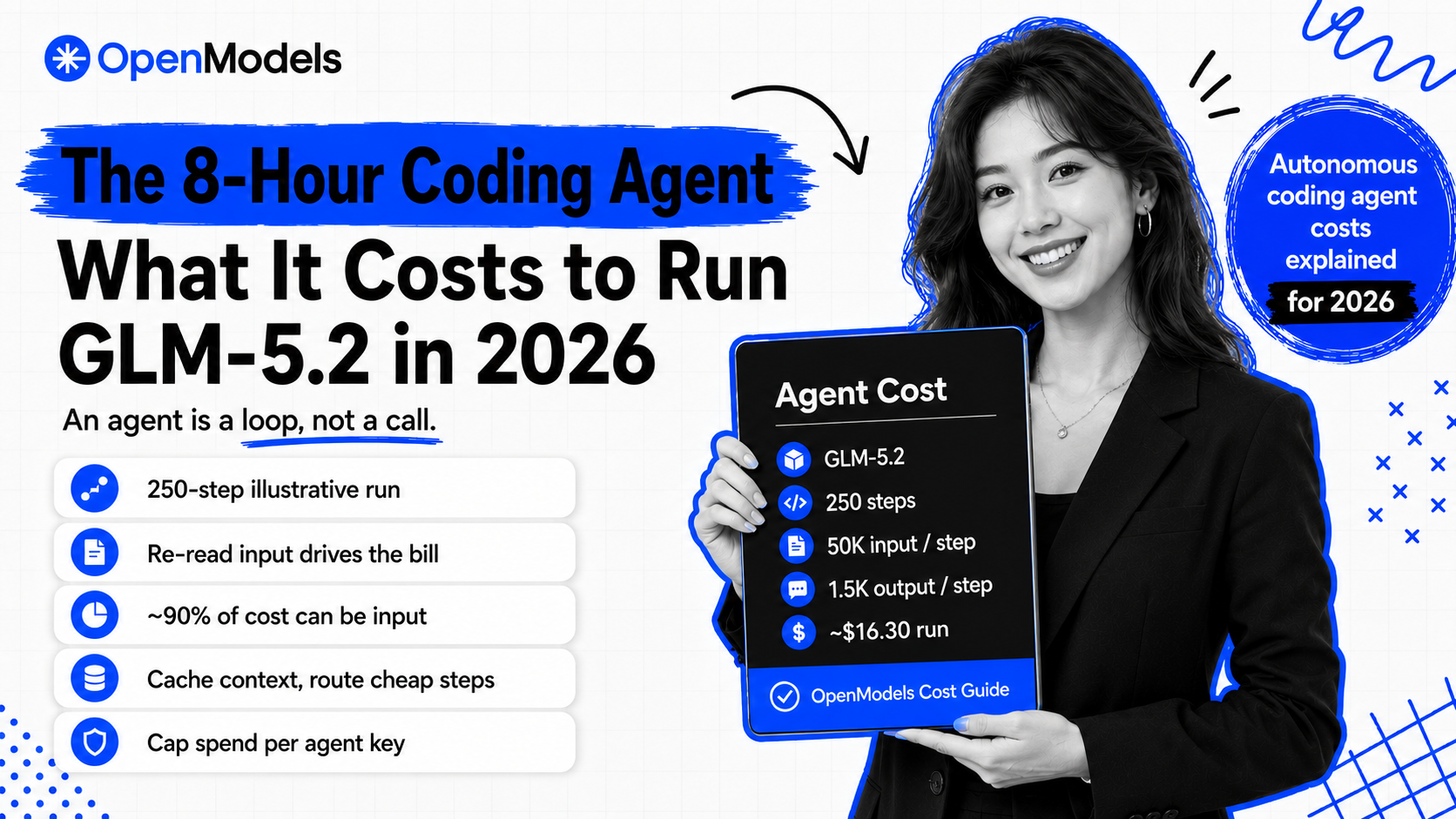
That flips the cost intuition. On a single call, output is the expensive side. Across a long agent run, input dominates, because it gets multiplied by the step count while output is generated once per step. We worked the arithmetic through in The 8-Hour Coding Agent: input runs about 90% of the bill on an illustrative 250-step run.
The rule underneath it is more portable than the percentage. Input dominates whenever an agent re-reads more than output_price / input_price times the tokens it generates per step. That threshold is a property of the model you chose, and it is not the same everywhere:
| Route | Input / 1M | Output / 1M | Break-even re-read ratio |
|---|---|---|---|
glm-5.2 (OpenModels) |
$1.18 | $4.14 | 3.5x |
| Claude Opus 4.8 | $5.00 | $25.00 | 5.0x |
| Claude Sonnet 5 | $3.00 | $15.00 | 5.0x |
| Claude Haiku 4.5 | $1.00 | $5.00 | 5.0x |
qwen3.5-flash (OpenModels) |
$0.03 | $0.296 | 9.9x |
A context-heavy coding agent re-reads 10 to 30 times what it writes each step, so every row here sits well inside input-dominated territory. Two consequences follow. Prompt caching on the stable prefix is the highest-leverage optimisation available on any of these models, ahead of trimming output length. And the cheap-input rows are cheap exactly where a coding agent spends.
One caveat, stated plainly because it cuts against the table: this prices tokens, not tasks. If a stronger model needs fewer steps, its higher per-token price can still produce a lower per-task bill. Measure your own step counts before concluding anything from a price column.
How OpenModels Makes GLM-5.2 Easier to Use
OpenModels is an open marketplace for LLM tokens: one ale-... key, OpenAI-compatible, prepaid credits billed on actual token usage with no per-request routing markup, and per-key USD spend limits. As of the 2026-06-18 feed it lists 27 live routes and advertises 0 proxy chains.
For the agent you write yourself, most existing OpenAI SDK code runs after changing two lines:
from openai import OpenAI
client = OpenAI(base_url="https://api.getopenmodels.com/v1", api_key=os.environ["OM_API_KEY"])
resp = client.chat.completions.create(
    model="glm-5.2",                       # or qwen3.5-flash for the easy steps
    messages=[{"role": "system", "content": SYSTEM_PROMPT},  # cache this stable prefix
              {"role": "user", "content": "Plan the refactor, then start editing."}],
    max_tokens=1500,
)
Three things this buys a coding agent specifically. GLM-5.2 lists content caching on the catalog, which targets the re-read prefix that dominates the bill. The same key reaches qwen3.5-flash at $0.03 / $0.296 per 1M, roughly 39x cheaper on input, so you can route trivial steps down without a second integration. This is model routing done in your own loop; OpenModels exposes both models on one key, it does not auto-route for you. And per-key USD spend limits (presets at $10 to $200, or custom) are enforced before the request goes upstream, so a thrashing agent hits its ceiling and stops.
To be exact about the boundary: this is the path for agents you build. It is not a way to run Claude Code, for the protocol reason in the table above.
Teams that want per-agent profit and loss on top of the cap (agent revenue minus model spend minus tool spend, per run) get that from the fuller AI Agent Finance Gateway layer OpenModels runs on. See Alephant and its Known Margin reporting.
GLM-5.2 Use Cases for Developers
Repo analysis
A 1M-token window holds a mid-sized codebase without chunking. You pay for the tokens you send, not for the ceiling, so a single pass over a repo slice costs what its tokens cost.
Long-context debugging
Stack trace, failing test, the three files involved, and the last twenty commits, in one request. Fewer retrieval round-trips means fewer steps, and steps are what multiply.
Multi-file refactoring
The headline job. Plan, edit across files, run tests, iterate. Watch the re-read: a refactor agent re-sends its working set every step, so cache the stable prefix and let only the diff churn.
Code review agents
Tool calling plus long context makes GLM-5.2 a reasonable reviewer over a full diff with surrounding context. Give each review agent its own key with its own cap, so a pathological PR cannot drain the balance.
Documentation generation
Generation-heavy rather than context-heavy, which is the one shape where output price leads. At a 3.5x output-to-input ratio, a doc-writing agent producing long prose against a small context can cross back over the line. Cap max_tokens here; it actually matters.
Backend architecture planning
Reasoning-capable and able to run long, so it suits planning steps where quality beats latency. Pair it with a cheaper model for the mechanical calls around it.
Tool-calling workflows
GLM-5.2 supports the OpenAI-compatible tools format, so existing function-calling code ports across with a base-URL and key swap. Tool messages and results bill as ordinary tokens, and spend is trackable per key and per model.
GLM-5.2 API Pricing on OpenModels
| Route | Input / 1M | Output / 1M | Context |
|---|---|---|---|
glm-5.2 |
$1.18 | $4.14 | 1M |
qwen3.5-flash |
$0.03 | $0.296 | — |
Prices are first-party, from the 2026-06-18 pricing feed. Against Claude Opus 4.8 at $5.00 / $25.00, GLM-5.2 is about 4.2x cheaper on input and 6.0x cheaper on output for the same 1M-token window. Against Claude Sonnet 5 at $3.00 / $15.00 the gap narrows to 2.5x and 3.6x, and narrows further while Anthropic's introductory Sonnet 5 pricing ($2.00 / $10.00) runs through 2026-08-31.
One precise caution on route IDs: glm-5.2 and zhipu/glm-5.2 are separate routes. They share the $1.18 / $4.14 price on this feed but differ in capabilities, and elsewhere on the same feed prefixed and unprefixed routes diverge sharply in price. Copy the exact route ID from the live catalog before launch.
Funding is pay-as-you-go (card or crypto) or monthly credit plans that add 10 to 20% bonus credits.
Final Recommendation
Do not pick between a model and a CLI. Pick between building the loop and buying it.
- Buy the loop. If you want a working coding agent today, with edit safety, approval gates and session management you did not write, use Claude Code. It is the better product for that job, and the per-token comparison above is the wrong lens if you are on a flat subscription.
- Build the loop. If the agent is yours (repo automation, CI review, an n8n workflow, an internal tool) and token cost scales with your usage, GLM-5.2 on an OpenAI-compatible endpoint is the stronger economic choice: the same 1M window at $1.18 / $4.14, model portability by model ID, and per-key hard caps.
- You want GLM inside Claude Code specifically. Point
ANTHROPIC_BASE_URLat an Anthropic-compatible endpoint such as Z.ai's, or run a translating gateway in front of an OpenAI-compatible route. An OpenAI-compatible marketplace, OpenModels included, will not drive Claude Code unaided.
For the full scored comparison of where to buy GLM-5.2 tokens, read Best GLM-5.2 API Providers in 2026. For the token economics of a long agent run, read The 8-Hour Coding Agent.
Start at openmodels.market, read the quickstart at docs.openmodels.market, or ask routing questions on Discord and the Open Models Lab Telegram.
FAQ
Can you use GLM-5.2 with Claude Code?
Yes, but only through an endpoint that speaks the Anthropic Messages API. Claude Code reads ANTHROPIC_BASE_URL, ANTHROPIC_AUTH_TOKEN and ANTHROPIC_MODEL at startup and sends every request to that address, appending /v1/messages itself. Z.ai publishes an Anthropic-compatible endpoint (https://api.z.ai/api/anthropic) built for exactly this, and OpenRouter offers an Anthropic-compatible route. An OpenAI-compatible endpoint (POST /chat/completions), which is what OpenModels and most token marketplaces expose, cannot drive Claude Code directly; you would need a translating gateway such as LiteLLM in front of it. OpenAI-compatible endpoints are the right surface for agents you write yourself, not for driving Claude Code.
Should I use GLM-5.2 or Claude for a coding agent?
It depends on whether you are building the agent loop or buying it. Claude Code ships the loop (tools, edit safety, approval gates, session management) and runs Anthropic's Claude models, so it is the faster path to a working agent and the better choice when model quality dominates cost. GLM-5.2 is a model you wire into your own agent, at $1.18 / $4.14 per 1M input/output on OpenModels versus $5.00 / $25.00 for Claude Opus 4.8 or $3.00 / $15.00 for Claude Sonnet 5. Pick GLM-5.2 when you already own the control flow and token cost scales with usage; pick Claude Code when you want the harness rather than the endpoint.
What is the difference between a coding model and a coding agent harness?
A model turns tokens into tokens. A harness is everything around it that makes an agent: the loop that calls the model repeatedly, the tools it can invoke (read, write, edit, bash, search), permission and approval gates on destructive actions, staleness checks so an edit cannot silently overwrite a changed file, session state, and context compaction when a long run approaches the window limit. GLM-5.2 is a model. Claude Code is a harness that ships with a first-party model attached. Comparing them on benchmark quality misses the point: a benchmark score does not give you an edit tool that refuses a stale write.
Is GLM-5.2 cheaper than Claude Opus for a coding agent?
Per token, substantially. GLM-5.2 lists at $1.18 / $4.14 per 1M input/output on OpenModels' 2026-06-18 feed against Claude Opus 4.8 at $5.00 / $25.00, roughly 4.2x cheaper on input and 6.0x cheaper on output. Because a coding agent re-reads far more than it generates, the input gap is the one that sets the bill. Two caveats. Per-token price is not per-task price: a stronger model that finishes in fewer steps can cost less overall, so measure your own step counts. And many Claude Code users pay a flat Pro or Max subscription rather than API rates, in which case the per-token comparison does not describe their bill at all.
Does GLM-5.2 have a bigger context window than Claude?
No. GLM-5.2, Claude Opus 4.8 and Claude Sonnet 5 all have 1M-token context windows. Context length is not a reason to choose GLM-5.2 over a current Claude model. The real differences are price per token (GLM-5.2 is several times cheaper), open weights (GLM-5.2 runs across many providers and can be self-hosted), and API protocol (GLM-5.2 is typically served OpenAI-compatible, Claude natively speaks the Anthropic Messages API). On a token-priced marketplace, a larger context window does not by itself raise per-request cost: you pay for the tokens you send, not for the ceiling.
Sources: GLM-5.2 pricing, capabilities and the ~8-hour autonomous-task note are from the OpenModels catalog and knowledge base. Claude model pricing and context windows are from Anthropic's published API pricing, and Claude Code's ANTHROPIC_BASE_URL behaviour from the Claude Code environment-variable documentation, both read 2026-07-10. Z.ai's Anthropic-compatible endpoint is documented in Z.AI's Claude Code guide. Per-token prices change; verify before budgeting. Published by the OpenModels team; OpenModels runs on Alephant Gateway infrastructure and sells the GLM-5.2 tokens priced here.