
Kimi K3 vs Claude Opus: Is It Really Opus-Level?
See whether viral Kimi K3 is really Claude Opus-level, compare benchmarks and price, and test its API through OpenModels.

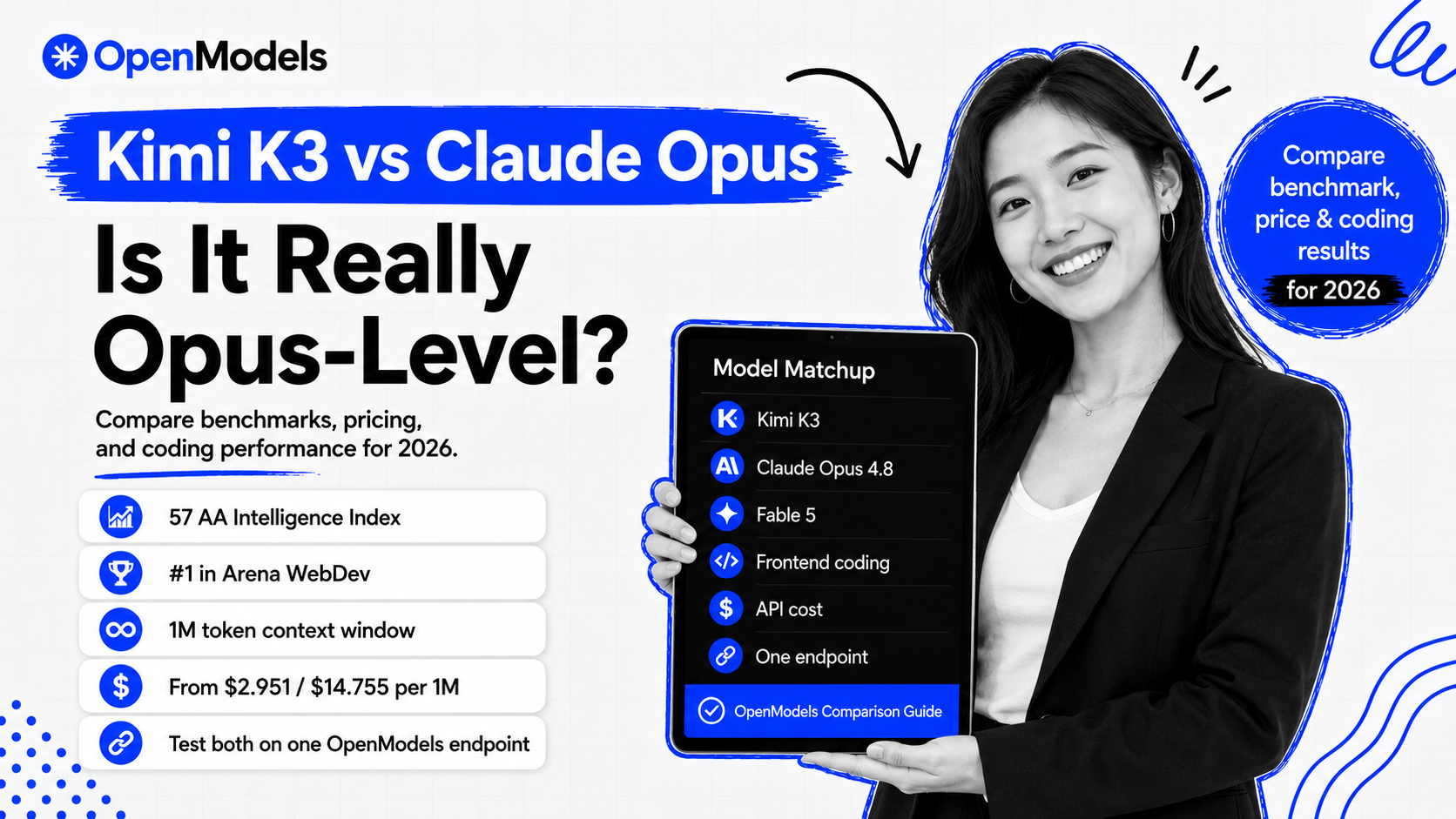
By the OpenModels team. Kimi K3 is now available in our marketplace through one OpenAI-compatible API. We reviewed the launch claims, independent results, pricing, and the workloads where K3 looks strongest.
TL;DR: Is Kimi K3 Really Claude Opus-Level?
Yes—Kimi K3 is broadly Claude Opus 4.8-level in current independent evaluations, but it is not uniformly better than Claude Fable 5 or GPT-5.6 Sol. Artificial Analysis scores K3 at 57 on its Intelligence Index, comparable to Opus 4.8 and GPT-5.5, while still behind Fable 5 and GPT-5.6 Sol. K3's clearest headline win is frontend coding: it reached number one in Arena's blind Frontend Code evaluation, ahead of Fable 5.
For developers, the more useful question is not whether K3 “beats Claude” in the abstract. It is whether K3 can lower the cost of a successful coding, research, or agent task in your own system.
| Kimi K3 fact | Current value |
|---|---|
| Developer | Moonshot AI |
| Architecture | Mixture of Experts with Kimi Delta Attention |
| Total parameters | 2.8 trillion |
| Experts | 896 total, 16 active per token |
| Context window | 1 million tokens |
| Input | Native text and images |
| Output | Text |
| OpenModels model ID | kimi-k3 |
| OpenModels routes | 2 verified providers |
| OpenModels displayed price | From $2.951 input / $14.755 output per 1M tokens |
| Best first tests | Frontend coding, long-horizon agents, knowledge work |
Data note: OpenModels prices and route availability can change. Check the live Kimi K3 model page before estimating production spend.
Why Kimi K3 Went Viral
Kimi K3 landed at the intersection of three stories: frontier-level performance, open-weight ambitions, and a large architectural bet.
Moonshot describes K3 as a 2.8-trillion-parameter, natively multimodal model with a 1M-token context window. Only 16 of its 896 experts activate for each token. The company says Kimi Delta Attention and Attention Residuals improve scaling efficiency while supporting long-context work.
The launch moved beyond model-community discussion when K3 reached first place in Arena's Frontend Code evaluation with 1,679 points. The Associated Press reported that the result put K3 ahead of Fable 5 in blind developer testing and described the release as a major challenge to leading American models.
That does not mean K3 wins every category. It means an open-weight candidate reached the frontier in a visible, practical task while offering lower API pricing than the premium Claude tier.
Kimi K3 vs Claude Opus 4.8 vs Fable 5
The cleanest reading of the public evidence is:
- Kimi K3 is Opus 4.8-level overall. Artificial Analysis gives K3 an Intelligence Index score of 57 and describes it as comparable to Opus 4.8 and GPT-5.5.
- Kimi K3 can beat Fable 5 on specific tasks. Arena placed K3 first in Frontend Code, ahead of Fable 5.
- Fable 5 still leads on broader independent agent evaluations. K3 reached 1,668 Elo on GDPval-AA v2 versus 1,760 for Fable 5.
- K3 beats Opus 4.8 on that agent benchmark. Opus 4.8 scored 1,600 Elo on the same GDPval-AA v2 evaluation.
- The top closed models still lead overall. Artificial Analysis places K3 behind Fable 5 and GPT-5.6 Sol on its composite index.
| Question | Evidence-based answer |
|---|---|
| Is Kimi K3 Opus-level? | Yes, comparable to Claude Opus 4.8 overall in current independent testing |
| Is Kimi K3 Fable 5-level? | Close in some tasks, but behind Fable 5 overall and on GDPval-AA v2 |
| Can Kimi K3 beat Fable 5? | Yes, it led the blind Frontend Code Arena at launch |
| Is Kimi K3 cheaper than Opus 4.8? | Yes in published API and cost-per-task comparisons |
| Should K3 replace Claude everywhere? | No; test it on your own tasks, latency targets, and failure costs |
Benchmark language matters. “Opus-level” is defensible. “Better than every Claude model” is not.
Kimi K3 Pricing: Token Price vs Successful-Task Cost
The first-party Kimi API launched at $3 per 1M uncached input tokens, $0.30 per 1M cached input tokens, and $15 per 1M output tokens. On OpenModels, our marketplace currently displays K3 from $2.951 per 1M input tokens and $14.755 per 1M output tokens across two verified routes.
Artificial Analysis found that K3 cost an average of $0.94 per task across its Intelligence Index suite. That was close to GPT-5.6 Sol at $1.04 and roughly half of Opus 4.8 at $1.80.
These numbers reveal two different comparisons:
- Token price tells you the price of generated and processed text.
- Cost per successful task includes how many tokens, retries, and model calls are required to finish the job.
K3 used about 21% fewer output tokens than K2.6 across the nine Artificial Analysis evaluations while scoring higher. That efficiency is promising for agent loops, but your production result depends on tool-call accuracy, latency, and retry behavior.
How to Use the Kimi K3 API on OpenModels
OpenModels exposes Kimi K3 through the same OpenAI-compatible chat-completions interface used by other models in our marketplace.
Python quickstart
from openai import OpenAI

client = OpenAI(
    base_url="https://api.getopenmodels.com/v1",
    api_key="YOUR_OPENMODELS_API_KEY",
)

response = client.chat.completions.create(
    model="kimi-k3",
    messages=[
        {
            "role": "system",
            "content": "You are a coding agent. Explain assumptions and preserve existing behavior.",
        },
        {
            "role": "user",
            "content": "Find the race condition in this queue worker and propose a tested patch.",
        },
    ],
)

print(response.choices[0].message.content)
cURL quickstart
curl https://api.getopenmodels.com/v1/chat/completions \
  -H "Authorization: Bearer $OM_API_KEY" \
  -H "Content-Type: application/json" \
  -d '{
    "model": "kimi-k3",
    "messages": [
      {"role": "user", "content": "Build a migration plan with tests and rollback checks."}
    ],
    "stream": false
  }'
Our K3 page lists verified routes from Neolink and Tencent. You can start with automatic routing or choose a provider route when you need explicit control.
Why Use Kimi K3 Through OpenModels?
OpenModels makes K3 useful inside a multi-model system, not only as a one-time benchmark test.
- One endpoint: call
kimi-k3through an OpenAI-compatible base URL. - Visible provider choice: compare the verified K3 routes shown in our marketplace.
- Model switching: test K3 against another model by changing the model ID instead of rewriting the integration.
- Fallback design: keep K3 and an alternative model behind the same endpoint so your application is not tied to one model route.
- Usage-based access: evaluate K3 before committing to the infrastructure required for a 2.8T-parameter model.
This is the practical OpenModels wedge: use one API surface to decide where K3 belongs in your stack, then switch or route based on measured results.
When Should You Choose Kimi K3?
K3 is a strong candidate when your workload includes frontend coding, long-horizon coding agents, agentic knowledge work, multimodal analysis, or cost-sensitive Opus-class tasks.
Frontend coding
K3's number-one Frontend Code Arena launch result makes interface generation, dashboard work, reference-based design, and data visualization natural first tests. Blind preference rankings are still not a substitute for repository tests and accessibility checks.
Long-horizon agents and knowledge work
A 1M-token context window gives K3 room for repository context, tool output, test logs, and an evolving plan. K3 also reached 1,547 Elo on Artificial Analysis's AA-Briefcase evaluation, second only to Fable 5 at launch.
Cost-sensitive Opus-class workloads
If you currently use a premium model for every complex request, K3 may handle part of that traffic at a lower cost. Route only after a matched evaluation shows comparable success rates.
A Five-Test Kimi K3 Evaluation Plan
| Test | Measure | Failure signal |
|---|---|---|
| Frontend build | Visual match, accessibility, test pass rate | Attractive output that misses requirements |
| Repository issue | Tests passed and regressions introduced | Plausible patch without working tests |
| Tool-use loop | Valid calls and successful recovery | Invalid arguments or repeated failed calls |
| Long-context task | Constraint retention after 20+ steps | Forgets an early rule or source |
| Cost per success | Tokens, latency, retries, total spend | Low token price but expensive retries |
Use at least 20 representative tasks for an initial signal. Keep human review blind where possible, and separate coding quality, presentation quality, latency, and cost instead of reducing every result to one score.
What Are Kimi K3's Limitations?
- Artificial Analysis measured a 51% hallucination rate in its AA-Omniscience evaluation, up from 39% for K2.6, even as K3's accuracy improved.
- A 1M-token context window states capacity, not perfect recall across every token.
- The model's 2.8T-parameter size makes self-hosting a serious infrastructure project.
- Vendor benchmarks and independent composite scores may not predict your private workload.
- Route latency and availability can change by provider and region.
For factual research, require citations and verify them. For code, run tests. For tools, validate arguments before execution. For high-impact workflows, keep a fallback model.
FAQ
What is Kimi K3?
Kimi K3 is Moonshot AI's 2.8-trillion-parameter Mixture-of-Experts model for coding, long-horizon agents, knowledge work, reasoning, and multimodal input. It activates 16 of 896 experts per token and supports a 1M-token context window.
Is Kimi K3 as good as Claude Opus?
Kimi K3 is comparable to Claude Opus 4.8 overall in Artificial Analysis's current Intelligence Index. K3 also beats Opus 4.8 on GDPval-AA v2. Results vary by task, so “Opus-level” is more accurate than claiming K3 wins everywhere.
Does Kimi K3 beat Claude Fable 5?
Kimi K3 beat Fable 5 in Arena's blind Frontend Code ranking at launch. Fable 5 still leads K3 on the broader Artificial Analysis Intelligence Index and GDPval-AA v2, so the answer depends on the workload.
How much does Kimi K3 cost on OpenModels?
OpenModels currently displays Kimi K3 from $2.951 per 1M input tokens and $14.755 per 1M output tokens, with two verified routes. Prices can change, so confirm the live model page before production use.
How do I call the Kimi K3 API?
Use the OpenModels base URL https://api.getopenmodels.com/v1, the chat-completions endpoint, your OpenModels API key, and the model ID kimi-k3. Existing OpenAI SDK clients can use the same request format.
Is Kimi K3 open source?
Moonshot describes K3 as an open-weight model and has announced a weights release. “Open weight” is the precise term: availability of weights does not automatically mean every component, training dataset, or use case is unrestricted. Check the published license before deployment.
The Bottom Line
Kimi K3 deserves the attention it is getting. Independent evaluation puts it around Claude Opus 4.8 level overall, Arena ranks it first for frontend coding, and its cost per evaluated task is about half that of Opus 4.8. It does not beat Fable 5 or GPT-5.6 Sol across the board.
The fastest way to turn the viral claim into an engineering decision is to run K3 against your current model on real tasks. On OpenModels, use kimi-k3 through our OpenAI-compatible endpoint, compare the verified routes, and keep model switching and fallback behind the same API integration.
Sources
- Moonshot AI: Kimi K3
- Moonshot AI technical report
- Artificial Analysis: Kimi K3 independent evaluation
- Associated Press: Kimi K3 challenges leading U.S. models
- Tom's Hardware: Kimi K3 architecture and launch
- OpenModels Kimi K3 marketplace page: model ID, provider routes, endpoint, and displayed pricing supplied by the OpenModels team and checked for this draft.