
The 8-Hour Coding Agent: What It Costs to Run GLM-5.2 Autonomously in 2026
GLM-5.2 can code unattended for hours, and the first invoice surprises people. An autonomous agent is a loop, not a call: it re-reads its context every step, so input can be 90% of the bill.

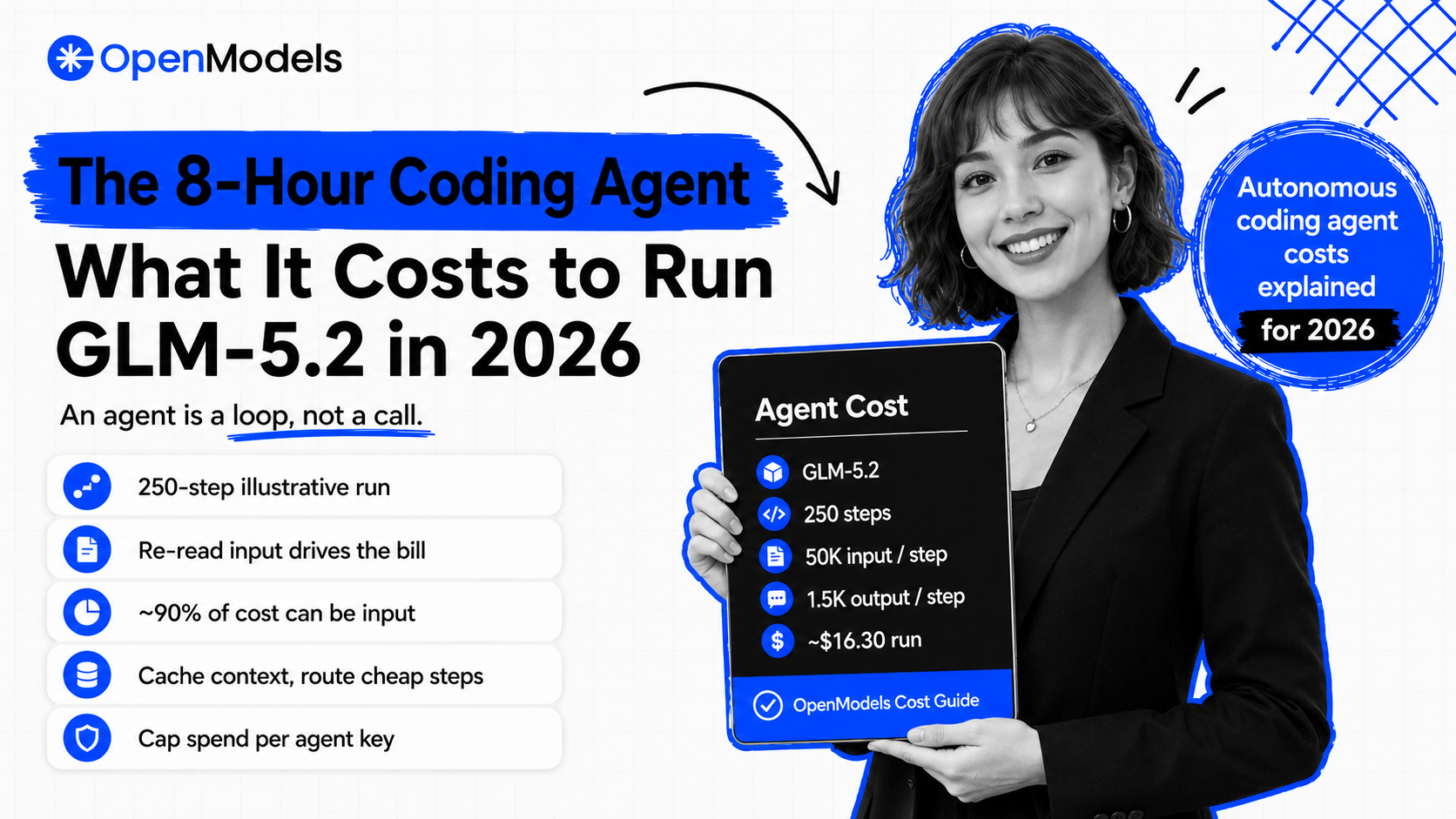
By the OpenModels team. OpenModels is an open marketplace for LLM tokens that runs on Alephant gateway infrastructure, and it sells the GLM-5.2 tokens this article prices, so read it as an interested source. The GLM-5.2 price ($1.18 / $4.14 per 1M input/output) is first-party, from the OpenModels pricing feed dated 2026-06-18. The per-run cost figure below is an illustrative token model built on stated assumptions (step count, tokens per step), not a benchmark we ran and not a measurement of any real agent. Verify live pricing and model your own token pattern before you budget.
GLM-5.2 can run autonomously for up to roughly eight hours on a single task, per the model notes on the OpenModels catalog. That one line is why it became the default base model for coding agents in 2026. It is also why the first invoice surprises people.
Here is the mistake almost every cost guide makes, including the ones ranking providers on price: they price a single API call. An autonomous agent is not a single API call. It is a loop that calls the model hundreds of times, and on every pass it re-reads a context that keeps growing. Price the call and you miss where the money actually goes. Price the loop and the bill makes sense.
Quick answer. A single GLM-5.2 call is output-heavy, so the usual advice is to cap
max_tokens. An autonomous agent run is the opposite: it re-sends its working context (the repo, the plan, everything it has done so far) on every step, so re-read input tokens, not generated output, drive the bill. On an illustrative 250-step run priced at OpenModels' GLM-5.2 rate, input is roughly 90% of the cost. That flips the levers that matter: prompt caching, per-step model routing, and a hard per-key spend cap beat trimming output length.
An autonomous agent is a loop, not a call
When you send one chat completion, the cost is easy: input tokens times the input price, plus output tokens times the output price. GLM-5.2 lists at $1.18 per 1M input and $4.14 per 1M output on the 2026-06-18 feed, so for a single generation the output side (about 3.5x the input price) is where you watch the meter. That is the model the GLM-5.2 provider comparison uses, and for a one-shot call it is correct.
An agent breaks that model. A coding agent working "up to roughly eight hours" is not thinking for eight hours in one call. It is running a loop:
- Read the current state (files, the plan, the last tool result).
- Decide the next action.
- Call a tool (edit a file, run a test, search the repo).
- Read the result, append it to the running context, and go back to step 1.
Every trip through that loop is a fresh API call. And here is the part that sets the bill: on each call, the agent re-sends the context it needs to stay coherent. The system prompt. The repo slice it is working on. The plan. A growing transcript of every step it has already taken. The model is stateless, so "remembering" means re-reading. Two hundred steps in, the agent is paying to re-read most of what it read at step one, plus everything that has happened since.
That is why a long agent run feels expensive out of proportion to what it produced. You did not generate a novel. You re-read a book two hundred times.
The hidden cost driver: re-read input, not output
For a single call, output is the expensive side. For a multi-step agent, input flips to the front because it is multiplied by the step count. A 40K-token repo context that costs you $0.05 to send once costs you $9.44 to re-send across 200 steps. Nothing was generated. The model just kept re-reading to stay in the loop.
This is the single most useful thing to internalize about agent economics, and it is the opposite of the single-call intuition:
- Single GLM-5.2 call: output-heavy. Cap
max_tokens. - Long GLM-5.2 agent run: input-heavy. Cut re-read tokens.
The levers are different because the cost shape is different. Trimming output length on an agent that re-reads a 50K context every step is tuning the 10% and ignoring the 90%.
An illustrative cost model: price the tokens, not the hours
You cannot price "eight hours" directly, because throughput (how many tokens per hour an agent burns) depends on the harness, the tools, the task, and the model's own pace, and none of that is published. So do not try to price hours. Price tokens, which you can.
Here is an illustrative model. Every number in it is a stated assumption, not a measurement. Real agents vary by an order of magnitude in each direction; the point is the shape, not the total.
| Assumption (illustrative) | Value |
|---|---|
| Model calls in the run (steps) | 250 |
| Avg input tokens per step (context re-read) | 50,000 |
| Avg output tokens per step (edit + reasoning) | 1,500 |
| Total input tokens | 12,500,000 |
| Total output tokens | 375,000 |
Priced at OpenModels' first-party GLM-5.2 rate ($1.18 / $4.14 per 1M):
input  = 12,500,000 / 1e6 * $1.18  = $14.75
output =    375,000 / 1e6 * $4.14  = $1.55
run    = $14.75 (input) + $1.55 (output) = ~$16.30
Input is $14.75 of a $16.30 run, about 90%. Read that against the single-call intuition. On one call, output at 3.5x the input price is the thing to watch. Across the loop, the cheaper input token wins the bill on volume, because it is re-read 250 times and the output is generated once per step. The per-token prices did not change. The multiplier did.
There is a clean rule under the arithmetic, and it is more useful than the 90%. Input dominates an agent's bill whenever it re-reads more than about 3.5x the tokens it generates per step, because 3.5 is exactly GLM-5.2's output-to-input price ratio ($4.14 / $1.18 = 3.5). A context-heavy coding agent re-reads 10 to 30 times what it writes each step, which is why input runs the bill and the 250-step model above sits so far on the input-heavy side. The rule also tells you when the thesis flips: a generation-heavy agent that writes long output against a small context (drafting essays, not editing repos) can cross that 3.5x line and put output back in front. Most coding and tool-using agents live well above the line, which is why re-read input is the tokens to attack.
Three levers that actually move an agent bill
Because input dominates, the three cost levers for an autonomous agent are all about the re-read context, not the generation.
1. Cache the stable context
Most of that 50K-per-step context does not change between steps. The system prompt is fixed. The repo files the agent is working in are mostly stable across a stretch of edits. Re-sending them raw, every step, at full input price is the waste.
GLM-5.2 lists content caching as a capability on the glm-5.2 route in the OpenModels catalog. Cache the stable prefix (system prompt plus the unchanging repo context) and the re-read input collapses toward the cache-read rate instead of the full input rate. Since input is around 90% of an agent's bill, the cache hit rate on that stable prefix is the highest-leverage number in the whole run. This is prompt caching applied to the one place it pays most: a loop that re-reads the same thing hundreds of times.
2. Route the easy steps to a cheaper model
Not every step in an eight-hour run needs an eight-hour model. Reading a file, formatting a diff, classifying whether a test passed, deciding which of three files to open next: those are cheap decisions you are paying GLM-5.2 prices to make.
On OpenModels, one OpenAI-compatible key reaches GLM-5.2 and the cheaper open-weight families, so you can send the trivial steps to qwen3.5-flash at $0.03 / $0.296 per 1M and reserve glm-5.2 for the hard planning and multi-file edits. Input on the cheap model is roughly 39x cheaper than on GLM-5.2 ($0.03 vs $1.18). Route the input-heavy trivial steps down and you are cutting the exact tokens that dominate the bill. This is the same idea as model routing, done in your own agent loop: you choose the model per step (OpenModels exposes both on one key, it does not auto-route for you), and it needs no code change beyond the model ID because the endpoint is the same.
3. Cap each agent per key
The failure mode that actually hurts is not the average run. It is the loop that never terminates: an agent that retries, re-reads, and re-plans in a circle, burning input tokens against a task it cannot finish. Eight hours of that is a real bill for zero output.
OpenModels sets per-key USD spend limits (presets at $10, $20, $50, $100, $200, or a custom cap), enforced before the request goes upstream. Give each agent, or each environment, its own key with its own ceiling. A runaway loop then hits its cap and stops instead of draining the whole credit balance. This is the cheapest insurance in the stack: it costs nothing until the day it saves you the eight-hour runaway.
Teams that want per-agent profit and loss on top of the cap (agent revenue minus model spend minus tool spend, per run) get that from the fuller AI Agent Finance Gateway layer that OpenModels runs on. For just running GLM-5.2 tokens cheaply with a hard cap, OpenModels is the focused surface.
Which provider should you actually run GLM-5.2 through?
This post is about the shape of an agent bill, not a provider ranking. The provider question has its own answer, and it matters because GLM-5.2 is open-weight: the same model runs across many vendors, and the price per token (plus any routing markup) is what changes, not the model. For the full scored comparison of where to buy GLM-5.2 tokens (OpenModels, Z.ai Direct, OpenRouter, Together AI and more), read Best GLM-5.2 API Providers in 2026. The short version: for the cheapest transparent GLM-5.2 tokens on one key, a marketplace fits; for official first-party access, go direct to Z.ai; for the widest model menu including closed models, OpenRouter.
The reason to name the provider inside an agent-cost article: your caching and routing levers only exist if the provider exposes them. A transparent per-token marketplace with published input and output prices, content caching, and multi-model access on one key is what lets you pull all three levers above without re-integrating.
Run it on OpenModels
OpenModels is an open marketplace for LLM tokens: one ale-... key, OpenAI-compatible, prepaid credits billed on actual token usage with no per-request routing markup, and per-key USD spend limits for exactly the runaway-agent case above. GLM-5.2 lists at $1.18 / $4.14 per 1M on the 2026-06-18 feed; qwen3.5-flash at $0.03 / $0.296 sits on the same key for the cheap steps.
Most existing OpenAI SDK code runs after changing two lines:
from openai import OpenAI
client = OpenAI(base_url="https://api.getopenmodels.com/v1", api_key=os.environ["OM_API_KEY"])
resp = client.chat.completions.create(
    model="glm-5.2",                       # or qwen3.5-flash for the easy steps
    messages=[{"role": "system", "content": SYSTEM_PROMPT},  # cache this stable prefix
              {"role": "user", "content": "Plan the refactor, then start editing."}],
    max_tokens=1500,
)
Set a per-key monthly limit when you create the key, run your agent, then watch spend by key and by model in the dashboard to see which steps and which model actually cost you. Start at openmodels.market, read the quickstart at docs.openmodels.market, or ask token-cost and routing questions in the shared community on Discord and the Open Models Lab Telegram.
Frequently Asked Questions
How much does an autonomous coding agent cost to run?
There is no single dollar answer, because cost scales with the number of steps and the tokens re-read per step, not with wall-clock hours. On an illustrative 250-step GLM-5.2 run (50,000 input and 1,500 output tokens per step) priced at OpenModels' $1.18 / $4.14 per 1M feed rate, the run works out to about $16.30, of which roughly 90% is input. That figure is an illustrative token model on stated assumptions, not a benchmark. To price your own agent, count its real steps and average tokens per step, then multiply by your provider's live input and output rates, because the re-read input is where most of the bill lives.
Why do AI agent costs balloon over a long run?
Because the model is stateless, so an agent "remembers" by re-sending its context on every step. As the run goes on, that context grows (the plan, the files touched, the transcript of prior steps), and each new step re-reads all of it at full input price. A 200-step run re-reads most of the same context 200 times. The cost is not one big generation, it is the same input paid for over and over across the loop.
Do input or output tokens drive the cost of a long-running agent?
Input, for context-heavy agents. A single API call is output-heavy, since output tokens usually cost several times more than input (GLM-5.2 is $4.14 output vs $1.18 input per 1M). But an agent re-reads a large context on every step while generating comparatively little, so input gets multiplied by the step count. The rule of thumb: input dominates whenever an agent re-reads more than about 3.5x the tokens it generates per step, because 3.5 is GLM-5.2's output-to-input price ratio ($4.14 / $1.18). A coding agent re-reads 10 to 30x what it writes each step, so on the illustrative 250-step model above input is about 90% of the bill. A generation-heavy agent with long output and little context can cross that line and flip it. That is why "cap max_tokens" helps a single call but barely moves a context-heavy agent run.
How do you cap the cost of an autonomous agent per run?
Give each agent its own API key with a per-key USD spend limit that the provider enforces before the request goes upstream. On OpenModels, per-key monthly limits (presets $10 to $200, or custom) block a key once it hits its ceiling, so a runaway loop stops instead of draining the whole credit balance. Combine that hard cap with a sane max_tokens, prompt caching on the stable context, and routing trivial steps to a cheaper model to control both the ceiling and the average.
Does prompt caching reduce AI agent costs?
Substantially, because caching targets the exact tokens that dominate an agent bill: the stable context re-read every step. GLM-5.2 lists content caching as a capability on the OpenModels catalog. Cache the fixed prefix (system prompt plus the unchanging repo context) and the re-read input is served from cache instead of billed at the full input rate. Since input is around 90% of an agent's cost, a high cache hit rate on that prefix is the highest-leverage optimization available, ahead of shortening output.