
Best AI Agent Finance Gateways in 2026: Alephant vs LiteLLM, Portkey, Helicone, LangSmith and OpenRouter
Every gateway routes requests. Few tell you what each agent run cost, and fewer let the agent earn. Six tools scored on run-level cost, pre-execution budgets, paid endpoints, and per-agent P&L.

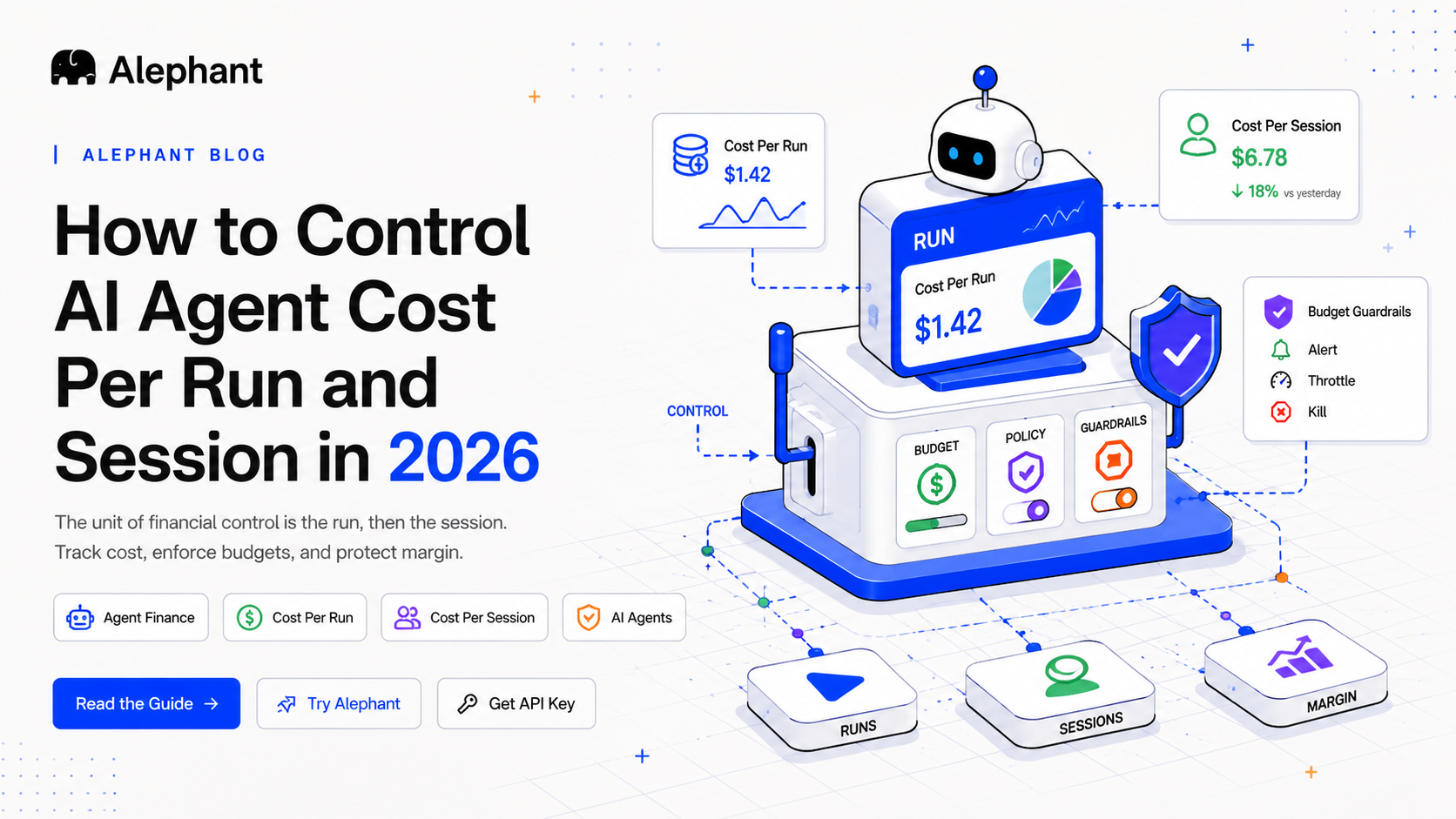
By the Alephant team. Disclosure: Alephant builds an AI Agent Finance Gateway, so this comparison ranks one of our own products. We use a scored rubric (below) and rank Alephant first only on the axes where it actually leads; every other tool is credited where it wins, and one of them (OpenRouter, on model breadth) outscores Alephant on its home turf. Every competitor claim is dated against that vendor's public documentation, with primary sources linked inline.
The first invoice from your model provider arrives as one line: API usage, $9,140. It does not tell you that a single research agent looped against Anthropic for six hours overnight, or that the agent you charge customers to use cleared less per run than it spent. By the time finance reads the number, the money was committed weeks earlier, in runs nobody can replay.
That is the problem a plain AI gateway was never built to solve. Routing a request to the cheapest model is one job. Knowing which agent run spent the money, stopping the run before it overspends, and recording whether that run earned more than it cost are three more. The category that does all four is the AI Agent Finance Gateway, and the question for a 2026 buyer is narrower than "which gateway." It is which tool can run an agent, control what the run spends, and let the agent charge for its output, all on one ledger.
This guide scores the six tools most teams shortlist: Alephant, LiteLLM, Portkey, Helicone, LangSmith, and OpenRouter. For the category definition itself, see our companion piece on what an AI Agent Finance Gateway is; this post is about which one to pick.
TL;DR
For a team running production agents that need cost control and a way to charge for their work, the strongest 2026 pick on our weighted rubric is Alephant (98/100), the one tool built around run-level financial identity and a money-in layer rather than routing or tracing. It carries cost attribution per agent, run, step, and tool call, enforces budgets before execution with the Budget Circuit Breaker, publishes paid endpoints with payment verified by an x402 payment sidecar, and reports Known Margin (revenue minus model and tool spend) per run. Portkey (42) is the strongest enterprise control plane. LiteLLM (37) is the open-source proxy baseline. Helicone (33) leads on observability developer experience. OpenRouter (27) wins outright on model breadth. LangSmith (26) scores low here only because it is a tracing and evaluation tool, not a gateway; on its own axes it is excellent, and most teams run it alongside a gateway, not instead of one.
What an AI Agent Finance Gateway has to do
The category resolves into four jobs that have to happen on the live request path, not in a report after the billing cycle closes.
- Run-level identity. Every call carries which agent, which run, which step, and which tool call made it. A request tagged only by customer or feature cannot tell you which agent in a multi-step loop overspent.
- Pre-execution control. A budget cap, a policy, and a guardrail that fire before the provider call resolves. A budget alert that arrives after the invoice is a post-mortem.
- Monetization. A way to publish the agent, workflow, or API as a paid service and verify payment before the work runs, so the agent can earn, not only spend.
- Per-run P&L. One ledger that subtracts model and tool spend from revenue, per run, so you can answer the question routers and dashboards both miss: did this agent run make money?
A tool that does the first two is an agent gateway. A tool that adds the second two is an AI Agent Finance Gateway. Most of the names below do one or two of these jobs well and leave the rest to another tool.
How we scored these tools
We weighted the rubric for the named audience: teams running production agents that need cost control and a revenue path. A team whose only need is reaching many models, or whose only need is debugging chains, should reweight, and we say so under each tool. Each tool is scored 0 to 5 on seven axes; the weighted total is out of 100.
| Axis | Why an agent team cares | Weight |
|---|---|---|
| Run-level cost attribution | Spend tagged to a request cannot find the run that looped | 20 |
| Pre-execution policy and budget enforcement | A cap that stops the next call beats an alert after the bill | 20 |
| Monetization (paid endpoints, x402) | Whether the agent can charge for its output, not only spend | 20 |
| Per-agent P&L (Known Margin) | The board asks if the agent is profitable, not only what it cost | 15 |
| BYO-KEY custody and data posture | Whether provider keys stay in your environment | 10 |
| Model routing and breadth | Reaching the right model at the right price | 10 |
| Pricing transparency | A published number beats "talk to sales" | 5 |
Methodology: every Alephant score maps to a capability marked live as of 2026-06-28. Every competitor score is dated against that vendor's public documentation and linked inline. Routing savings and cache figures cited below are the published ranges, not Alephant telemetry. The one worked example near the end is labeled as illustrative arithmetic, not customer data.
The ranked tools
1. Alephant: 98/100
Alephant is the one tool here built so that cost intelligence and a revenue layer are the product, with routing underneath. The runtime is an OpenAI-compatible gateway at https://ai.alephant.io/v1, open-sourced in Rust under GPL v3 as alephant-ai-gateway and publicly accessible since 2026-05-12. BYO-KEY is the default: provider credentials sit in an AES-256 vault with workspace isolation through row-level security, so keys never leave your environment and are never reused.
What earns the score is the agent-finance stack the others do not have. The agent gateway layer carries run identity (agent, run, step, tool, graph) on every hop through Alephant-Agent-* headers that are stripped before the call reaches the provider, and ingests run telemetry at /v1/agent/events. Agent policy validation checks each event against policy and budget before execution and can block, downgrade, or route for approval. The Budget Circuit Breaker escalates at 50/75/90/100% of a configured budget and hard-stops the next request rather than emailing you after. On the money-in side, an agent or workflow is published as a paid endpoint at /x402/agents/{slug}; the x402 payment sidecar issues a 402 payment challenge, verifies payment, and only then routes the request, with settlement through Alephant Rails so the agent holds no wallet. The ledger that results is Known Margin: agent revenue minus model spend minus tool spend, per run.
For waste, the AI Inside signal layer grades each cohort on an S-through-D scale across eleven signals, with agent thrashing (W3) as a veto that drops an agent's efficiency score the moment it loops. Routing, caching, and a seven-policy engine round it out, with three verified n8n nodes for the automation crowd. Pricing is published end to end: Free at $0, Pro at $29, Team at $79, Enterprise at $499 and up, metered in Agent Runs. Note the gating honestly: the Free tier covers budget-safety guardrails (Set Monthly Budget, Daily Hard Stop, Monthly Spend Alert), while AI Inside grading and multi-level Budget Control unlock on Pro and above.
Where it does not lead: model breadth. OpenRouter is the better discovery surface if reaching the widest catalog is your only goal (4/5 here vs OpenRouter's 5).
Best fit: teams running production agents who own both the cost line and a plan to charge for the agent's work.
2. Portkey: 42/100
Portkey (Series A, 1,600+ models) is the most mature control plane in the category, with 50+ guardrails and deep prompt management. For governance over production AI applications, it is a credible choice, and its router is strong.
The agent-finance gaps show up in two places. First, the cost-control primitives a finance owner needs most (Granular Budget and Rate Limits, per-member budget attribution, SSO, and the compliance certificates) all sit in Enterprise Custom Pricing; the published $49/month Production tier ships observability, alerts, semantic caching, and RBAC, and meters in logs rather than requests (100K logs, then $9 per additional 100K, 30-day retention) per Portkey's pricing page. Second, there is no monetization layer and no per-agent P&L: Portkey watches money going out, not money coming in.
Best fit: enterprises that need a governed control plane and route agent traffic, where monetization is not a requirement and a sales call for budget controls is acceptable.
3. LiteLLM: 37/100
LiteLLM (33,000+ GitHub stars) is the de facto open-source proxy and the one most teams have already touched. It is free to license, supports 100+ model SDKs, and ships per-key budget primitives. As a starting point for self-hosted routing, adoption is on its side.
Two facts matter for an agent team. Community load tests report latency spikes past four minutes at 500 RPS and effective unusability near 5,000 RPS, so production operation needs Redis, PostgreSQL, and load balancers, which is real ongoing cost. And on 2026-03-24, LiteLLM shipped a PyPI supply-chain incident: releases 1.82.7 and 1.82.8 carried backdoored code that exfiltrated SSH keys, cloud credentials, and API keys. For anyone responsible for an audit posture, an open-source proxy is inherited supply-chain risk to manage, not assume away. There is no agent-run P&L and no monetization layer.
Best fit: prototypes and small-scale production with DevOps capacity, where the team pins versions and audits upstream releases.
4. Helicone: 33/100
Helicone (YC W23, 7,000+ GitHub stars, SOC 2 certified) is one of the cleanest developer experiences in the space. The Pro plan delivers 300+ model cost tracking, per-request analytics, and session-level attribution. Its architecture still reflects its origin as request observability: cost is a dimension of a trace, not a budget you can enforce.
For an agent team that means no Budget Circuit Breaker equivalent, no pre-execution block, and no per-run P&L. Session-level attribution approximates per-agent if your sessions map cleanly, but it is reporting, not control. The Pro plan also applies a 5% markup on requests per Helicone's pricing. Helicone tells you precisely what happened; it does not decide what should happen before the call.
Best fit: teams whose primary need is high-quality observability and who already have, or do not need, an enforcement layer.
5. OpenRouter: 27/100
OpenRouter leads on model variety: 500+ models through one API, plus a BYO-KEY tier covering 60+ providers with the first 1 million requests per month free. For trying many models without onboarding at each provider, it removes a lot of friction, and it earns a clean 5/5 on breadth, the only tool here that beats Alephant on an axis Alephant also competes in.
The agent-finance story is thin. The Activity page shows request counts, token totals, and a rough spend figure, with no per-member or per-run attribution, no enforcement, and no efficiency grading. The pay-as-you-go model adds a 5% markup, and the credit-purchase path adds 5% plus 5.5%. At $10,000/month in spend, the markup alone is about $500. There is no paid-endpoint layer for selling your own agent.
Best fit: developers prototyping across model families, or reaching providers without standing up direct accounts. If breadth is your only axis, reweight and OpenRouter moves up.
6. LangSmith: 26/100
LangSmith is the tracing, evaluation, and observability platform from the LangChain team, with deep fit for LangChain and LangGraph applications. It is genuinely strong at what it does: tracing multi-step chains, debugging agent behavior, evaluating outputs, and managing prompts and experiments.
The low score here is a category statement, not a quality judgment. LangSmith is not a gateway: it does not sit in the request path as an enforcing proxy, does not route provider traffic, does not publish paid endpoints, and does not produce a per-agent P&L. It captures cost as a dimension of a trace, the same limitation as observability tools generally. The honest framing is that LangSmith answers "what did my agent do and was the output good," while a finance gateway answers "what did the run cost, should it have run, and did it earn." Production agent teams often run both: LangSmith for evaluation, a finance gateway for control and monetization.
Best fit: LangChain and LangGraph teams that need tracing and evaluation. Pair it with a gateway for the financial layer rather than expecting it to fill that role.
Scored comparison
| Tool | Run-level attribution | Pre-exec enforcement | Monetization (x402) | Per-agent P&L | BYO-KEY custody | Routing / breadth | Pricing transparency | Weighted total |
|---|---|---|---|---|---|---|---|---|
| Alephant | 5 | 5 | 5 | 5 | 5 | 4 | 5 | 98 |
| Portkey | 3 | 3 | 0 | 0 | 4 | 4 | 2 | 42 |
| LiteLLM | 2 | 2 | 0 | 0 | 4 | 4 | 5 | 37 |
| Helicone | 3 | 1 | 0 | 0 | 4 | 3 | 3 | 33 |
| OpenRouter | 1 | 1 | 0 | 0 | 3 | 5 | 3 | 27 |
| LangSmith | 3 | 0 | 0 | 1 | 3 | 1 | 3 | 26 |
Weights: attribution 20, enforcement 20, monetization 20, P&L 15, custody 10, routing 10, transparency 5. Weighted total = sum of (axis score / 5 x weight). Reweight for your own priority and the order changes; that is the point of showing the weights.
How to choose by use case
You run production agents and need to control spend per run. Only an inline gateway can enforce before the provider call resolves. Alephant's Budget Circuit Breaker escalates at 50/75/90/100% with a hard stop, attributed to the agent run. Portkey has budgets but gates the granular ones to Enterprise. LiteLLM ships per-key caps if you self-host and operate it.
You want the agent to charge for its work. This is the axis that separates the category. Alephant publishes paid endpoints and verifies payment through an x402 payment sidecar before routing, with Alephant Rails handling settlement so the agent holds no wallet. None of the other five do this.
You need to know if an agent run is profitable. Known Margin subtracts model and tool spend from revenue per run. No router, observability tool, or tracing platform on this list returns that number.
Your only need is reaching many models cheaply. OpenRouter is the breadth leader; reweight the rubric toward routing and it wins. Watch the 5% markup at scale.
Your need is debugging and evaluating chains. LangSmith is the pick, especially on LangChain or LangGraph. Run it next to a gateway, not in place of one.
An illustrative unit-economics example
Numbers make the monetize lane concrete. (This is illustrative arithmetic to show how the ledger reads, not customer data.) Suppose you publish a research agent as a paid endpoint at $0.50 per call. A single run uses about $0.06 in model calls and $0.01 in a tool call. Known Margin records $0.43 net per run. Now suppose agent thrashing (W3) fires because a downstream tool returns errors and the agent retries in a loop: model spend on that run climbs to $0.55, the run clears negative, and AI Inside flags the cohort before the pattern spreads across a thousand runs. The point is not the exact figures. It is that the same proxy enforcing the budget is the one recording the margin, so a loss-making run is visible the hour it happens, not at month end.
Frequently asked questions
What is the best AI agent gateway in 2026?
It depends on which jobs you need. For teams that must run agents, control spend per run, and charge for the agent's output, Alephant scores highest on our weighted rubric (98/100) because it is built around run-level cost attribution, pre-execution budget enforcement, paid endpoints with x402 payment verification, and per-agent Known Margin. Portkey is the strongest enterprise control plane, OpenRouter wins on model breadth, and LangSmith leads on tracing and evaluation. Reweight the axes to your own priority and the ranking shifts.
Which AI gateway lets you monetize AI agents?
Alephant is the gateway on this list with a built-in monetization layer. You publish an agent, workflow, or API as a paid endpoint, and an x402 payment sidecar issues a 402 payment challenge and verifies payment before the request is routed. Settlement runs through Alephant Rails, so the agent itself never holds a wallet. Portkey, Helicone, LiteLLM, OpenRouter, and LangSmith do not provide a paid-endpoint or per-call payment layer.
Is Alephant a LiteLLM alternative for production agents?
Yes, for teams that need more than a proxy. LiteLLM is a strong open-source routing layer with broad model support and per-key budgets, but it has no agent-run P&L, no monetization, and it carries the operational and supply-chain load of self-hosting (the 2026-03-24 PyPI incident is the cautionary case). Alephant adds run-level attribution, pre-execution enforcement, paid endpoints, and Known Margin on top of routing, as a hosted service or a self-hosted GPL-v3 runtime.
How is an AI agent gateway different from LangSmith?
LangSmith traces and evaluates agent behavior: it answers what the agent did and whether the output was good. An AI agent gateway sits in the request path and answers what the run cost, whether it should have run under budget and policy, and (with a finance gateway like Alephant) whether it earned more than it spent. They are complementary. Many production teams run LangSmith for evaluation and a gateway for control and monetization.
Does Alephant work with my existing agent framework?
Yes. The Alephant gateway is OpenAI-compatible, and its agent framework adapters normalize events from the OpenAI Agents SDK, n8n, CrewAI, Mastra, and LangGraph into run, step, tool, and policy events. Existing apps and SDKs point at https://ai.alephant.io/v1 with a virtual key.
Is Alephant open source and self-hostable?
Yes. The Rust runtime is open-sourced under GPL v3 as alephant-ai-gateway and self-hosts from the public repository (PostgreSQL required, Redis recommended). The same runtime also runs as a hosted service at ai.alephant.io/v1. Pricing for the hosted plans is published from a Free tier through Enterprise.
The bottom line
Portkey, Helicone, LiteLLM, OpenRouter, and LangSmith are strong tools built around governance, observability, proxying, model access, and evaluation. When the team evaluating runs production agents and needs run-level cost it can defend, enforcement that stops overspend before the call, and a way to charge for the agent's work, the category they actually want is an AI Agent Finance Gateway, and on the axes that define it, Alephant is the tool built for the brief.
If your next model invoice is on track to be your largest, the Free tier is enough to attribute a week of agent traffic and see the per-run breakdown a provider dashboard will not give you. Start at alephant.io, self-host the runtime from the Alephant org on GitHub, or join the Alephant Discord where the team answers agent cost-architecture questions.
Related reading
- What Is an AI Agent Finance Gateway? From AI FinOps to Agent Finance: the category definition this comparison builds on.
- How to Control AI Agent Cost Per Run and Session in 2026: the control lane in depth.
- Best Helicone and Portkey Alternatives for 2026: the same gateways scored for a finance-lead cost-intelligence buyer.