
What Is an AI Agent Finance Gateway? From AI FinOps to Agent Finance (2026)
98% of FinOps teams now manage AI spend. The next layer is the AI Agent Finance Gateway: run, control, and monetize agents on one ledger, where an agent's spend and its revenue finally meet.

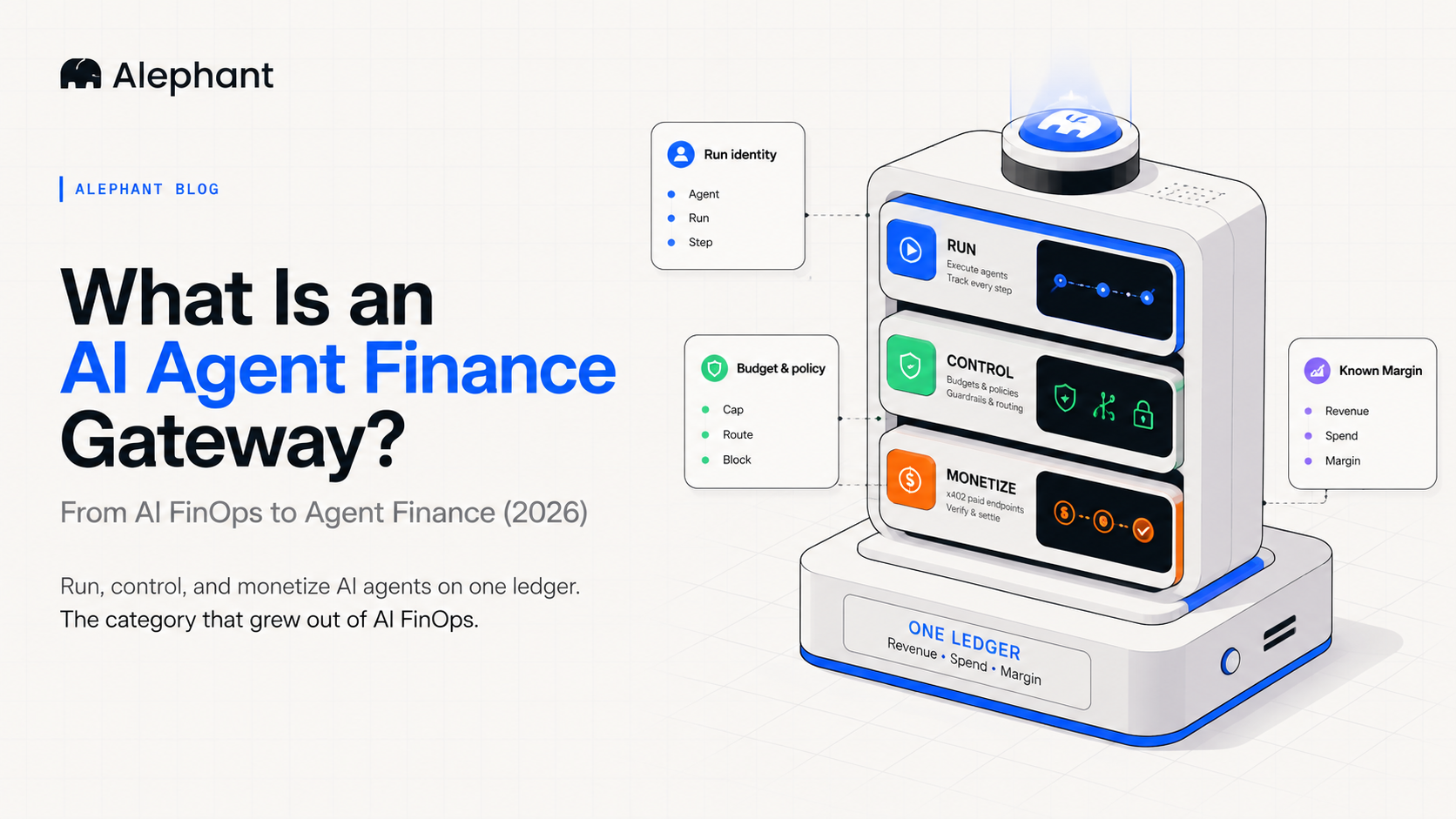
A definitional reference for engineering, finance, and platform teams running AI agents in production.
In 2024 the conversation about AI cost was about model prices. In 2025 it became a discipline with a name: AI FinOps, the practice of attributing and controlling what your AI calls spend. By 2026 that discipline is nearly universal. The FinOps Foundation's State of FinOps 2026 report puts it at 98% of FinOps practitioners now managing AI spend, up from 31% two years earlier (confirmed in the Linux Foundation announcement, 1,192 respondents).
Then the workload changed underneath the discipline. The thing spending the money is no longer a feature calling an API a few times. It is an agent: a loop that plans, calls tools, retries, and sometimes earns revenue of its own. Controlling what an agent spends is half the problem. The other half is tracking what it earns, and putting both on one ledger.
That is the layer this post defines: the AI Agent Finance Gateway. What it is, how it grew out of AI FinOps, how it differs from a plain AI gateway, and what the three lanes (run, control, monetize) actually contain.
TL;DR
An AI Agent Finance Gateway is a control layer between AI agents and model or API providers that runs every agent call, enforces what each run is allowed to spend, and monetizes the agent's output through paid endpoints, with revenue, model spend, and per-run margin tracked on one ledger. It is the category that AI FinOps grew into. An AI FinOps gateway answers "what did this cost, and can I cap it." An agent finance gateway adds two things neither a router nor a cost dashboard has: run-level financial identity (which agent, which run, which step, which tool call) and a money-in layer (per-call payment verified before the request is routed). The same proxy that stops an agent from overspending also records what the agent brought in.
What is an AI Agent Finance Gateway?
An AI Agent Finance Gateway is a request-path layer that sits between your AI agents and the model and API providers they call. Every call an agent makes passes through it. On the way through, the gateway does three jobs at once: it carries run identity (which agent, which run, which step, which tool call made the call), it enforces what that run is allowed to spend before the provider ever sees it, and (for agents that sell their output) it verifies payment before the work runs.
Each of those jobs already exists in a partial form. An AI FinOps gateway added real-time cost control, but at the level of a request tagged by feature or customer, not a run. An agent gateway added run identity, but no money layer. The finance gateway is the first to carry run identity, spend control, and a money-in layer together, all attributed to the same agent run. The category label Alephant uses for the whole layer: run, control, and monetize agents with financial control.
The reason this is a distinct category and not a feature bolt-on is that all three jobs need the same piece of context, the agent run. Cost control tagged to a request cannot tell you which agent in a multi-step loop overspent. Run identity without a spend control cannot stop it. And neither one, on its own, knows whether a given agent run made money or lost it. The finance gateway is the layer where run identity, spend control, and payment meet on one record.
From AI FinOps to agent finance: what changed
AI FinOps was the right frame for 2024 to 2025, when the cost problem was a feature making too many API calls. The four-pillar practice (visibility, optimization, governance, unit economics) and the AI FinOps gateway that enforced it in real time solved the runaway-bill problem. That work is not obsolete. It is the control half of the new category.
What changed is that agents do two things a feature never did. They run as multi-step loops, so cost has to follow a run across many calls instead of tagging a single request. And some of them now charge for their work, so the gateway that used to only watch money going out also has to watch money coming in.
| Dimension | AI FinOps Gateway (2024 to 2025) | AI Agent Finance Gateway (2026) |
|---|---|---|
| Unit of attribution | A request, tagged by feature or customer | An agent run: agent, run, step, tool call |
| Money direction | Money out (provider spend) | Money out and money in (paid endpoints) |
| Primary question | "What did this cost, and can I cap it?" | "Did this agent run make money or lose it?" |
| Control trigger | Budget cap on spend | Budget cap on spend, plus payment verified before run |
| Headline metric | Cost per feature or customer | Known Margin: revenue minus model and tool spend, per run |
The bridge is literal: keep the cost-control practice, then add run identity and a money-in layer on top. A team already running AI FinOps has done the harder half. Agent finance is the same gateway position with a P&L attached.
AI gateway, agent gateway, agent finance gateway
These three terms get used interchangeably, and they are not the same layer.
- AI gateway routes requests across providers and tracks usage. Examples: Portkey, LiteLLM, Cloudflare AI Gateway.
- Agent gateway is built for multi-step, multi-call agent workflows. It understands run identity, agent attribution, and tool-call chains across a whole agent lifecycle, not just one request.
- Agent finance gateway adds the money layer: budgets enforced before execution, paid endpoints with payment verified before routing, and per-run P&L.
Each layer is a superset of the one before it. You can run an AI gateway with no concept of an agent. You can run an agent gateway with no way to charge for an agent's output. The finance gateway is the layer where spend control and revenue meet.
The three lanes: run, control, monetize
The category resolves into three lanes. Alephant's architecture is one implementation; the lanes themselves are vendor-neutral.
RUN
The agent or workflow calls the gateway through a scoped Virtual Key. The gateway applies model routing (send each call to the cheapest model that can answer it), executes the tool call, and writes a run trace. The agent gateway layer carries the run identity (agent, run, step, tool, graph) through every hop and strips its internal headers before the call reaches the provider.
CONTROL
This is the AI FinOps practice, folded in. Before a call reaches a provider, agent policy validation checks it against policy, a budget, and guardrails. If the run is over budget or out of policy, the gateway blocks it, downgrades the model, or routes it for approval. A budget circuit breaker enforces hard caps that stop the next request rather than emailing you after the spend. Intelligent model routing alone delivers 30 to 70% cost reduction on mixed workloads (Avengers-Pro routing research).
MONETIZE
The lane that did not exist in the FinOps era. An agent, workflow, or API is published as a paid endpoint with a per-call price. When a buyer calls it, an x402 payment sidecar issues a payment challenge, verifies payment, and only then routes the request. Settlement runs through payment rails, so the agent itself never holds a wallet. What lands on the ledger is Known Margin.
The money layer: x402 and Known Margin
Two concepts make the monetize lane concrete.
x402 is a payment protocol that verifies per-call payment at the HTTP layer, named after HTTP status 402 (Payment Required). A buyer calling a paid endpoint receives a payment challenge; the payment is verified on-chain, and the request is only routed after payment is confirmed, with no SDK required on the buyer's side. x402 is an open standard (originated by Coinbase); Alephant's contribution is the gateway-side implementation through its payment sidecar and rails-intermediated settlement.
Known Margin is the per-agent P&L: agent revenue minus model spend minus tool and API spend, tracked per run. It is called "known" because it counts the costs the gateway actually meters (model and tool calls through the proxy), not a modeled estimate. A named formula like this is what turns "the agent is busy" into "the agent cleared $0.42 on a $0.07 run."
Where Alephant fits
Alephant is an open-source AI Agent Finance Gateway, built in Rust and released under GPL v3. It is publicly accessible: the gateway runs at ai.alephant.io/v1 as a hosted service, and it self-hosts from the public repository. The design choices that place it in this category rather than the AI-gateway one:
- BYO-KEY: provider keys stay in the customer's workspace, encrypted at rest, never reused by the gateway. Alephant Credits is an alternative funding path for teams that prefer not to attach their own keys.
- Run-level attribution: cost and revenue are attributed per agent, run, step, and tool call, not just per request.
- Alephant Rails: agents hold no wallets; the rails sign and settle, and the seller sees a settlement, not the agent's identity.
- Known Margin: per-run P&L is a first-class metric, not a report you assemble after the fact.
Routing and observability tools record what an agent did. A finance gateway sits in the request path, so it can also enforce a budget before the call and verify payment before the work, and it joins both to the run on one ledger.
FAQ
What is an AI Agent Finance Gateway in one sentence?
An AI Agent Finance Gateway is a control layer between AI agents and model or API providers that runs every agent call, enforces what each run is allowed to spend, and monetizes the agent's output through paid endpoints, tracking revenue, model spend, and per-run margin on one ledger.
How is an AI Agent Finance Gateway different from an AI gateway?
An AI gateway routes requests across providers and tracks usage. An AI Agent Finance Gateway adds two layers an AI gateway has no concept of: run-level financial identity (cost and revenue attributed per agent run, step, and tool call) and a money-in layer (paid endpoints with per-call payment verified before routing). Spend control and revenue meet on one ledger.
Is "agent finance gateway" the same as "AI FinOps"?
No, it is the category AI FinOps grew into. AI FinOps is the cost-control discipline: attribute, optimize, and govern what AI calls spend. An AI Agent Finance Gateway keeps that control practice as one of three lanes (control) and adds two more: running agents with run-level identity, and monetizing them through paid endpoints. AI FinOps watches money going out; agent finance watches money going out and coming in.
What is x402, and why does it matter for agents?
x402 is a payment protocol that verifies per-call payment at the HTTP layer, named after HTTP status 402 (Payment Required). It lets an autonomous buyer pay for a single API or agent call without a subscription or a stored card: the endpoint returns a payment challenge, the payment is verified, and only then is the request routed. It matters for agents because it is how an agent's output can be sold per call to other agents, which is the revenue side of agent economics.
What is Known Margin?
Known Margin is the per-agent profit and loss: agent revenue minus model spend minus tool and API spend, tracked per run. It is "known" because it is built from the costs the gateway actually meters, not a modeled estimate. It is the headline metric of an AI Agent Finance Gateway because it answers the one question cost dashboards and routers both miss: did this agent run make money?
Do I need an AI Agent Finance Gateway if I already do AI FinOps?
If your AI workload is still feature-shaped (a few API calls per request, no agent loops, no selling of output), an AI FinOps practice covers it. The agent finance layer earns its place when you run multi-step agents whose cost has to be attributed across a run, or when you want to charge for an agent's output. You keep the FinOps control practice and add run identity and a monetization lane on top.
Is Alephant available now?
Yes. Alephant is publicly accessible and open-source under GPL v3. The hosted gateway runs at ai.alephant.io/v1, and it can be self-hosted from the public repository. Pricing starts at a free tier, and the run, control, and monetize lanes described here are live as of 2026-06-17.
Sources
- FinOps Foundation, State of FinOps 2026 Report (data.finops.org) and the Linux Foundation announcement: 98% of practitioners manage AI spend, up from 31% two years earlier.
- Avengers-Pro routing research, arxiv 2508.12631: 30 to 70% model-routing cost reduction on mixed workloads.
- alephant.io product surface as of 2026-06-17: the run, control, and monetize lanes, the x402 payment sidecar, payment rails, and Known Margin.
Related reading
- What Is AI FinOps? The 2026 Definitive Guide: the cost-control discipline this category grew out of.
- How to Control AI Agent Cost Per Run and Session in 2026: the control lane in depth.