
Tencent Hy3 API Guide: Run the New Agent Model
Learn what Tencent Hy3 changes for AI agents, compare it with Hy3 Preview, and call Hy3 through one OpenAI-compatible OpenModels API.

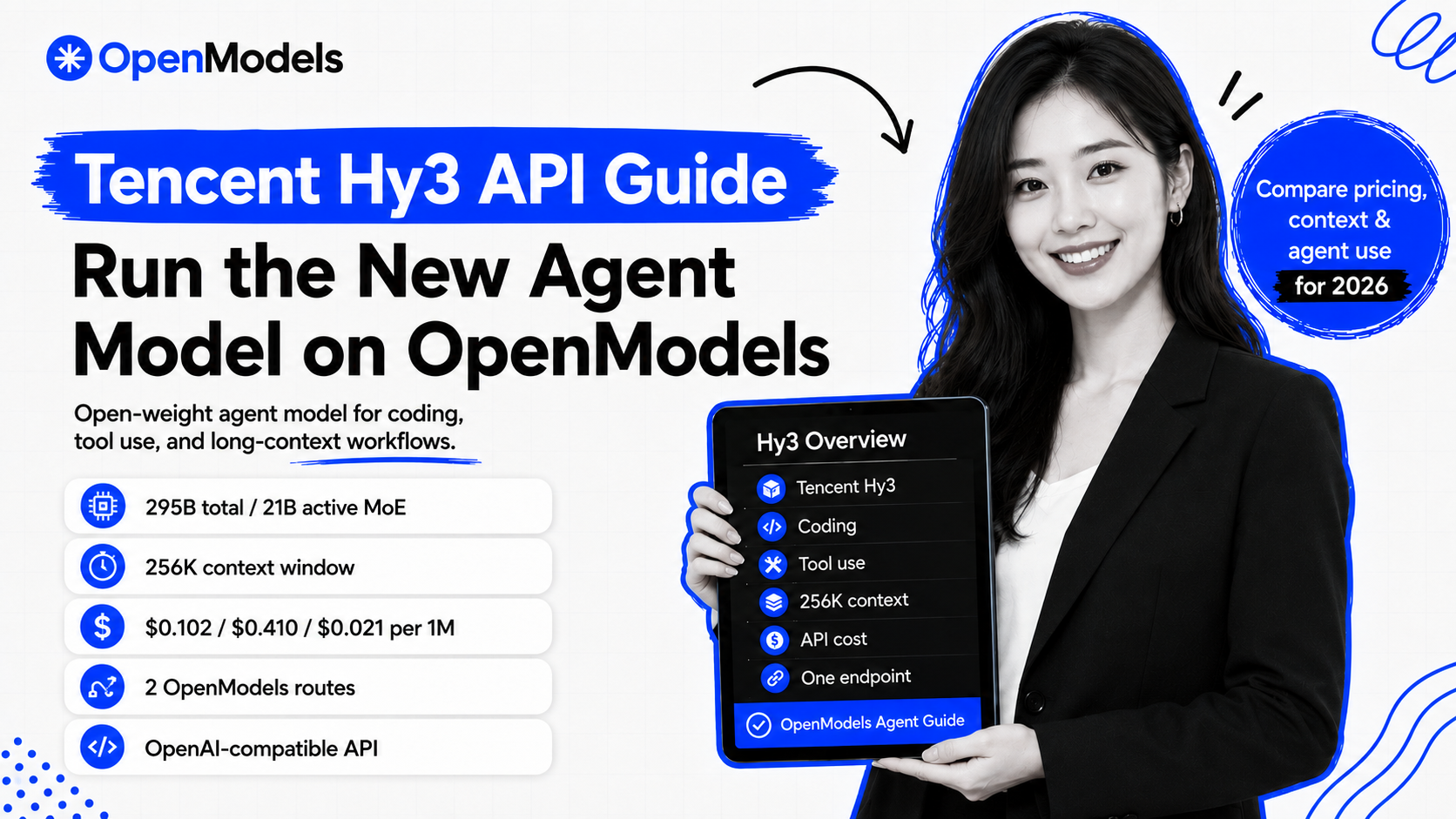
By the OpenModels team. Hy3 is now available in our marketplace through one OpenAI-compatible API. This guide explains what changed from Hy3 Preview, what the final model is designed to do, and how to test it without operating an eight-GPU deployment.
TL;DR: What Is Hy3 and How Can You Use Its API?
Hy3 is Tencent's open-weight, agent-focused Mixture-of-Experts language model. It has 295 billion total parameters, activates 21 billion per token, and supports a 256K-token context window. On OpenModels, use the model ID hy3 with the standard OpenAI chat-completions format. Our catalog currently shows two Hy3 routes, with displayed pricing of $0.102 per 1M input tokens, $0.410 per 1M output tokens, and $0.021 per 1M cached tokens.
That makes the final Hy3 especially timely for developers testing coding agents, tool use, long-running research, document workflows, and structured task execution.
| Hy3 fact | Current value |
|---|---|
| Developer | Tencent Hy Team |
| Architecture | Mixture of Experts |
| Total / active parameters | 295B / 21B |
| Context window | 256K tokens |
| License | Apache 2.0 |
| OpenModels model ID | hy3 |
| OpenModels routes | 2 |
| Displayed OpenModels price | $0.102 input / $0.410 output / $0.021 cache per 1M tokens |
| Best first evaluation | Tool-calling and multi-step agent tasks |
Data note:
Prices and route availability can change. Check the live OpenModels model page before estimating production cost or committing traffic.
Why Hy3 Is a Hot Model for Agent Developers
Hy3 matters because Tencent optimized the final release around agent reliability, not only benchmark scores. The official model card says post-training was expanded after feedback from more than 50 product teams. Tencent also reports adoption in products covering coding, file operations, office work, search, and task execution.
The strongest public evidence is unusually specific:
- In a blind evaluation by 270 experts using real work tasks, Tencent reports Hy3 scoring 2.67 out of 4, versus 2.51 for GLM-5.1.
- Across CodeBuddy, Cline, and KiloCode scaffolds, Tencent reports less than four percentage points of variation on SWE-bench Verified.
- In Tencent's internal evaluations, hallucination rate fell from 12.5% to 5.4% between the tested baselines.
- Commonsense error rate fell from 25.4% to 12.7%.
- Multi-turn issue rate fell from 17.4% to 7.9%.
- The official Hugging Face model card reports a 78 score on SWE-bench Verified and 57.9 on SWE-bench Pro.
These are vendor-reported or model-card results, not our own independent benchmark. They make Hy3 worth testing; they do not prove it will beat every larger model on every workload.
Hy3 vs Hy3 Preview: What Changed?
The final model keeps the preview's core 295B-total, 21B-active MoE design and 256K context window. The meaningful change is post-training and product reliability.
| Area | Hy3 Preview | Final Hy3 |
|---|---|---|
| Status | Early public release | Official production-oriented release |
| Architecture | 295B MoE, 21B active | 295B MoE, 21B active |
| Context | 256K | 256K |
| Training feedback | Initial launch | Feedback from 50+ product teams |
| Main emphasis | Agent capability and efficiency | Stability, tool calls, output formats, recovery, and long conversations |
| OpenModels displayed input | $0.123 / 1M | $0.102 / 1M |
| OpenModels displayed output | $0.410 / 1M | $0.410 / 1M |
| OpenModels displayed cache | $0.034 / 1M | $0.021 / 1M |
| OpenModels routes | 1 | 2 |
Based on our displayed catalog values, the final model cuts input price by about 17% and cache-read price by about 38% versus Hy3 Preview, while adding a second route. Output price is unchanged. This is the clearest reason to start new tests on hy3, not hy3-preview.
How to Call Hy3 Through OpenModels
OpenModels gives you a hosted route, so you do not need to download roughly 295B parameters or operate Tencent's recommended eight-GPU serving configuration.
Python quickstart
from openai import OpenAI

client = OpenAI(
    base_url="https://api.getopenmodels.com/v1",
    api_key="YOUR_OPENMODELS_API_KEY",
)

response = client.chat.completions.create(
    model="hy3",
    messages=[
        {
            "role": "system",
            "content": "You are a careful coding agent. State assumptions and return a test plan.",
        },
        {
            "role": "user",
            "content": "Find likely race conditions in this job queue design.",
        },
    ],
    temperature=0.9,
    top_p=1.0,
)

print(response.choices[0].message.content)
cURL quickstart
curl https://api.getopenmodels.com/v1/chat/completions \
  -H "Authorization: Bearer $OM_API_KEY" \
  -H "Content-Type: application/json" \
  -d '{
    "model": "hy3",
    "messages": [
      {"role": "user", "content": "Create a migration plan and list rollback checks."}
    ],
    "temperature": 0.9,
    "top_p": 1.0
  }'
Tencent recommends temperature=0.9 and top_p=1.0 for the official model. Start there, then evaluate consistency on your own task set. Confirm which optional reasoning controls the selected hosted route exposes before depending on provider-specific request fields.
When Should You Choose Hy3?
Choose Hy3 when your application needs several of these traits at once:
- Repeated tool calls. The final release specifically targets stable tool calls, output constraints, and recovery after errors.
- Long-running agents. A 256K context window gives agents room for plans, tool results, and multi-turn constraints.
- Coding plus operations. Tencent highlights frontend development, CI/CD, data and storage, file management, and diagnostics.
- Open weights. Apache 2.0 weights support self-hosting when your hardware, privacy requirements, and operations budget justify it.
- A low-cost hosted test. OpenModels lets you validate the model through one API key before investing in an eight-GPU deployment.
Hy3 is not automatically the best choice for every coding request. A specialized coding model may win on repository edits, while a model with a 1M-token window may fit exceptionally large context. The right test is a representative agent loop, not a single prompt.
A Five-Test Hy3 Evaluation Plan
Use the same evaluation setup and scoring rules for Hy3 and your current model:
| Test | What to measure | Failure signal |
|---|---|---|
| Tool selection | Correct tool and arguments across 50 calls | Wrong tool, malformed JSON, invented field |
| Recovery | Completion after 10 injected tool errors | Repeats call or abandons task |
| Long-task memory | Constraint retention after 25+ steps | Drops an early requirement |
| Coding agent | Tests passed on 20 real issues | Plausible patch that fails tests |
| Cost | Input, cache, output, and retry spend | Cheap tokens offset by excess retries |
Do not copy a public leaderboard verdict into production. Record task success, tool-call validity, retry count, latency, and total cost per successful job. This reveals whether Hy3's agent focus creates value in your system.
Hy3 on OpenModels vs Self-Hosting
| Choose OpenModels when... | Choose self-hosting when... |
|---|---|
| You want to test Hy3 immediately | You need full infrastructure control |
| You prefer usage-based token billing | Utilization can justify dedicated GPUs |
| One OpenAI-compatible key is useful | Requests cannot leave your environment |
| You want visible route and cache pricing | You can operate vLLM or SGLang at scale |
| You do not want an eight-GPU serving stack | Your team can tune kernels, quantization, and capacity |
The two paths are complementary. Start with hosted evaluation, measure demand, and self-host only if control or sustained utilization makes the infrastructure worthwhile.
FAQ
What is Tencent Hy3?
Tencent Hy3 is an Apache-2.0, open-weight language model designed for reasoning, coding, tool use, and multi-step agents. It uses a Mixture-of-Experts architecture with 295B total parameters, 21B active parameters, and a 256K-token context window.
Is Hy3 the same as Hunyuan 3?
Yes. Tencent uses Hy internationally for the model family known as Hunyuan in China. The final Hy3 language model should not be confused with Hunyuan3D or HunyuanImage, which are separate 3D and image-generation model families.
Is there a Hy3 API?
Yes. OpenModels exposes Hy3 through an OpenAI-compatible chat-completions API using the model ID hy3. Tencent also documents self-hosted OpenAI-compatible serving through vLLM and SGLang.
How much does the Hy3 API cost on OpenModels?
Our current displayed route costs $0.102 per 1M input tokens, $0.410 per 1M output tokens, and $0.021 per 1M cached tokens. The catalog lists two routes. Prices and availability can change, so check the live model page before production use.
Is Hy3 good for AI agents?
Hy3 is explicitly trained for agent workloads, including tool use, coding, search, file operations, and multi-turn task execution. Tencent reports stronger tool-call stability and lower error rates in the final model. Run your own agent evaluation before replacing a production model.
The Bottom Line
Hy3 is one of the most relevant new open-weight models for agent developers because its final release targets the failures that break real workflows: invalid tool calls, weak error recovery, constraint drift, and unreliable structured output.
With OpenModels, you can call hy3 through the same OpenAI-compatible client used for other models, compare two available routes, and pay for the tokens used. Start with the five-test evaluation above. If Hy3 improves successful-job cost rather than just raw token price, it has earned a place in your agent stack.
Sources
- Tencent Hy3 official model card: architecture, license, context, evaluation results, recommended parameters, and deployment guidance.
- Tencent Hy3 launch announcement: release status, product adoption, and agent positioning.
- vLLM Hy3 recipe: supported serving setup, tool parser, reasoning modes, and GPU configurations.
- OpenModels marketplace catalog: route count and displayed Hy3 and Hy3 Preview pricing checked at publication.