
How to Cut Kimi K3, Grok 4.5, and Claude Opus API Costs in 2026: A 6-Step Playbook
Same tokens, $200 to $500 depending on which levers you pull. The frontier-cost playbook for Kimi K3, Grok 4.5, and Claude Opus: price the work, match the task, cache, route behind one API, then cap the spend.

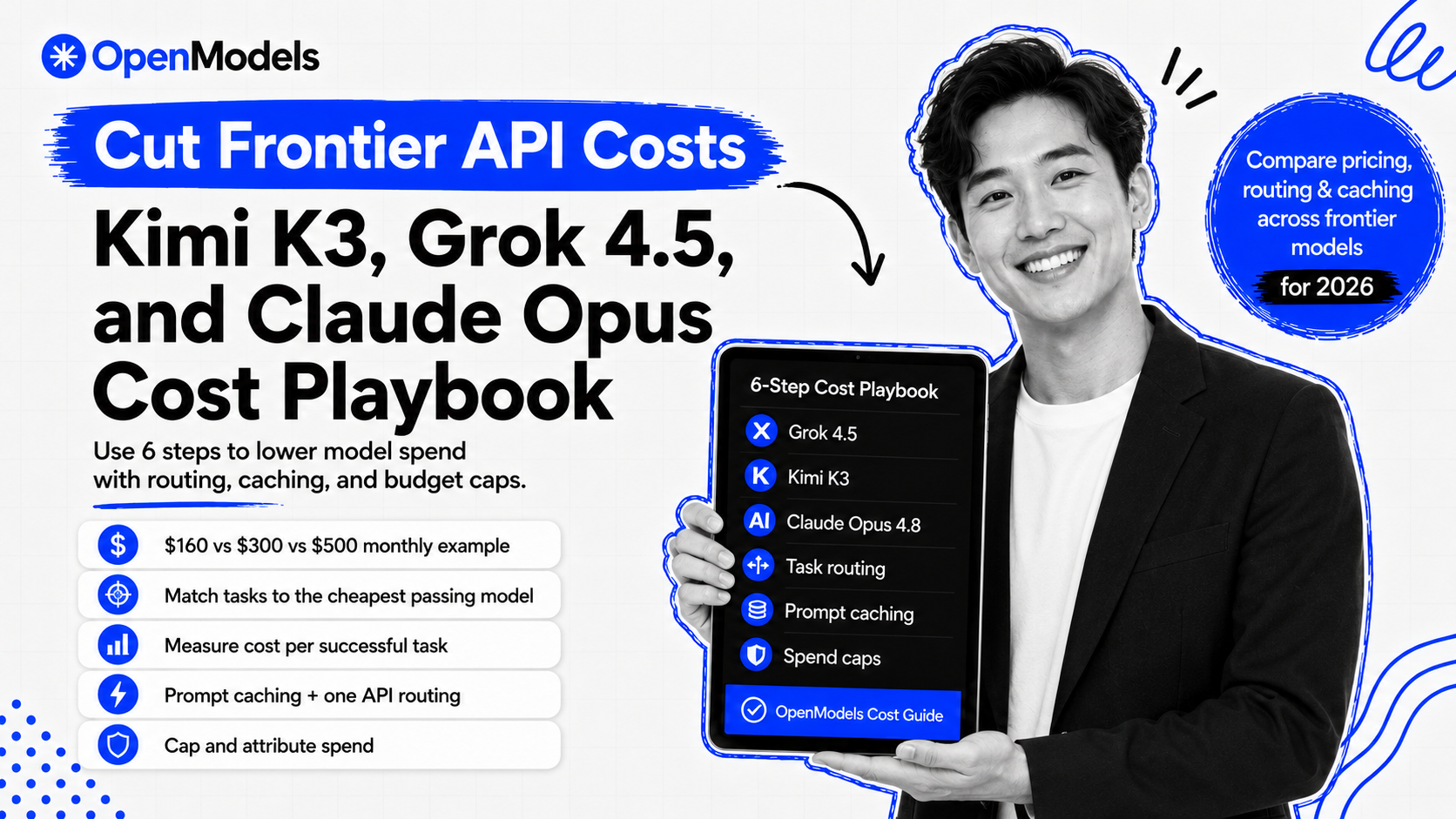
By the OpenModels team. OpenModels is an open marketplace for LLM tokens, and we sell access to the models in this guide, so treat the routing advice as interested. The token prices and benchmark figures below are first-party and independently sourced, dated, and linked. For "which model is smarter," see our companion piece, Kimi K3 vs Claude Opus; this guide is only about paying less to use them.
TL;DR: How Do You Cut Frontier-Model API Costs?
Stop paying flagship prices for work a near-flagship model finishes. In July 2026 the price of near-frontier intelligence collapsed: Grok 4.5 lists at $2/$6 per 1M tokens and Kimi K3 at $3/$15, while Claude Opus 4.8 lists at $5/$25, yet all three sit within about three points of each other on the Artificial Analysis Intelligence Index. The method is six steps: price the work from list rates, match each task to the cheapest model that passes your tests, measure cost per successful task instead of token price, turn on prompt caching, route all three behind one API, then cap and attribute the spend.
The mistake is treating "use the best model" as a pricing strategy. At production volume the gap between a $2/$6 model and a $5/$25 model is the difference between a $160 and a $500 monthly bill for the same token count. This guide turns that gap into a repeatable procedure.
Why Frontier-Model Cost Is the 2026 Story
Three near-frontier models launched inside about eight days in July 2026: Grok 4.5 (xAI, July 8), Kimi K3 (Moonshot AI, July 16), and the wider GPT-5.6 family, landing on top of Claude Opus 4.8 (Anthropic, May 28). Artificial Analysis reported that six labs now have a model scoring above 50 on its Intelligence Index, up from two in early June, and that "the price of near-frontier intelligence has collapsed."
That collapse is uneven, which is exactly why cost engineering matters. Here is the cost-and-capability profile of the three models this guide covers, plus the current index leader (Claude Fable 5) as the ceiling reference. These are inputs to the method below, not a ranking we are asking you to adopt.
| Model | First-party list price (input / output per 1M) | Context | AA Intelligence Index | Reported cost per task |
|---|---|---|---|---|
| Grok 4.5 (xAI) | $2 / $6 | 500K | 53.83 | not published by AA |
| Kimi K3 (Moonshot AI) | $3 / $15 (cache-hit input $0.30) | 1M | 57.11 | ~$0.94 |
| Claude Opus 4.8 (Anthropic) | $5 / $25 | 1M | 55.69 | ~$1.80 |
| Claude Fable 5 (ceiling reference) | see vendor pricing | 1M | 59.86 | not shown here |
Read the middle two rows together. Kimi K3 scores above Opus 4.8 on the index while listing cheaper on input, and Grok 4.5 gives up roughly two index points to Opus for 40% of the input price and 24% of the output price. The headline is not "which model wins." It is that near-frontier quality is now available at a fraction of flagship price, so paying flagship rates by default is a choice you are making, usually without measuring it.
Step 1: Price the Work From List Rates, Not Vibes
Before choosing a model, put a number on the workload. Pick a representative month of traffic in input and output tokens, then multiply by each model's list price. Here is a worked example at 50M input and 10M output tokens per month, using first-party list prices only. (Marketplace routes can undercut these; we handle that in Step 5, and we deliberately keep them out of this table because a mis-stated route price produces a confidently wrong bill.)
| Model | Input cost | Output cost | Monthly total |
|---|---|---|---|
| Grok 4.5 ($2 / $6) | 50M x $2 = $100 | 10M x $6 = $60 | $160 |
| Kimi K3 ($3 / $15) | 50M x $3 = $150 | 10M x $15 = $150 | $300 |
| Claude Opus 4.8 ($5 / $25) | 50M x $5 = $250 | 10M x $25 = $250 | $500 |
Same token count, a 3.1x spread. The arithmetic is deliberately simple so you can rebuild it with your own volumes: monthly cost = (input tokens x input rate) + (output tokens x output rate). Do this before you argue about benchmarks. The benchmark difference between these models is small; the price difference is not.
Step 2: Match Each Task to the Cheapest Model That Passes
Route by task, not by reputation. The practical rule: send each job to the least expensive model that still passes your acceptance tests, and reserve the flagship for the jobs that actually fail on cheaper models.
A workable default split for a mixed workload:
- High-volume, well-specified work (classification, extraction, routine drafting, first-pass code): a $2/$6-class model such as Grok 4.5. This is usually most of your token volume, so it is where price matters most.
- Long-context and agentic coding (repository work, multi-step plans, frontend generation): Kimi K3, which carries a 1M-token context window and led Arena's blind Frontend Code evaluation at launch.
- The hard 10% (ambiguous reasoning, high-failure-cost decisions, final review): Claude Opus 4.8, used deliberately rather than by habit.
The savings come from the mix. If Opus handled 100% of your traffic at $500/month and you move 70% of it to a $2/$6 model, your blended bill drops toward $260/month for the same work, assuming the cheaper model passes on that traffic. It only counts as a saving if it passes, which is Step 3.
Step 3: Measure Cost Per Successful Task, Not Token Price
Token price is the sticker; cost per successful task is what you actually pay. A model with a low token price that needs three retries, a larger prompt, or a correction pass can cost more than a pricier model that succeeds on the first try.
Artificial Analysis measured Kimi K3 at about $0.94 per task across its Intelligence Index suite, close to GPT-5.6 Sol at ~$1.04 and roughly half of Claude Opus 4.8 at ~$1.80. K3 also used about 21% fewer output tokens than the previous Kimi generation while scoring higher, which matters because output tokens are the expensive half of every bill above.
Compute your own version:
Cost per successful task = (total tokens billed across all attempts x rate) / number of tasks that passed review.
Run at least 20 representative tasks per model with identical prompts, tools, and scoring. If a cheaper model's cost per success is not actually lower once retries and failures are counted, it is not cheaper. This single metric prevents the most common frontier-cost mistake: optimizing the number on the pricing page instead of the number on the invoice.
Step 4: Turn On Prompt Caching Before You Switch Anything
Caching is the highest-leverage cost cut that does not change your model choice. Repeated context (system prompts, tool definitions, retrieved documents, code files) is re-billed on every call unless it is cached.
The lever is large. Kimi K3's cache-hit input price is $0.30 per 1M tokens versus $3 on a cache miss, a 10x reduction on input. Apply that to the worked example. If 75% of K3's input tokens are served from cache, the blended input rate becomes (0.25 x $3) + (0.75 x $0.30) = $0.975 per 1M, so input drops from $150 to about $49 and the monthly total falls from $300 to roughly $200, before you change a single model ID.
At the gateway layer this compounds. A gateway like Alephant adds native prompt caching and exact-match caching across providers, and semantic deduplication collapses near-identical requests so you are not paying full price for the same question asked twice. Cache first, then decide whether you still need to switch models at all.
Step 5: Route All Three Behind One API (and Verify Live Prices)
To move traffic between Grok 4.5, Kimi K3, and Claude Opus without three integrations, put them behind one OpenAI-compatible endpoint. On OpenModels all three are reachable by changing the model field, so model switching and fallback are a config change, not a rewrite.
from openai import OpenAI

client = OpenAI(
    base_url="https://api.getopenmodels.com/v1",
    api_key="YOUR_OPENMODELS_API_KEY",
)

# Route by task: cheap model for volume, flagship for the hard 10%.
def answer(task, tier="volume"):
    model = {"volume": "grok-4.5", "agent": "kimi-k3", "hard": "claude-opus-4.8"}[tier]
    return client.chat.completions.create(
        model=model,
        messages=[{"role": "user", "content": task}],
    )
A marketplace also lets provider routes compete on price, which can undercut first-party list rates. But read displayed prices carefully.
⚠️ Displayed "from" prices are starting points, not a single callable route. Marketplace model pages show a "lowest available verified route" figure. The lowest input and lowest output can come from different routes, so the pair is not necessarily one price you can call. Kimi K3's page currently shows from $0.975 input, while its actual verified auto-route (Neolink) is $2.956 input / $14.780 output, roughly 3x the "from" number. Treat marketplace prices as directional, confirm the exact route on the live model page before you budget, and never compute a monthly bill from a composite "from" pair. That is why every number in Step 1 uses first-party list prices.
Routing earns its keep two ways: it lets a cheaper verified route win when one exists, and it gives you an instant fallback when a provider is slow or down, so a single route's latency does not become your outage.
Step 6: Cap and Attribute the Spend
Routing lowers the unit price; guardrails stop the bill from surprising you. Two controls do most of the work.
- A hard cap. A budget circuit breaker enforces a monthly ceiling with escalation at 50/75/90/100%, so a runaway agent loop on a $25-output model cannot quietly spend your quarter. On Alephant this runs at the gateway, in front of every provider, on every request.
- Attribution. Cost attribution breaks spend down by member, agent, and department, so when the bill moves you know which workload and which model moved it. Without attribution, "our AI costs went up" is a mystery; with it, it is a line item you can route or cap.
For teams monetizing agents, per-agent P&L (Known Margin) closes the loop by tracking per-agent revenue minus model and tool spend, so a model choice becomes a margin decision rather than a guess. Cost control is not a separate project from model choice; it is the feedback signal that tells you whether Steps 2 through 5 are working.
Worked Example: The Same Workload, Four Ways
Putting the levers together on the 50M-input / 10M-output month, first-party list prices, so you can see where each step lands:
| Approach | Monthly cost | Lever applied |
|---|---|---|
| Opus 4.8 for everything | $500 | baseline |
| Kimi K3 for everything | $300 | Step 2 (cheaper flagship-class model) |
| Kimi K3 with 75% input cache | ~$200 | Step 4 (caching) |
| Grok 4.5 for the volume 70%, Opus for the hard 10%, Kimi for the agent 20% | ~$220 blended | Steps 2 + 5 (task routing) |
The point is not a single winning row. It is that the same tokens cost between $200 and $500 depending on which levers you pull, and none of the cheap rows require accepting worse output if the task tests pass. Verify the routing row against your own acceptance rates before trusting it.
FAQ
Which is cheaper: Kimi K3, Grok 4.5, or Claude Opus?
By first-party list price, Grok 4.5 is cheapest at $2 input and $6 output per 1M tokens, Kimi K3 is next at $3 and $15 (with a $0.30 cache-hit input rate), and Claude Opus 4.8 is the most expensive at $5 and $25. At 50M input and 10M output tokens per month that is roughly $160, $300, and $500 respectively. Cost per successful task can reorder this once retries are counted, so test on your own workload.
How do I lower my Claude Opus API bill without losing quality?
Move the traffic that a near-frontier model passes (usually the majority) to a cheaper model, keep Opus for the failing minority, turn on prompt caching for repeated context, and put a hard budget cap in front of every request. Measure cost per successful task, not token price, so you only keep a switch that actually holds quality.
Does routing between models actually save money?
Yes, when it is driven by task tests rather than defaults. Sending high-volume, well-specified work to a $2/$6 model and reserving a $5/$25 model for the hard cases can cut a blended bill by roughly half, because most token volume is routine. Routing also provides fallback, so one provider's latency does not become your outage.
How much can prompt caching cut Kimi K3 costs?
Kimi K3's cache-hit input price is $0.30 per 1M tokens versus $3 on a miss, a 10x reduction on input. If 75% of input tokens hit cache, the blended input rate falls to about $0.975 per 1M, which in the worked example lowers the monthly bill from $300 to roughly $200 with no change in model or output quality.
Can I use Kimi K3, Grok 4.5, and Opus through one API?
Yes. Through an OpenAI-compatible marketplace like OpenModels, all three are reachable from one base URL and API key by changing the model field, so switching and fallback are a config change rather than three separate integrations.
What is "cost per successful task" and why does it matter more than token price?
It is total tokens billed across every attempt, times the rate, divided by the number of tasks that passed review. It matters because a low token price loses its advantage if the model needs retries, larger prompts, or a correction pass. A pricier model that succeeds first try can be cheaper per finished job.
The Bottom Line
Frontier and near-frontier model prices spread more than 3x for output that lands within a handful of index points, which makes cost an engineering variable, not a fixed cost. The method is not "buy the cheapest model." It is: price the work from list rates, match each task to the cheapest model that passes your tests, measure cost per successful task, cache repeated context, route everything behind one API while verifying live prices, then cap and attribute the spend. Run those six steps and the same workload that costs $500 on a flagship model routinely lands closer to $200, without accepting worse results on the tasks that matter.
Sources
- Artificial Analysis: Kimi K3 Intelligence Index and cost-per-task (index scores, cost per task, output-token efficiency, "price of near-frontier intelligence has collapsed"): https://artificialanalysis.ai/articles/kimi-k3-achieves-3-in-the-artificial-analysis-intelligence-index-comparable-to-opus-4-8-and-gpt-5-5/
- Tom's Hardware: Moonshot releases 2.8-trillion-parameter Kimi K3 (architecture, first-party API pricing, Frontend Code Arena result): https://www.tomshardware.com/tech-industry/artificial-intelligence/moonshot-releases-2-8-trillion-parameter-kimi-k3
- eesel AI: Grok 4.5 pricing breakdown (API rates, long-context pricing, context window): https://www.eesel.ai/blog/grok-4-5-pricing
- IntuitionLabs: AI API pricing comparison 2026 (cross-vendor list-price comparison): https://intuitionlabs.ai/articles/ai-api-pricing-comparison-grok-gemini-openai-claude
- OpenModels marketplace model pages (Kimi K3, Claude Opus 4.8, Claude Fable 5): displayed lowest-available verified route prices, route counts, and context windows, supplied by the OpenModels team and checked for this draft. Marketplace prices are directional and change; confirm the live model page before budgeting.