
DeepSeek API Migration: Replace deepseek-chat Before July 24
Replace DeepSeek's retiring API aliases, choose V4 Flash or Pro, test thinking-mode behavior, and add a fallback through one OpenModels endpoint.

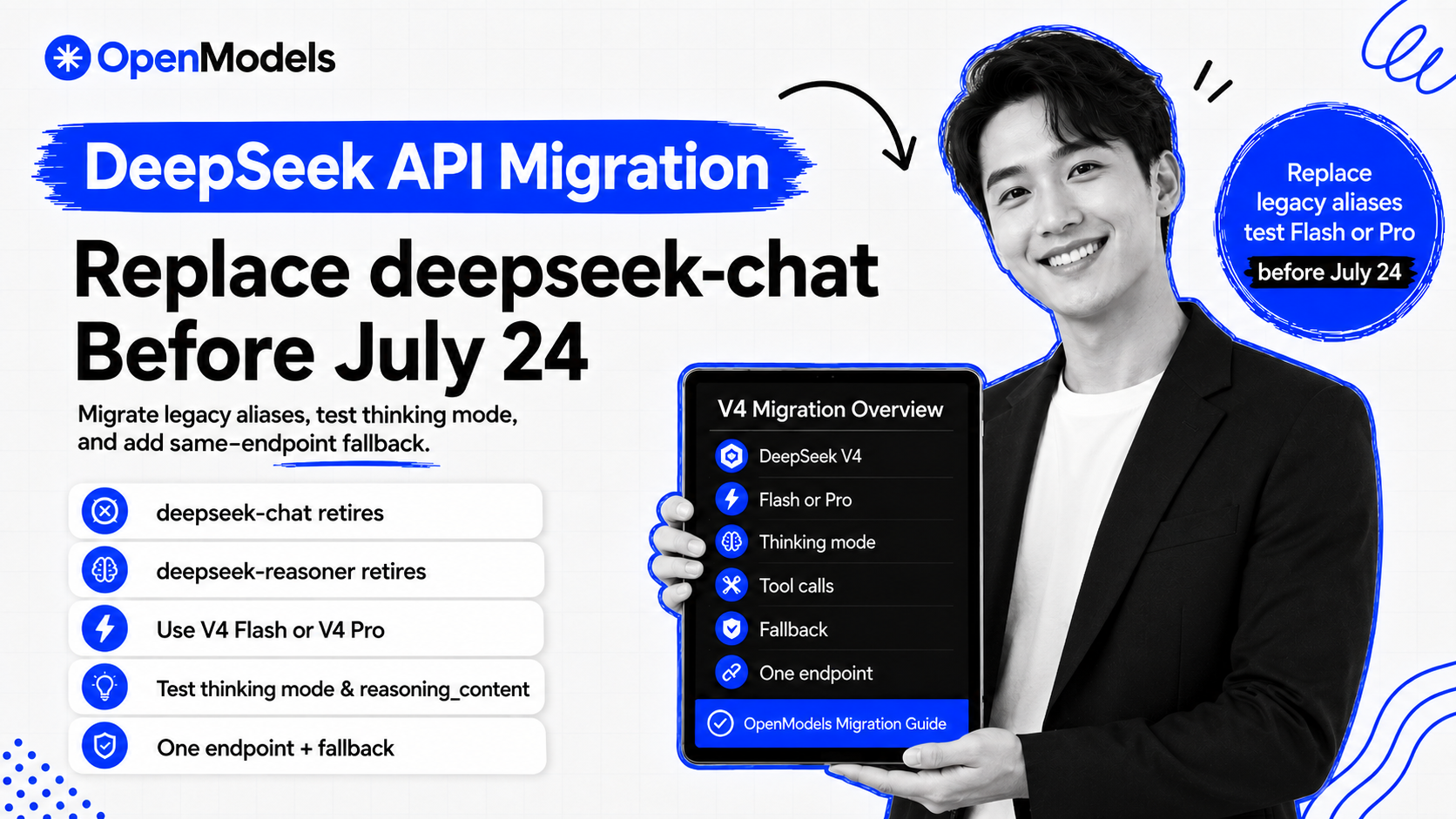
By the OpenModels team. We provide paid access to DeepSeek V4 through our OpenAI-compatible API. DeepSeek specifications and the retirement deadline below come from DeepSeek's official documentation. OpenModels route counts and prices come from our marketplace catalog and can change; check the live model page before production use.
TL;DR: What Must DeepSeek API Users Change?
DeepSeek will discontinue the legacy API model names deepseek-chat and deepseek-reasoner on July 24, 2026, at 15:59 UTC. Replace them with deepseek-v4-flash, or select deepseek-v4-pro when the workload justifies the higher-cost model. Test thinking mode, tool calls, output parsing, latency, and fallback behavior before the deadline.
| Retiring model name | Current behavior | Replacement |
|---|---|---|
deepseek-chat |
V4 Flash in non-thinking mode | deepseek-v4-flash with thinking disabled |
deepseek-reasoner |
V4 Flash in thinking mode | deepseek-v4-flash with thinking enabled |
Changing the model string prevents the immediate break. It does not finish a production migration. Applications also need to verify mode selection, reasoning_content, tool-call history, unsupported sampling controls, and retry behavior.
On OpenModels, deepseek-v4-flash and deepseek-v4-pro are available through the same OpenAI-compatible base URL as other supported models. That lets us keep the DeepSeek migration and a tested cross-model fallback inside one client integration.
DeepSeek V4 Migration Quick Facts
| API fact | V4 Flash | V4 Pro |
|---|---|---|
| Official model ID | deepseek-v4-flash |
deepseek-v4-pro |
| Context length | 1M tokens | 1M tokens |
| Maximum output | 384K tokens | 384K tokens |
| Thinking mode | Enabled or disabled | Enabled or disabled |
| JSON output | Supported | Supported |
| Tool calls | Supported | Supported |
| Official concurrency limit | 2,500 | 500 |
| OpenModels displayed routes | 6 | 6 |
| OpenModels displayed input price | $0.124 / 1M | $1.482 / 1M |
| OpenModels displayed output price | $0.247 / 1M | $2.965 / 1M |
The official DeepSeek prices and OpenModels marketplace prices are different commercial surfaces. Do not mix them in cost calculations. The OpenModels figures above are the displayed marketplace values checked while preparing this article, not permanent quotes.
Why Are deepseek-chat and deepseek-reasoner Being Discontinued?
DeepSeek introduced V4 Flash and V4 Pro as explicit model IDs. During the transition, the older names continued working as compatibility aliases:
deepseek-chatpoints to V4 Flash with thinking disabled.deepseek-reasonerpoints to V4 Flash with thinking enabled.
That compatibility period ends on July 24. The old aliases hide two decisions that production systems should now make explicitly: which V4 model to use and whether thinking mode should be enabled.
An explicit model ID is also easier to operate. Logs, evaluations, alerts, and cost reports can identify the model that actually handled the request instead of recording a moving alias such as deepseek-chat.
A model alias migration is not only a string replacement. It is the point where an application must pin the intended model, reasoning mode, request contract, and failure policy.
Should You Choose DeepSeek V4 Flash or V4 Pro?
Start with V4 Flash when the current application uses either retiring alias. Both aliases already resolve to Flash during the compatibility period, so this is the lowest-risk behavioral starting point.
Choose V4 Flash for high-volume chat, extraction, latency-sensitive paths, routine tool use, and workloads where cost per completed task matters more than maximum model capability.
Evaluate V4 Pro for difficult coding, long multi-step agent tasks, and complex reasoning where better completion quality could reduce retries.
Do not upgrade every request to Pro based on the name. Build a test set of 20 to 50 real tasks, then compare accepted-result rate, latency, tokens, retries, and cost per successful task.
Replace the Legacy Model Name in Python
from openai import OpenAI

client = OpenAI(
    api_key="YOUR_DEEPSEEK_API_KEY",
    base_url="https://api.deepseek.com",
)

response = client.chat.completions.create(
    model="deepseek-v4-flash",
    messages=[
        {
            "role": "user",
            "content": "Return three migration risks as JSON.",
        }
    ],
)

print(response.choices[0].message.content)
Search configuration files, database records, environment variables, agent presets, evaluation scripts, and customer-level overrides for both retiring strings. Updating one source file is not enough if a model ID is also stored outside the application.
Select Thinking Mode Explicitly
DeepSeek V4 supports thinking and non-thinking modes. DeepSeek documents thinking as enabled by default and accepts the OpenAI-format toggle through extra_body.
response = client.chat.completions.create(
    model="deepseek-v4-flash",
    messages=[
        {
            "role": "user",
            "content": "Review this deployment plan and identify hidden dependencies.",
        }
    ],
    reasoning_effort="high",
    extra_body={"thinking": {"type": "enabled"}},
)

answer = response.choices[0].message.content
reasoning = response.choices[0].message.reasoning_content
Test these differences:
- Thinking mode returns reasoning separately in
reasoning_content. temperature,top_p,presence_penalty, andfrequency_penaltyhave no effect in thinking mode.- A tool-calling turn in thinking mode must preserve the assistant's
reasoning_content. - Losing the required reasoning history during a tool loop can produce a
400response.
Do not expose private reasoning text to end users by accident.
Migrate to DeepSeek V4 Through OpenModels
import os
from openai import OpenAI

client = OpenAI(
    api_key=os.environ["OM_API_KEY"],
    base_url="https://api.getopenmodels.com/v1",
)

response = client.chat.completions.create(
    model="deepseek-v4-flash",
    messages=[
        {
            "role": "system",
            "content": "Return concise, testable migration advice.",
        },
        {
            "role": "user",
            "content": "List the checks required before renaming an API model in production.",
        },
    ],
    max_tokens=800,
)

print(response.choices[0].message.content)
Our marketplace currently displays six routes for deepseek-v4-flash and six for deepseek-v4-pro. Model and route availability can change, so copy the exact model ID from the live catalog and verify the selected route's optional-parameter support.
OpenModels does not make an untested model interchangeable. The advantage is operational: one key, one OpenAI-compatible endpoint, and one client can address supported models. Your application still owns model selection, evaluation, fallback triggers, and output validation.
Add a Same-Endpoint Fallback
from openai import (
    APIConnectionError,
    APITimeoutError,
    InternalServerError,
    RateLimitError,
)

RETRYABLE_ERRORS = (
    APIConnectionError,
    APITimeoutError,
    InternalServerError,
    RateLimitError,
)

def complete_with_fallback(messages):
    candidates = [
        "deepseek-v4-flash",
        "YOUR_TESTED_FALLBACK_MODEL_ID",
    ]
    last_error = None

    for model_id in candidates:
        try:
            response = client.chat.completions.create(
                model=model_id,
                messages=messages,
                max_tokens=1200,
                timeout=45.0,
            )
            return model_id, response
        except RETRYABLE_ERRORS as error:
            last_error = error

    raise RuntimeError("All configured models failed") from last_error
Only fall back on failures another model can solve. A different model will not repair an invalid key, malformed request, insufficient balance, broken tool schema, or application bug.
A fallback is production-ready only when the secondary model has passed the primary model's contract tests.
DeepSeek API Migration Checklist
- Inventory every use of
deepseek-chatanddeepseek-reasoner. - Replace the aliases with explicit V4 model IDs.
- Choose Flash or Pro using real workload evaluations.
- Set thinking mode deliberately.
- Update parsers to handle
reasoning_content. - Verify tool loops preserve required assistant history.
- Remove assumptions about sampling parameters in thinking mode.
- Test JSON output, streaming, tools, and multi-turn conversations.
- Set timeouts and bounded retries.
- Add and test a fallback model for critical paths.
- Log requested model, final model, latency, tokens, retries, and request ID.
- Run the production prompt set in staging before switching traffic.
Common Migration Mistakes
| Mistake | Why it fails | Better approach |
|---|---|---|
| Updating one hard-coded string | IDs may also live in runtime configuration | Search code and configuration |
Treating deepseek-reasoner as a separate V4 model |
It maps to Flash thinking mode | Pin Flash and select thinking |
| Switching all traffic to Pro | Higher cost may not improve routine tasks | Route by evaluated workload |
Ignoring reasoning_content in tool loops |
Required history can be lost | Preserve the full assistant message |
| Falling back on every error | Auth and request bugs repeat | Use fallback for transient failures |
| Assuming compatible means identical | Optional parameters differ | Contract-test every candidate |
Frequently Asked Questions
Is deepseek-chat being discontinued?
Yes. DeepSeek says deepseek-chat will be discontinued on July 24, 2026, at 15:59 UTC. It currently maps to the non-thinking mode of deepseek-v4-flash. Replace the alias with an explicit supported model ID and test the request contract before the deadline.
What replaces deepseek-reasoner?
The closest replacement is deepseek-v4-flash with thinking enabled. During the compatibility period, deepseek-reasoner already maps to V4 Flash thinking mode. Explicitly set the model and mode, then verify reasoning content, tools, and multi-turn history.
Is the DeepSeek V4 API OpenAI-compatible?
Yes. DeepSeek V4 Flash and Pro support an OpenAI-format chat-completions API. OpenModels also exposes supported DeepSeek V4 routes through an OpenAI-compatible endpoint. Optional parameters and model behavior still require testing.
Should I migrate to DeepSeek V4 Flash or Pro?
Start with V4 Flash when replacing either retiring alias because both currently map to Flash. Test V4 Pro on difficult coding, reasoning, and agent tasks where a higher accepted-result rate may offset its higher token price.
Can OpenModels provide a DeepSeek API fallback?
OpenModels lets an application call DeepSeek V4 and other supported models through one endpoint and key. Your code can catch retryable errors and resend the request with a tested fallback model ID. This is application-controlled fallback, not automatic switching.
The Bottom Line
The DeepSeek API migration has a fixed deadline but a straightforward first step: replace the two legacy aliases with explicit V4 model IDs. The production work is choosing Flash or Pro, controlling thinking mode, preserving tool-call history, and testing failure behavior.
We recommend using this deadline to make the integration model-portable. On OpenModels, DeepSeek V4 Flash, V4 Pro, and another supported fallback can share one OpenAI-compatible client and key. That reduces the next model change from a vendor integration project to a tested configuration decision.
Explore the OpenModels marketplace, review the OpenModels API documentation, or read our same-endpoint API and fallback implementation guide.
Sources
- DeepSeek official changelog
- DeepSeek official models and pricing
- DeepSeek official thinking-mode guide
- DeepSeek official tool-calling guide
- OpenModels marketplace catalog and API reference, checked while preparing this article.