
What Is AI FinOps? The 2026 Definitive Guide
98% of FinOps teams now manage AI spend, up from 31% in 2024. This is what AI FinOps means in 2026 — definition, four pillars, the gateway layer, and a five-step practice.

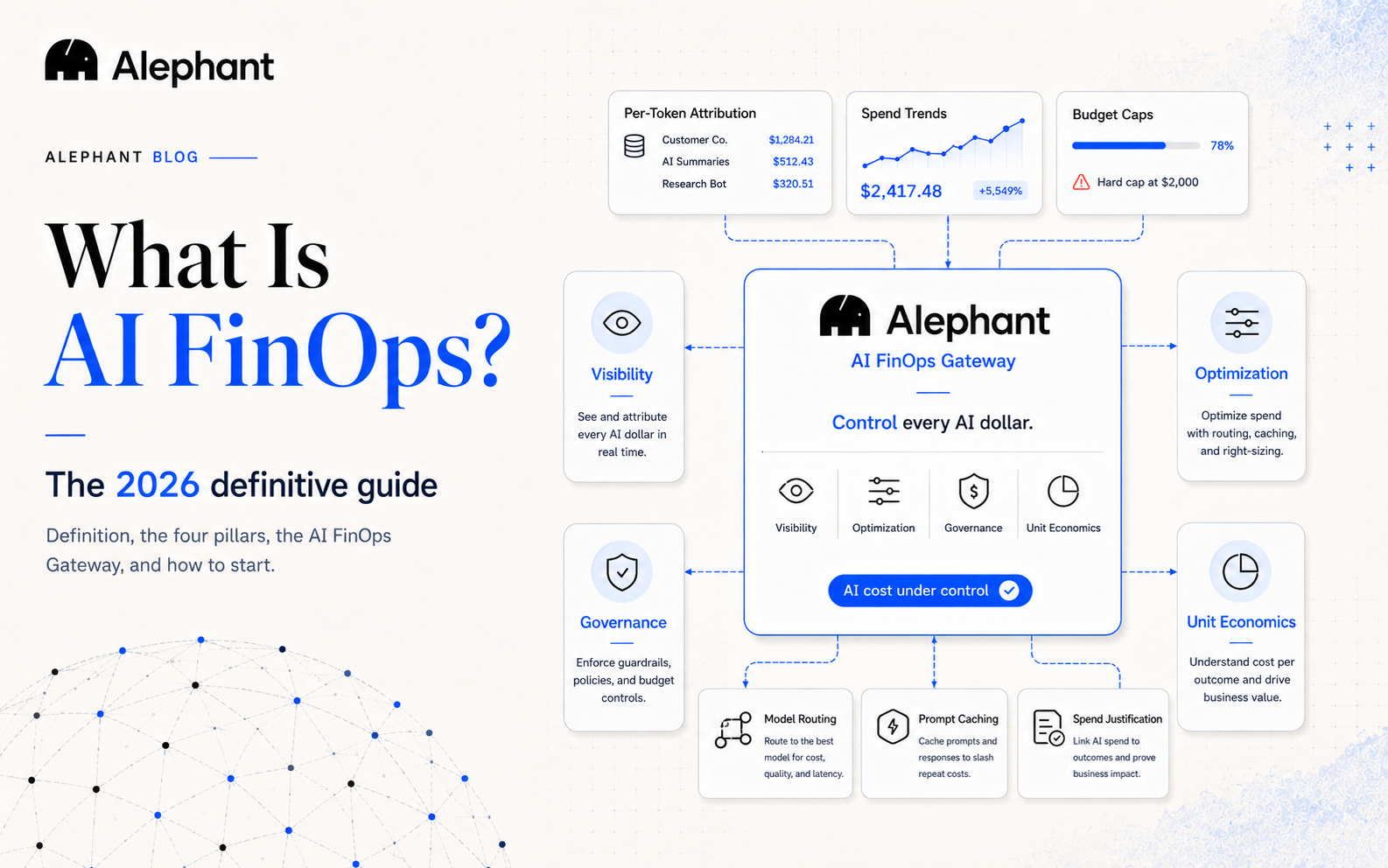
A definitional reference for engineering, finance, and platform teams running AI in production.
The 2024 conversation about AI cost was mostly about model prices. The 2026 conversation is about a discipline. AI FinOps is what that discipline is called, and as of this year almost every FinOps team has it on their plate.
The FinOps Foundation's State of FinOps 2026 report puts the number at 98% of FinOps practitioners now manage AI spend, up from 31% in 2024. Three years, a 3.2× growth multiplier, and a brand-new line item that very few organizations had a vocabulary for in 2023.
This post is the vocabulary. What AI FinOps is, how it differs from cloud FinOps, the four pillars that define a working practice, and where the AI FinOps Gateway fits as the layer that makes the practice operational.
TL;DR
AI FinOps is the practice of controlling, attributing, and optimizing AI infrastructure spend — primarily the cost of LLM API calls, agent loops, and model inference — through real-time enforcement, per-token attribution, and continuous unit-economics measurement. It extends classical FinOps (which governs cloud compute, storage, and network) to a workload class where the cost unit is a token, the bill arrives 24–48 hours after the spend, and a single unattended agent loop can produce a multi-thousand-dollar invoice in a single weekend. The control layer that makes AI FinOps enforceable in real time is the AI FinOps Gateway — a thin proxy between application and provider that meters every call, attributes it to a customer or feature, and can stop, throttle, or route the next request before the provider bill grows.
What is AI FinOps?
AI FinOps is the financial-operations practice for AI infrastructure. It applies the FinOps Foundation's three principles — visibility, optimization, governance — to the workloads that classical FinOps tools were never designed to see: token-metered LLM calls, agentic workflows, vector-database queries, and hosted inference endpoints.
The discipline has three jobs:
- Make every AI dollar attributable to a customer, a feature, a team, an agent, or a single engineer's experiment.
- Make every AI dollar justified by a measurable business outcome, not a model preference.
- Make the next AI dollar enforceable through real-time budget caps, routing, caching, and policy, before the provider bills it.
The first two are reporting problems. The third is an architectural one. That is why most working AI FinOps practices in 2026 sit on top of a request-path control layer, not just a billing dashboard.
AI FinOps vs cloud FinOps: what changed
Cloud FinOps grew up around hourly compute, monthly storage, and reserved-instance commitments. The cost unit was a virtual machine or a gigabyte. The billing arrived in a Cost and Usage Report that you could parse, attribute by tag, and forecast within reason.
AI FinOps inherits the principles but operates on a different cost surface. The structural differences:
| Dimension | Cloud FinOps | AI FinOps |
|---|---|---|
| Cost unit | Compute-hour, GB-month, request | Token (input, cached input, output) |
| Bill latency | Hours to days | 24–48 hours, sometimes longer |
| Volatility | Predictable within a few percent | Order-of-magnitude swings on a single agent loop |
| Attribution dimensions | Service, account, tag | Customer, feature, agent, prompt, model, member |
| Governance lever | Reserved instances, savings plans, rightsizing | Routing, caching, prompt compression, hard caps, Virtual Keys |
| Enforcement window | Daily / monthly | Per-request, in real time |
Three implications follow.
The bill is too late. A 24-hour delay between spend and invoice is fine when an EC2 instance is mis-sized; it is not fine when an autonomous agent is in a retry loop. By the time the alert fires, the damage is invoiced.
Attribution is multi-dimensional. Cloud cost can usually be tagged by team and service. AI cost has to be tagged by customer, by feature, by agent run, by model choice, and by token type. A single AI request answers four or five different attribution questions at once.
The optimization levers are different. You do not "rightsize" an LLM call. You route it to a cheaper model, you cache its prefix, you compress its prompt, or you reject it entirely.
The four pillars of AI FinOps
A working AI FinOps practice rests on four pillars. Removing any one of them collapses the practice into either a reporting exercise or a guessing game.
Pillar 1 — Visibility (per-token, per-request)
Every AI request needs to be observable at the token level. Input tokens, cached input tokens, output tokens, model used, latency, error class, retry count. Aggregating up to per-customer, per-feature, per-agent rollups is the table-stakes layer.
Provider dashboards (the OpenAI Usage page, the Anthropic Console) give you the aggregate view: spend by model, requests over time. They do not know which of your customers drove which row, or which of your features chose which model. That gap is the visibility gap AI FinOps closes.
Pillar 2 — Optimization (cost levers, not vibes)
The 2026 best practice is six concrete cost levers, applied in order of leverage:
- Native prompt caching — when a provider supports cached input pricing (OpenAI, Anthropic, Google), reuse cached prefixes. GPT-5.4 cached input is $0.25 per million tokens versus $2.50 per million standard, a 90% input-token discount with up to 80% latency reduction.
- Gateway exact match — hash-level dedup at the proxy layer. A repeated request returns the cached response in milliseconds at zero token cost.
- Model routing — Model routing can reduce cost when lower-cost models handle simpler requests and frontier models are reserved for harder ones. In Avengers-Pro routing research, the framework matched GPT-5-medium performance at 27% lower expense on benchmark tasks, showing why routing is becoming a core AI FinOps lever.
- Prompt compression — strip redundancy before the request leaves your gateway.
- Prompt template caching — version-controlled prompt templates with cache-friendly prefixes.
- Semantic dedup — vector-similarity match for paraphrased queries; bypasses the model call entirely on hit.
These are not all the levers. They are the ones with measurable economic return and concrete implementation surface.
Pillar 3 — Governance (real-time, not retrospective)
Governance is where AI FinOps stops looking like cloud FinOps. The classic governance tools — budgets, alerts, reserved-capacity commitments — were designed for workloads that do not 100x in an hour. AI workloads can.
Real-time governance means three things:
- Hard caps that block the next request, not soft caps that send an email after the spend. The Budget Circuit Breaker pattern.
- Per-member, per-agent, per-customer enforcement through scoped credentials. The Virtual Key pattern.
- Policy-engine layering: rate limits, IP allowlists, model whitelists, time windows, sensitive-info redaction, audit logs. Composable, not one-size-fits-all.
A billing dashboard cannot do any of this. The control surface has to live in the request path.
Pillar 4 — Unit economics (the question nobody else is asking)
The first three pillars answer what you spent and how to spend less. Pillar 4 is the one that converts AI FinOps into a strategic function: was the spend justified?
Unit economics asks: per dollar of AI spend, what business outcome did we get? Per customer, what is our gross margin after AI cost? Per feature, is the model choice still the right one at current volume?
The 2026 framing for this pillar is efficiency scoring — ranking every dollar of spend against whether the call should have happened at all. Alephant's branded surface for it is AI Inside, but the category-level point stands regardless of vendor: this is the layer that turns AI FinOps from a cost-cutting exercise into an input to product pricing decisions.
Why 2024-style FinOps tools cannot do AI FinOps alone
Classical FinOps tools — CloudZero, Finout, Vantage — ingest billing data. They live entirely outside the request path. For cloud workloads with predictable cost dynamics, that is fine; the bill is the source of truth and the optimization happens in capacity planning.
For AI workloads, the bill is the symptom, not the lever. The lever is the request itself. That is why the 2026 architecture for AI FinOps uses two layers, not one:
Application
    ↓
[Proxy: AI FinOps Gateway]   ← real-time enforcement, routing, caching, token telemetry
    ↓
Model Providers (OpenAI, Anthropic, Google, ...)
    ↓
[Billing platform: CloudZero / Finout / Vantage]   ← retrospective unit economics, multi-cloud reporting
    ↑
Token telemetry (via FOCUS 1.2 normalization)
The proxy generates the rich token-level telemetry. The billing platform reconciles it into the broader cloud-cost view. Together they form what the FinOps Foundation calls the enforcement plus reporting stack.
What the AI FinOps stack actually contains in 2026
A production AI FinOps practice has six moving parts. Most teams have two or three; mature teams have all six.
| Layer | Job | Representative tools |
|---|---|---|
| Provider primitives | Project budgets, usage tiers, rate limits | OpenAI Projects, Anthropic Workspaces |
| AI FinOps Gateway | Real-time enforcement, attribution, routing, caching | Alephant, Portkey, LiteLLM, Helicone |
| Observability (LLM-aware) | Tracing, eval, prompt-version diffing | LangSmith, Langfuse, Braintrust |
| Billing-based FinOps | Retrospective cost, unit economics, chargeback | CloudZero, Finout, Vantage |
| Data layer | Token usage warehouse, cost models | Snowflake / BigQuery + custom ETL |
| Practice layer | Policies, runbooks, ICP-aligned cost-to-serve | Internal — owned by FinOps + Engineering |
The middle two rows are the most contested. Observability tools are bolting on cost views; gateways are bolting on tracing. The honest dividing line in 2026: observability tells you what happened, the gateway makes something different happen next.
The role of the AI FinOps Gateway
An AI FinOps Gateway is a request-path control layer between an application and AI providers. It exists because the four pillars above need a common substrate.
What the gateway position enables:
- Pillar 1 (Visibility): every request is metered as it passes through. Per-token, per-customer, per-agent attribution is automatic.
- Pillar 2 (Optimization): caching, routing, and compression happen on the wire, with no application-layer changes.
- Pillar 3 (Governance): budget caps, rate limits, and policy enforcement fire before the request reaches the provider.
- Pillar 4 (Unit economics): the gateway holds the only data plane that joins cost-per-call to business context — customer, feature, agent.
The category did not have a clean name in 2024. By 2026, "AI FinOps Gateway" is the working label for what Alephant, Portkey, Helicone, OpenRouter, and LiteLLM are converging on, with different positioning and different depth in each pillar.
The architectural anchor that distinguishes Alephant in this category is BYO-KEY: the customer's provider keys stay in the customer's workspace, encrypted at rest, never reused by the gateway. AI FinOps without key custody is the configuration most enterprise buyers prefer; it removes the trust ceiling that gateway-as-broker models hit.
How to start an AI FinOps practice
Alephant is building the AI FinOps Gateway for teams that need real-time cost visibility, budget guardrails, and usage attribution across models, users, keys, agents, and sessions.
Join the private beta waitlist at Discord.
Five steps, in order of leverage. Each is independently valuable; together they form a working practice.
1. Inventory the workloads. List every place AI calls are made: production features, internal agents, batch jobs, RAG pipelines, evals. For each, capture the model, expected daily call volume, and current owner.
2. Establish baseline visibility. Before you optimize, you need to see. Turn on provider-level usage reporting (OpenAI Projects, Anthropic Workspaces). For each workload, record month-to-date spend, daily average, and worst-case spike.
3. Put a gateway in the request path for production workloads. This is the step that converts AI FinOps from a reporting exercise into an operational one. The gateway should support cost attribution (per-customer, per-feature, per-agent), native prompt caching, model routing, and a budget circuit breaker pattern. BYO-KEY is preferred for enterprise security postures.
4. Set hard caps before soft alerts. A monthly soft alert is the last line of defense. The first line is a daily hard stop on each agent and a per-customer cap on each customer-facing AI feature. Soft alerts feed the FinOps practice; hard caps protect the business.
5. Move from cost reporting to unit economics. Within 90 days of step 3, the gateway will have enough telemetry to answer: per dollar of AI spend, which customer / feature / cohort generated it, and what business outcome it produced. That data is the input to product pricing, customer-success conversations, and the next quarter's roadmap.
A note on scale: the market is doubling
The reason AI FinOps is the fastest-growing FinOps discipline is straightforward arithmetic. Per industry analyst tracking summarized in 2026 cost-monitoring reports: model API spending doubled from $3.5 billion to $8.4 billion between late 2024 and mid-2025; the enterprise LLM market is projected to reach $71.1 billion by 2034.
A discipline that did not exist three years ago now manages a workload class that is on track to be larger than most companies' current cloud bill. That is why 98% of FinOps teams have it on their plate.
A note on caching: the three layers most posts conflate
A specific point of confusion that comes up in every "what is AI FinOps" conversation: caching is not one thing. It is three.
The 2026 best practice is a three-layer caching stack: exact-match caching (catches identical repeats), semantic caching (catches paraphrased queries via vector similarity), and prompt caching (reduces cost on novel queries with shared prefixes). Together they cover the full spectrum of query patterns.
| Layer | What it catches | What it saves | Where it lives |
|---|---|---|---|
| Exact-match caching | Identical request hash | Both input + output tokens, full latency | Gateway |
| Semantic caching | Paraphrased queries via vector match | Both input + output tokens | Gateway |
| Native prompt caching | Novel queries sharing a prefix | Input tokens (90% discount on cached portion) | Provider, coordinated by gateway |
Most teams ship one layer and assume they are done. The economic difference between one and three is roughly an order of magnitude on cache-friendly workloads.
FAQ
What is AI FinOps in one sentence?
AI FinOps is the practice of controlling, attributing, and optimizing the cost of AI infrastructure — primarily LLM API calls and agent inference — through real-time enforcement, per-token attribution, and continuous unit-economics measurement.
What is the difference between AI FinOps and cloud FinOps?
Cloud FinOps governs compute, storage, and network costs measured in instance-hours and gigabytes, with a 24–48-hour billing latency and predictable per-day volatility. AI FinOps governs token-metered LLM and inference costs where a single autonomous agent loop can swing daily spend by an order of magnitude. Cloud FinOps optimization happens in capacity planning. AI FinOps optimization happens in the request path.
What is an AI FinOps Gateway?
An AI FinOps Gateway is a request-path control layer between an application and AI providers. It meters every call, attributes cost to a customer or feature, applies routing and caching, and can block, throttle, or route the next request before the provider bill grows. Examples include Alephant, Portkey, Helicone, OpenRouter, and LiteLLM.
What are the four pillars of AI FinOps?
Visibility (per-token, per-request observability), Optimization (the six cost levers: caching, dedup, routing, compression, template caching, native prompt caching), Governance (real-time hard caps, virtual keys, policy enforcement), and Unit economics (cost-to-business-outcome, efficiency scoring, spend justification). Removing any one of the four collapses the practice into either reporting or guesswork.
How do I start an AI FinOps practice?
Five steps, in order. Inventory the workloads. Establish baseline visibility through provider-level reporting. Put a gateway in the request path for production workloads. Set hard caps before soft alerts. Move from cost reporting to unit economics within the first 90 days of gateway telemetry.
Is AI FinOps only for large enterprises?
No. Solo developers and small teams hit the same failure modes — runaway agent loops, model overkill, missing attribution — at smaller dollar amounts. The four-pillar structure is the same; the tooling depth scales with spend. A useful baseline at any size: provider-level project budgets, a gateway with hard caps and per-key attribution, and a weekly review.
Where does Alephant fit in this category?
Alephant is an AI FinOps Gateway built around four design choices: BYO-KEY (customer keys never leave the customer's workspace), per-customer / per-feature / per-agent cost attribution in the gateway data plane, six cost levers shipped together rather than one at a time, and AI Inside — efficiency scoring that ranks every dollar of spend against whether the call should have happened.