
How to Control AI Agent Cost Per Run and Session in 2026
A single model call costs cents. A failed agent run with retries, tool calls, and long context does not. The unit of financial control for production agents is the run, then the session. Here is how to bound both.

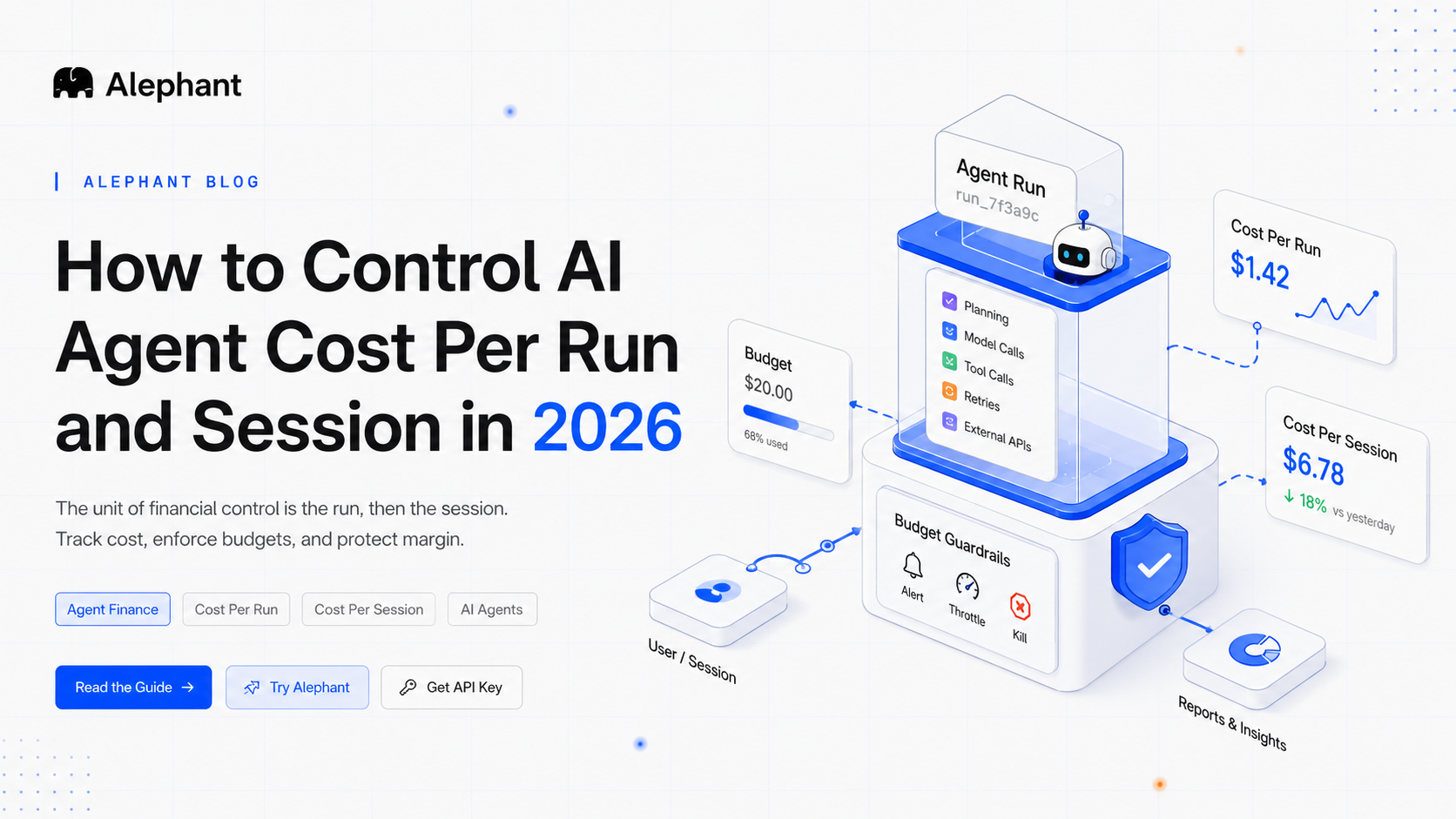
Most AI cost dashboards were designed for a simpler world. A user sends a prompt, a model returns a response, and the platform logs tokens, latency, provider, and price. That is enough for an LLM app. It is not enough for a production agent.
Agents do not answer one request. They run. They plan, call tools, retry, branch, delegate, wait, resume, and sometimes loop. A single agent task can fire many model calls, many tool calls, and several external services before it finishes. That changes the unit of financial control. For a production agent the unit is no longer the request. The unit is the run, and in many products the unit above that is the session.
This guide is for teams running production agents and workflows who need to control cost at the level the agent actually operates. It covers why request-level tracking breaks, the six execution units that matter, why cost per run and cost per session are the operative budgets, and how the AI Agent Finance Gateway layer differs from a plain AI gateway. Everything specific to Alephant maps to its shipped capability surface as of June 2026.
TL;DR. For production AI agents the unit of financial control is the run, not the request. A single model call can cost a cent while a failed run with retries, tool calls, long context, and external APIs runs to dollars. Above the run sits the session (one user, customer, or task context across multiple runs), and a session can lose margin even when every run looks fine. Controlling agent cost means attributing spend to six units (request, run, session, workflow, agent, workspace), making per-run and per-session cost visible, and enforcing budget and policy in the request path. A plain AI Gateway routes model traffic. An Agent Gateway adds run, session, tool, and policy context. An Agent Finance Gateway adds cost per run, cost per session, known margin, and paid-endpoint revenue on top. Alephant ships this layer, open source under GPL v3 at
https://ai.alephant.io/v1.
Why Request-Level Cost Tracking Breaks for Agents
Request-level tracking answers exactly one question: how much did this model call cost? Agent systems need a different set of questions:
- How much did this whole agent run cost?
- Which step created the most cost?
- Did retries push this run over budget?
- Did this session become too expensive for one customer?
- Should this agent be allowed to call this tool again?
- Should this run stop before it spends more?
Those are not token-dashboard questions. They are agent-finance questions. An agent can look cheap at the request level and still be expensive at the run level: one model call costs cents, but a failed run with retries, tool calls, a long context window, and a couple of external APIs becomes expensive fast. The provider invoice confirms it three weeks later, with no breakdown by run, session, or agent.
The macro pressure is real. Per the FinOps Foundation, 98% of FinOps practitioners now manage AI spend in 2026, up from 31% in 2024. The discipline arrived. What most teams still lack is cost control wired around agent execution, not just provider spend.
The Six Units: Request, Run, Session, Workflow, Agent, Workspace
Alephant treats agent cost as a structured execution problem. Six units matter, nested from the model call outward:
| Unit | What it is | Why it matters for cost |
|---|---|---|
| Request | A single model or API call | The level provider dashboards and AI gateways already understand |
| Run | One attempt by an agent to complete a task | Can contain many requests, tool calls, retries, and policy checks |
| Session | A longer interaction for one user, customer, or task context | Can contain many runs; where product margin is won or lost |
| Workflow | A structured automation (n8n, Make, Zapier, LangGraph, CrewAI, custom) | Combines model calls, APIs, and business logic into one billable shape |
| Agent | The named system doing the work | Runs across many sessions, workflows, tools, and endpoints |
| Workspace | The team, customer, account, or environment | Where budget governance spans multiple agents and users |
In Alephant, the Agent Gateway attaches this structure to traffic through an AgentContext (agent, run, step, tool, graph) carried on Alephant-Agent-* headers that are stripped before the request reaches the provider. Cost Attribution then resolves spend along those axes, and the Alephant-Session-Id header groups requests into a session. The unit you want to budget against becomes a dimension you can actually slice.
Why Production Agents Need Cost Per Run
Cost per request tells you what a model call cost. Cost per run tells you whether the agent task was financially reasonable. That is the difference that matters in production.
support_agent.run_1827
  -> llm.request      $0.012
  -> tool.call        customer_lookup
  -> llm.request      $0.018
  -> tool.call        refund_policy_check
  -> llm.request      $0.025
  -> retry            failed tool response
  -> llm.request      $0.031
  -> run.completed

  total run cost:     $0.086
The individual requests look trivial. The run tells the real story, and the retry is half of it. Once a team can see cost per run, the operational questions become answerable: which step drives cost, whether retries blow the budget, whether an expensive model is being used for a low-value task.
Alephant makes the run a first-class object. The Agent Event Log records run, step, tool, and policy events on a pipeline independent from raw LLM request logs, Known Margin computes a per-run profit-and-loss line (agent revenue minus model spend minus tool and API spend), and the pricing meter itself is the Agent Run rather than the token, so the unit you are billed on is the unit you control.
Why Session Cost Matters
Some products do not only need cost per run. They need cost per session: a support conversation, a coding-agent task, a research workflow, a multi-step onboarding. Each run inside it can pass budget while the session still loses money.
session: customer_492_support_session
  run 1  classify issue          $0.018
  run 2  search knowledge base   $0.034
  run 3  draft response          $0.041
  run 4  retry escalation        $0.067
  run 5  summarize outcome       $0.022

  session cost:                  $0.182
If the customer pays $0.10 for that interaction, the session is unprofitable, and no single run looks wrong. Session-level visibility protects product margin before the provider bill surprises you. In Alephant, the Alephant-Session-Id header is what stitches those five runs into one session line, so the loss is visible at the unit where it actually happens.
Cost Control Is Also Policy Control
Agent spend control is only half the problem. The deeper issue is agent activity. The category-level wishlist for a production agent is long: a team may want to cap cost per request, per run, and per session, bound runtime and retries, restrict models and providers, gate tool and endpoint access, and hold workspace and customer budgets. The gateway should be able to answer, in the request path:
Should this agent be allowed to continue this run?
Should this tool be called?
Should this model be used?
Is this session still within budget?
Will this endpoint remain profitable?
Here is the honest mapping to what Alephant enforces today, kept separate from what the category aspires to:
- Budget enforcement. The Budget Circuit Breaker holds monthly and daily budgets with 50/75/90/100% escalation (Pro and above) and a hard stop, plus per-member caps on Team and above. It bounds spend at the budget envelope, not per individual run.
- Loop containment. A 100 RPM always-on Basic Rate Cap runs on every tier, and the Policy Engine's Rate Limit policy throttles or rejects at the per-key, per-agent envelope. This is the floor under an accidental
while True:agent. - Pre-execution policy. Agent Policy Validation checks agent events before they execute and can allow, block, audit, or skip them, with phase-based gating and forged-metadata protection.
- Visibility and margin. Cost Attribution, the Agent Event Log, and Known Margin make per-run and per-session cost and profitability visible and attributable even where a hard per-run dollar cap is not a single toggle. You cannot bound what you cannot see, so visibility is the first control, not an afterthought.
This is why Alephant frames the category as an Agent Finance Gateway, not a cost dashboard. Cost, policy, and execution context belong in the same layer.
AI Gateway vs Agent Gateway vs Agent Finance Gateway
The term "AI Gateway" is overloaded. For many teams an AI gateway handles model traffic: routing, fallback, retries, provider abstraction, token logs, rate limits. That is useful, and it is also where Portkey, OpenRouter, Helicone, and LiteLLM mostly live. Agentic systems need a deeper layer. The three tiers sort cleanly:
| Layer | Understands | Answers |
|---|---|---|
| AI Gateway | Model traffic: routing, fallback, retries, token logs, rate limits | What did this request cost, and which provider served it? |
| Agent Gateway | Agent identity, run and session context, tool calls, workflow steps, agent events, policy decisions | What did this run do, and was it allowed to? |
| Agent Finance Gateway | Everything above plus cost per run, cost per session, cost per workflow, budget policy, known margin, revenue, paid-endpoint monetization | What did this run cost, what did it do, was it allowed, and did it create margin? |
Alephant is built for the third tier. The Agent Gateway layer normalizes events from frameworks (OpenAI Agents SDK, n8n, CrewAI, Mastra, LangGraph) into run, step, tool, and policy events through Agent Framework Adapters, so the finance layer sees a consistent run shape no matter which framework produced it.
Where x402 Fits
x402 (per-call payments for agents, named after the dormant 402 Payment Required HTTP status) matters, but it is not the first problem to solve. Before a team sells an agent capability, it needs to know what the run costs, what the session costs, whether the agent followed policy, and whether the service is profitable. The sequence is one-directional:
control cost
  -> trace runs
  -> enforce policy
  -> understand margin
  -> publish selected capabilities as paid x402 endpoints
x402 handles the payment. Alephant provides the gateway layer around the agent run. When a capability is ready to sell, Paid Endpoints publish it as a per-call service through the x402 Payment Sidecar, revenue lands as Alephant Credits, Alephant Rails settle it so agents never hold wallets, and Known Margin nets revenue against cost per run. The full mechanics live in the companion piece, how to monetize an AI agent. The point here is ordering: monetize last, after the run is controlled.
What Alephant Provides
For production teams, Alephant routes agent and workflow traffic through one gateway and then:
- attaches agent, run, session, workflow, endpoint, and workspace context to every request,
- tracks cost per request, run, session, workflow, agent, and endpoint,
- enforces budget and policy controls in the request path,
- traces agent execution through the Agent Event Log,
- nets revenue and cost into Known Margin per run, and
- publishes selected capabilities as paid x402 endpoints when you are ready.
Imagine a research agent that searches the web, summarizes findings, and writes a report. Without a finance layer, the only artifact is a provider bill that says, for example, $2,813 this month, with no owner. With Alephant the same work resolves to a readable line:
research_agent
  workspace:  growth_team
  session:    competitor_research_2026_06
  run:        report_generation_183

  model cost:              $0.94
  tool cost:               $0.36
  retry cost:              $0.21
  total run cost:          $1.51
  policy:                  passed
  session budget remaining: $18.49
  known margin:            72%
(Those figures are an illustrative example, not measured customer data.) Now the team can decide: use a cheaper model for early research through Smart Routing, cap tool calls, or price this workflow at $5 per successful run and publish it as a paid endpoint. That is the value of controlling the run, not only logging the request.
A note on tiers, because honesty compounds trust: the Free plan ships budget-safety primitives (Set Monthly Budget, Daily Hard Stop, Monthly Spend Alert, the always-on Basic Rate Cap) and 3 paid endpoints. Multi-level Budget Control, Custom Rate Limit, and the AI Inside efficiency-grading layer are Pro and above.
Frequently Asked Questions
What is AI agent cost control?
AI agent cost control is the practice of tracking and limiting cost across agent requests, runs, sessions, workflows, tools, and workspaces, rather than only across model requests. It treats the run (one attempt by an agent to complete a task) as the unit of financial control, because a single agent task fires many model and tool calls. The goal is to prevent runaway spend and to know whether agent work is financially sustainable before the provider invoice arrives.
What is cost per agent run?
Cost per agent run is the total cost created by one agent task from start to finish, including model calls, tool calls, retries, workflow steps, and external services. Individual requests in a run can cost cents while the run totals dollars, especially when retries and long context stack up. It is the operative budget for production agents because it maps cost to a complete unit of work, not to a single call.
What is session cost control?
Session cost control tracks and limits cost across a longer interaction, such as a customer support conversation, a coding-agent task, or a multi-step automation, where the session contains multiple runs. Each run can stay within budget while the session as a whole becomes unprofitable. Session-level limits protect product margin at the unit a customer actually experiences. In Alephant, the Alephant-Session-Id header groups requests into a session.
Why are token dashboards not enough for AI agents?
Token dashboards report model spend per request, but agents need execution context. A single production run may use many model calls, tool calls, retries, and workflow steps, so a per-request log cannot answer what the run cost, which step drove it, or whether the session stayed profitable. Agents need cost attributed to runs, sessions, workflows, and the agent itself, plus policy enforcement in the request path, none of which a token dashboard provides.
What is an Agent Finance Gateway?
An Agent Finance Gateway is infrastructure for controlling cost, policy, execution traces, revenue, and margin across production AI agents and workflows. It sits above a plain AI gateway (which routes model traffic) and an Agent Gateway (which adds run, session, and tool context) by adding cost per run, cost per session, budget policy, known margin, and paid-endpoint monetization. Alephant is an open-source implementation, built in Rust and available at https://ai.alephant.io/v1.
How does Alephant relate to x402?
Alephant can publish selected agents, workflows, skills, or APIs as paid x402 endpoints, but monetization is the last step. The order is control cost, trace runs, enforce policy, understand margin, then publish. x402 handles the per-call payment at the HTTP layer; Alephant provides the gateway, attribution, policy, and Known Margin around the agent run so that what you publish is already controlled and profitable.
The Bottom Line
Production agents need more than model routing. They need financial control around the work they perform. The weak question is how much did this model request cost? The operative question is what did this agent run cost, what did it do, was it allowed, and did it create margin? Answering it requires attributing spend to the run and the session, not just the request, and wiring budget and policy into the request path.
Alephant is the open-source Agent Finance Gateway for production AI agents and workflows. The runtime is publicly accessible at https://ai.alephant.io/v1 since 2026-05-12, with the Rust source under GPL v3 at github.com/AlephantAI/AIephant-AI-Agent-Gateway. The Free tier ships the budget-safety primitives with no credit card; per-run attribution starts on the first call you tag with Alephant-Session-Id. Architecture questions get answered in public in the Alephant Discord.