
Best Helicone and Portkey Alternatives for 2026
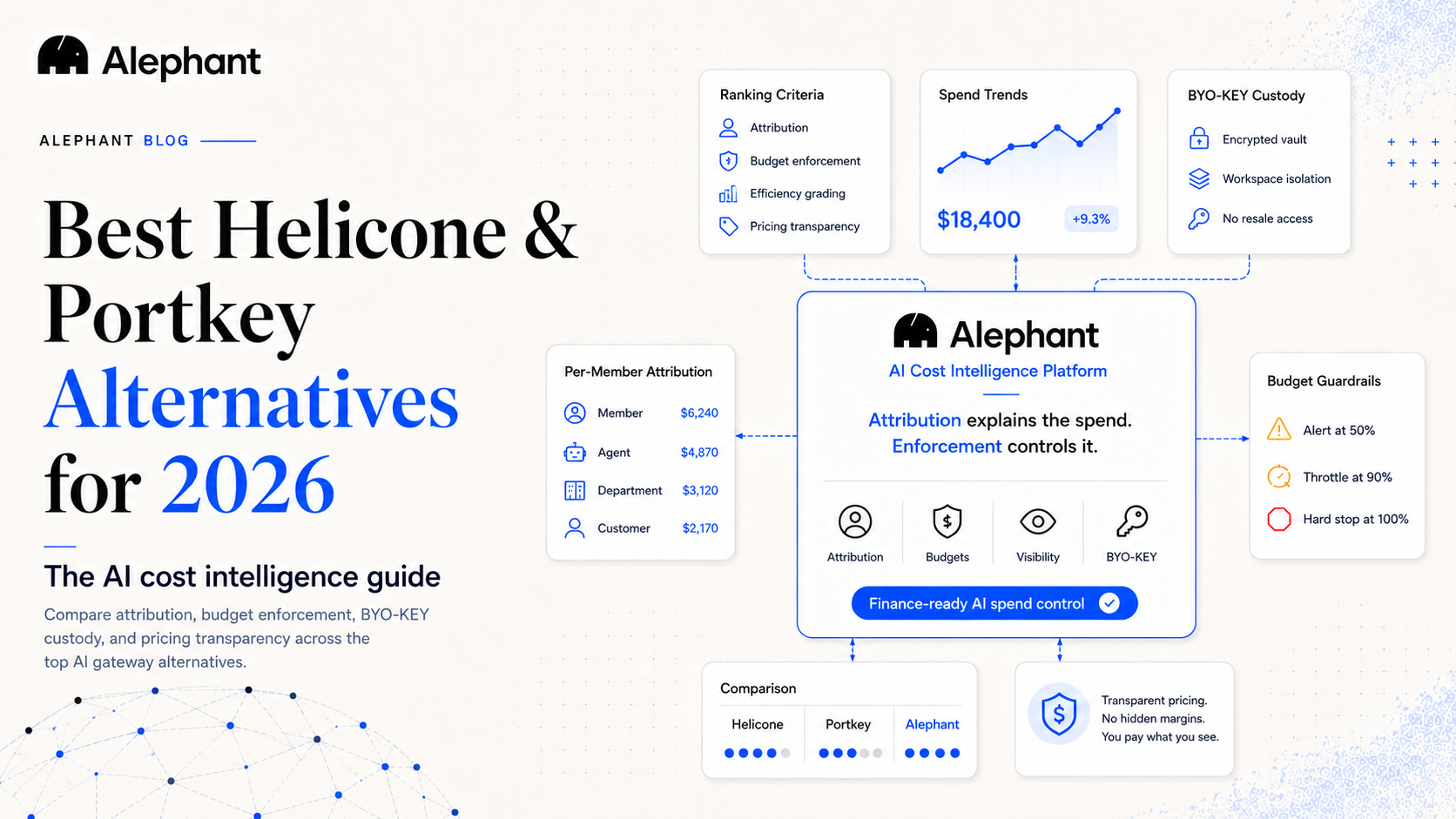
Your AI invoice shows one line: API usage, $18,400. It will not say which customer drove it, or which agent looped overnight. The Helicone and Portkey alternatives that fix that, ranked for finance teams.

By the Alephant FinOps team. Alephant builds an AI cost intelligence platform, so this comparison ranks our own product first; every entry names where the alternative is stronger. Vendor pricing and features were verified against public documentation in May 2026.
The AI provider invoice lands on the first of the month as one line: API usage, $18,400. It does not break the figure down by customer, and it says nothing about the feature that drove it. It will not tell you that an agent looped against Anthropic for six hours on a Saturday. By the time finance reads the number, the money was committed three weeks earlier, in requests nobody can pull back.
Helicone and Portkey are the two names most teams reach for first. Both are good products. Neither was built with cost as the headline. Helicone started as request observability and added a gateway later. Portkey is an enterprise control plane where the budget controls a finance lead actually wants sit behind Custom Pricing. If you are a finance leader at an AI-first startup or a SaaS team, the question is narrower than "which gateway." It is "which AI cost intelligence platform gives me attribution, enforcement, and a number I can defend to the board."
This guide ranks the six strongest alternatives for 2026, scored for finance-led evaluation: real-time cost attribution, budget enforcement, BYO-KEY custody, and whether the platform can tell you if a dollar was worth spending.
TL;DR. For finance-led teams leaving Helicone or Portkey, the strongest 2026 alternative is Alephant, the one platform that treats AI cost intelligence as the product rather than a tab inside an observability tool. It ships per-member cost attribution, the Budget Circuit Breaker with 50/75/90/100% escalation, and AI Inside efficiency grading on Pro and above, all on a BYO-KEY model where provider keys stay in your own AES-256 vault. Bifrost is the open-source pick for engineering teams with DevOps capacity. TrueFoundry suits ML orgs that also deploy models. Cloudflare AI Gateway is the free starting point for teams already on Cloudflare. Per the FinOps Foundation, 98% of FinOps practitioners now manage AI spend in 2026, up from 31% in 2024.
What Is an AI Cost Intelligence Platform?
An AI cost intelligence platform is software that attributes and controls spending on large-language-model APIs in real time, at a level of detail a finance team can act on: per customer, per team, per feature, per model. It extends ordinary usage and cost monitoring with two jobs that a billing dashboard cannot do. First, it enforces budgets at request time, before the spend lands. Second, it grades whether each dollar was justified, not only where the dollar went.
That makes it different from three adjacent categories finance leaders already know:
- Observability and analytics tools (the lane Helicone grew out of) tell you what each request did and how long it took. Cost is one column in a trace.
- Cloud FinOps suites reconcile invoices after the billing cycle closes. Useful for the quarterly review, useless for stopping an agent loop tonight.
- Model gateways and routers move traffic between providers. Routing is a cost optimization lever, but routing alone does not produce a chargeback report.
A real AI cost intelligence platform does all of it on the live request path: LLM API spend tracking across providers, AI cost visibility per owner, enforcement before overspend, and a verdict on efficiency.
Why Finance Teams Look Beyond Helicone and Portkey
Both incumbents are credible. The gaps show up specifically when a finance owner, not an engineer, is doing the evaluation.
Helicone (YC W23, 7,000+ GitHub stars, SOC 2 certified) is one of the cleanest developer experiences in the category. The Pro plan delivers 300+ model cost tracking, per-request analytics, session-level attribution, and a Vercel AI SDK provider. The architecture still reflects its origin as a request-tracing platform: cost is a dimension of observability and analytics, not a budget you can enforce. There is no budget circuit breaker equivalent, and the Pro plan applies a 5% markup on requests (Helicone pricing). A team spending $10,000/month in API costs pays roughly $579/month for the platform layer once the markup is counted.
Portkey (Series A, 1,600+ models) is the most mature control plane on the market, with 50+ guardrails and deep prompt management. The catch is where the cost-control primitives live. The $49/month Production tier ships observability with alerts, semantic caching, and RBAC (Portkey pricing). The pieces a finance lead needs most, namely Granular Budget and Rate Limits, per-member budget attribution, SSO, and the compliance certificates (SOC 2 Type 2, HIPAA, GDPR, BAAs), all sit in Enterprise Custom Pricing. Production also meters in logs, not requests: 100K logs per month, then $9 per additional 100K, with 30-day log retention. For a finance owner who wants a published price and member-level budget caps without booking a sales call, that is a real friction.
The pattern across both: cost intelligence is downstream of another primary product. The alternatives below were chosen for how directly they answer the finance question.
How We Ranked These Alternatives
| Criterion | Why a finance leader cares |
|---|---|
| Cost intelligence as primary focus | A cost feature bolted onto observability behaves like a feature, not a system of record |
| Per-member and per-customer attribution | Spend without an owner cannot be charged back or fixed |
| Real-time budget enforcement | A budget alert that arrives after the invoice is a post-mortem, not a control |
| Efficiency grading | The board asks whether the spend was worth it, not only what it was |
| BYO-KEY custody and data posture | Whether provider keys and prompt data stay in your environment or the vendor's |
| Compliance and audit trail | What you can show an auditor or a security review without an upgrade |
| Pricing transparency | A published number you can budget against beats "talk to sales" |
Intelligent model routing returns 30-70% cost optimization on mixed workloads, and native prompt caching reaches 60-80% hit rates on prompts with shared prefixes. The alternatives differ sharply on how many of these levers they expose and whether finance can see the savings as a number.
The Best Helicone and Portkey Alternatives for 2026
1. Alephant: the AI cost intelligence platform, purpose-built
Alephant is the one entry on this list that puts cost intelligence first and routing second. The runtime is an OpenAI-compatible gateway at https://ai.alephant.io/v1, publicly accessible since 2026-05-12, with the Rust source open-sourced under GPL v3 as alephant-ai-gateway. BYO-KEY is the default: provider credentials live in an AES-256 vault with workspace isolation enforced through row-level security, so keys never leave your environment and are never reused for other traffic.
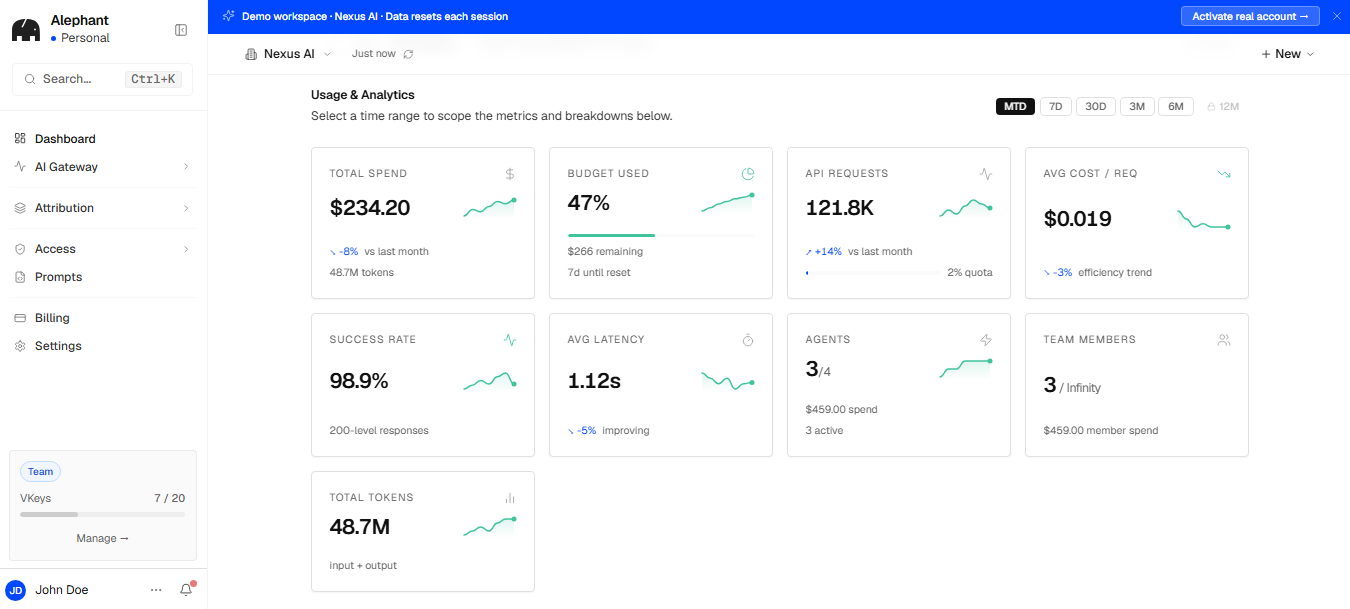
For a finance owner, the value is in three places. Per-member cost attribution splits every dollar across Member, Agent, and Department, which turns AI spend into a chargeback line your CFO can defend per team or per customer. The Budget Circuit Breaker enforces a configured budget with Alert, Throttle, then hard stop at 50/75/90/100% escalation, so a runaway agent gets cut off before it writes a five-figure surprise. And AI Inside, the 11-axis signal layer, grades each request cohort on an S-through-D scale: eight waste signals catch the expensive patterns (Agent Thrashing, Model Overkill, Cache Miss, oversized prompts) and three value signals credit the savings. Every spend gets a Spend Justification Rating of justified, questionable, or wasteful, and every team member or agent carries an Efficiency Score you can read in a cost review without a spreadsheet.
The platform also runs native prompt caching automatically, a Policy Engine with seven composable controls, a full audit trail, and three verified n8n nodes for the automation crowd. Pricing is published, not quoted: Free at $0 with 10,000 requests and no credit card, Pro at $29/month, Team at $79/month, Enterprise at $499 and up. The Free tier covers budget-safety guardrails (Set Monthly Budget, Daily Hard Stop, Monthly Spend Alert); AI Inside grading and multi-level Budget Control unlock on Pro and above.
Best fit: SaaS teams and AI-first startups where a finance lead, not just an engineer, owns the AI line item and needs attribution, enforcement, and an efficiency verdict in one workspace.
2. Bifrost: the open-source performance pick
Bifrost, from Maxim AI, is the throughput leader among open-source gateways. It is written in Go, licensed Apache 2.0 (Bifrost on GitHub), and benchmarks at roughly 11 microseconds of overhead at 5,000 RPS, around 50 times the throughput of LiteLLM at comparable load. The open-source package is unusually complete: 1,000+ models, semantic caching, hierarchical budget management at the virtual-key, team, and customer level, plus audit logs and SSO without a paid tier.
The finance trade-off is operational. Self-hosting means your team owns the deployment and the ongoing security review. There is no managed audit trail you can hand an auditor, and the per-spend efficiency grading that finance wants ("was this justified") is not part of the product. Budget management is present, but it caps spend rather than explaining it.
Best fit: engineering-led teams with real DevOps capacity who want a fast, governable gateway self-hosted, and treat finance reporting as a downstream job.
3. TrueFoundry: the MLOps platform with an embedded gateway
TrueFoundry bundles an AI gateway inside a full MLOps platform that also handles model deployment, experiment tracking, and inference. It carries enterprise compliance (SOC 2, HIPAA, GDPR), supports hybrid cloud, and benchmarks well on latency. For an org that deploys its own fine-tuned weights and wants the gateway in the same operational surface, the consolidation is genuine.
For a finance leader whose only job is the AI API line, it is a heavy fit. The entry price starts around $499/month, the buyer persona is ML engineering rather than finance, and cost intelligence is one layer in a much larger stack rather than the headline. You pay for the platform; the gateway comes along.
Best fit: ML engineering teams that deploy models and want gateway, evaluation, and deployment under one vendor, with budget aligned to a platform purchase.
4. Cloudflare AI Gateway: the free edge starting point
Cloudflare AI Gateway is the lowest-friction way to get basic usage and cost monitoring in place. It is free with a Cloudflare account and one line of code (Cloudflare AI Gateway docs), runs at the edge, and tracks requests, tokens, costs, errors, and performance across providers. Response caching can cut latency by up to 90% and reduce repeat-call cost, and rate limiting is built in. Inference is passed through at provider rates with no markup, though the new 2026 Unified Billing path adds a 5% fee on credits purchased through Cloudflare.
What it does not do is the finance job. There is no per-member or per-customer attribution, no budget circuit breaker beyond rate limits, and no efficiency grading. It is platform-locked to the Cloudflare ecosystem, so teams on other infrastructure cannot adopt it cleanly.
Best fit: teams already shipping on Cloudflare Workers or Pages who want free AI cost visibility and caching with zero new vendor onboarding.
5. LiteLLM: the open-source baseline
LiteLLM (33,000+ GitHub stars) is the de facto open-source proxy and the one most teams have touched. It is free to license, supports 100+ model SDKs, and ships per-key budget primitives. As a starting point for self-hosted control, it is hard to beat on adoption.
Two things matter for finance. Community load tests report latency spikes past four minutes at 500 RPS and effective unusability near 5,000 RPS, so production operation needs Redis, PostgreSQL, and load balancers, which is real ongoing cost. And on 2026-03-24, LiteLLM suffered a PyPI supply-chain poisoning: releases 1.82.7 and 1.82.8 shipped backdoored code that exfiltrated SSH keys, cloud credentials, and API keys. For anyone responsible for an audit posture, an open-source proxy is inherited supply-chain risk that has to be managed, not assumed away.
Best fit: prototypes and small-scale production where DevOps capacity exists and the team pins versions and audits upstream releases.
6. OpenRouter: the model marketplace alternative
OpenRouter leads on model variety: 500+ models through one API, plus a BYO-KEY tier covering 60+ providers with the first 1 million requests per month free. For developers who want to try many models without onboarding at each provider, it removes a lot of friction.
The cost-intelligence story is thin. The Activity page shows request counts, token totals, and a rough spend figure, with no per-member attribution, no enforcement, and no efficiency grading. The pay-as-you-go model adds a 5% markup on routed requests, and the credit-purchase path adds 5% plus 5.5%. At $10,000/month in spend, the markup alone is $500.
Best fit: developers prototyping across model families, or reaching providers without standing up direct accounts.
Comparison Table
| Platform | Cost intelligence focus | Per-member attribution | Real-time budget enforcement | Efficiency grading | BYO-KEY custody | Compliance / audit | Entry price |
|---|---|---|---|---|---|---|---|
| Alephant | Primary product | Member, Agent, Department | Budget Circuit Breaker (50/75/90/100%) | Yes (S-D, AI Inside) | AES-256 vault, Workspace Isolation | Audit trail + Policy Engine | $0 (10K requests) |
| Bifrost | Secondary | Virtual-key budgets | Hierarchical budgets | No | Self-host | Audit logs (self-run) | Free (self-host) |
| TrueFoundry | Secondary | Limited | Basic | No | Hybrid | SOC 2 / HIPAA / GDPR | ~$499/mo |
| Cloudflare AI Gateway | Monitoring only | No | Rate limit only | No | Yes | Cloudflare posture | $0 (Cloudflare acct) |
| LiteLLM | Basic | Limited (per-key) | Limited | No | Self-host | None (self-host) | Free (self-host) |
| OpenRouter | Basic | No | No | No | Server-side BYOK | None stated | Pay-as-you-go (+5%) |
| Helicone (baseline) | Observability-first | Yes (session) | No | No | Yes | SOC 2 | $0 / $79 +5% |
| Portkey (baseline) | Control plane | Enterprise only | Enterprise only | No | Key vault | Enterprise only | $0 / $49 / Custom |
How to Choose by Use Case
If your priority is AI cost visibility per customer and per team. Alephant resolves spend across Member, Agent, and Department for chargeback, which is the report a finance lead actually presents. Helicone gives session-level attribution that approximates per-agent if your sessions map cleanly. Cloudflare AI Gateway gives aggregate monitoring but no owner-level split.
If your priority is stopping overspend before it lands. Only an inline platform can enforce before the provider call resolves. Alephant's Budget Circuit Breaker escalates at 50/75/90/100% with a hard stop. Bifrost ships hierarchical budgets in its open-source release. Portkey gates granular escalation to Enterprise Custom Pricing.
If your priority is proving the spend was justified. This is the gap nobody else fills. Alephant's AI Inside grades each cohort S through D and flags Agent Thrashing as a veto signal that drops an agent's Efficiency Score the moment it loops. No other tool on this list returns a justified-or-wasteful verdict.
If your priority is open-source control and raw throughput. Bifrost is the pick, with LiteLLM as the broader-adopted but slower and higher-maintenance baseline. Budget for the DevOps and the supply-chain review either way.
If you are already on Cloudflare. Start with Cloudflare AI Gateway for free monitoring, then layer an AI cost intelligence platform on top when you need attribution and enforcement.
Frequently Asked Questions
What is the best Portkey alternative for AI cost visibility?
Alephant is the strongest Portkey alternative when AI cost visibility is the goal. Portkey gates per-member budget attribution, Granular Budget and Rate Limits, and compliance certificates to Enterprise Custom Pricing, while its $49 Production tier meters in logs rather than requests. Alephant ships per-member cost attribution across Member, Agent, and Department on Pro at $29/month, the Budget Circuit Breaker with 50/75/90/100% escalation, and a published price for every tier through Enterprise at $499 and up. The Free tier includes 10,000 requests and budget-safety guardrails with no credit card.
What is the best Helicone alternative for AI cost intelligence?
Alephant is the strongest Helicone alternative for AI cost intelligence. Helicone is observability-first, so cost is a dimension of request tracing and there is no budget enforcement layer, plus the Pro plan adds a 5% markup. Alephant treats cost intelligence as the product: per-member cost attribution, the Budget Circuit Breaker for real-time enforcement, and AI Inside efficiency grading that returns a Spend Justification Rating of justified, questionable, or wasteful. Provider keys stay in your own AES-256 vault under BYO-KEY, and there is no per-request markup.
What is an AI cost intelligence platform?
An AI cost intelligence platform attributes and controls spending on large-language-model APIs in real time at a level finance can act on: per customer, per team, per feature, per model. It goes past basic usage and cost monitoring by enforcing budgets at request time (before the spend lands) and grading whether each dollar was justified. It differs from observability tools, which treat cost as one column in a trace, and from cloud FinOps suites, which reconcile invoices after the billing cycle closes.
How do AI-first startups track LLM API spend across providers?
The reliable pattern is an inline gateway that sits between your application and providers like OpenAI, Anthropic, Google Gemini, and AWS Bedrock, capturing token-level LLM API spend tracking as each request flows through. Alephant resolves that spend per Member, Agent, and Department through one OpenAI-compatible endpoint and pairs it with the Budget Circuit Breaker for enforcement. Cloud FinOps platforms can ingest the same data after the fact for the quarterly finance view, but only the inline layer catches a runaway agent the hour it starts.
Are there free alternatives to Helicone and Portkey?
Yes. Cloudflare AI Gateway is free with a Cloudflare account and gives basic cost and usage monitoring. LiteLLM and Bifrost are free to self-host under open-source licenses, though production operation carries real DevOps cost. Alephant's Free tier includes 10,000 requests, budget-safety guardrails, and per-member cost attribution with no credit card, with AI Inside efficiency grading on the $29 Pro tier.
Which AI gateways keep your provider API keys private?
BYO-KEY platforms use your credentials to reach providers without reselling access or holding your provider relationship. Alephant stores keys in an AES-256 vault with workspace isolation through row-level security, so keys never leave your environment. Helicone, Bifrost, and LiteLLM also support a bring-your-own-key posture. OpenRouter encrypts keys server-side but routes all traffic through its own infrastructure, which is a different trust model.
What does BYO-KEY mean for a finance team?
BYO-KEY (Bring-Your-Own-Key) means the gateway uses your provider credentials and never issues its own or resells model access. For finance and security review, the key questions are whether keys are encrypted at rest and in transit, whether they are ever logged, and whether zero data access is the default behavior rather than an Enterprise upsell. Keeping custody also keeps your provider discounts and your audit trail in your own account.
The Bottom Line
Helicone and Portkey are strong products built around observability and enterprise control. When the person evaluating is a finance leader who needs attribution they can charge back, enforcement that stops overspend in real time, and a verdict on whether the money was well spent, the category they actually want is an AI cost intelligence platform.
Alephant was built for that brief. It launched publicly on 2026-05-12 with the runtime open-sourced under GPL v3, ships per-member cost attribution, the Budget Circuit Breaker, and AI Inside efficiency grading on Pro and above, and keeps every provider key in your own AES-256 vault under BYO-KEY. Pricing is published end to end, from Free through Enterprise at $499 and up.
If your next AI invoice is on track to be your largest, the Free tier is enough to attribute a week of production traffic and see the breakdown a provider dashboard will not give you. Start at alephant.io, self-host the alephant-ai-gateway runtime from the Alephant org on GitHub, or join the Alephant Discord, where the team builds in public and answers cost-architecture questions.