
Real-Time LLM Budget Guardrails and Attribution in 2026
The invoice says $14,200. Nobody knows which agent did it. Token-level attribution plus inline policy enforcement is the two-layer architecture that catches LLM spend the second it happens, across every provider.

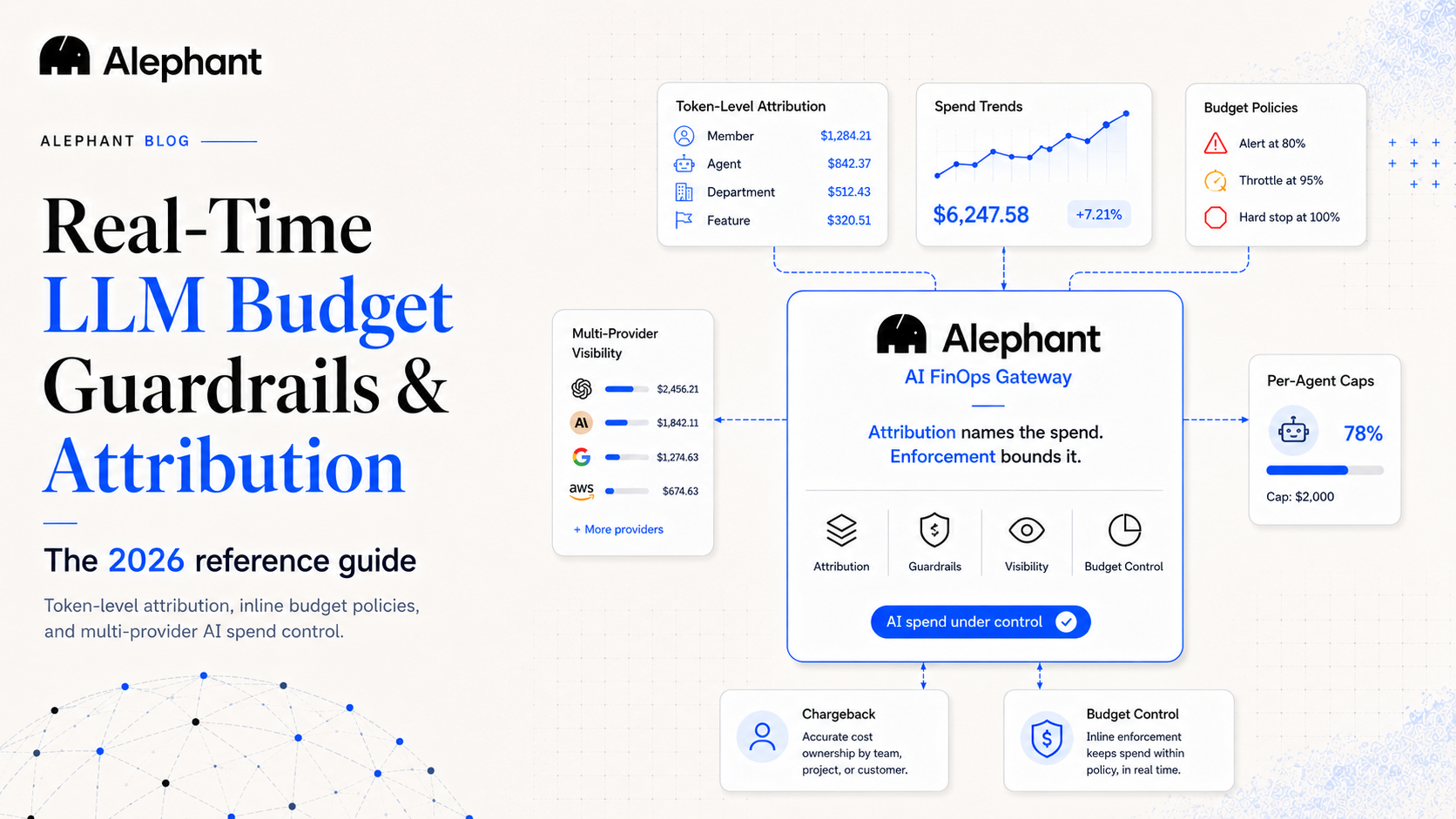
The invoice arrives. It says $14,200. The finance lead asks which agent produced this. The engineering lead asks which product surface. Both look at the same OpenAI dashboard, the same Anthropic dashboard, the same Google Gemini console, and arrive at the same answer: aggregate totals, ownership by guess.
This is the structural reason 2026 LLM spend ran past plan. By the time the bill resolves, the spend is three weeks old, the agent that produced it is still running, and no single person in the org owns the line item. Model API spending doubled from $3.5 billion to $8.4 billion between late 2024 and mid-2025, and 98% of FinOps practitioners now manage AI spend in 2026, up from 31% in 2024 per the FinOps Foundation. CostLayer's 2026 tracking guide puts a sharper edge on the diagnosis: engineering teams using OpenAI, Anthropic, or Google Gemini APIs overspend by 3 to 5 times what they need because nobody can see where the spend is going.
Two missing layers explain the gap. The first is token-level attribution: every request tagged by user, agent, department, and feature at the moment of the call, so spend is owned the second it happens. The second is real-time budget policies: enforceable limits in the request path that warn, throttle, or reject when those attributed slices cross a threshold. Both layers have to sit inline with the request. Provider invoices are post-hoc. Provider dashboards are single-vendor. Billing-platform integrations reconcile against invoices, which means they arrive minutes to hours after the spend they describe.
This guide is the implementation architecture for finance leaders and engineering managers running multi-provider LLM spend in 2026. It covers how the attribution layer works, how the enforcement layer composes with it, and what the end-to-end pattern looks like through Alephant, the open-source AI FinOps Gateway.
TL;DR. Real-time LLM budget control is a two-layer architecture. Attribution tags every request at the token level with four dimensions (Member, Agent, Department, Feature) so you know who spent what within seconds. Enforcement evaluates those attributed slices against budget and rate policies in the request path, then warns, throttles, or rejects in milliseconds. Both layers require inline placement. Provider dashboards cannot do either, billing platforms cannot do real-time, and markup gateways like OpenRouter do not expose per-agent dimensions. The 2026 reference architecture is a multi-provider BYO-KEY proxy with Cost Attribution feeding the Policy Engine and Budget Circuit Breaker inline. Alephant ships this pattern at
https://ai.alephant.io/v1, open source under GPL v3.
What Is Token-Level Attribution?
Token-level attribution is the practice of tagging every LLM API request with ownership metadata (which user, which agent, which department, which feature) at the moment the request is forwarded to a provider, then aggregating spend across those tags in real time. A single response from claude-haiku-4-5 is not one row in a monthly invoice. It is an attributed event with user ID, agent ID, department code, feature flag, prompt tokens, completion tokens, cached tokens, and dollar cost computed at the moment.
Three reasons this is the central layer of multi-provider cost management:
- Aggregate totals do not answer the only question that matters. When spend doubles, the question is never by how much (the dashboard tells you). The question is because of whom (the dashboard does not). A bill with no owner is a number, not a signal.
- Provider keys are shared. Three engineers using the same
OPENAI_API_KEYproduce one invoice line. "Attribution" at the provider layer is whoever copied the key into.env. That is name-the-blame, not cost intelligence. - Cost-justification questions depend on it. "Is this spend worth it?" is a question about a specific agent against a specific job. Without per-agent attribution, the answer is the team's average, which is wrong by construction. Galileo's 2026 observability playbook flags single agent-coordination patterns that produce 4x token overhead and $152 per month of redundant retrieval calls. Both numbers are invisible without entity-level attribution.
The 2026 standard for token-level attribution is four dimensions:
| Dimension | What it tags | How it is set |
|---|---|---|
| Member | An individual engineer or team member | Bound to their Virtual Key (no shared secrets) |
| Agent | An autonomous agent or workflow | Session ID request header, e.g. Alephant-Session-Id |
| Department | A cost center, project, or business unit | Workspace mapping or Department Key Access |
| Feature | A specific product surface or capability | Request tag, e.g. Alephant-Feature: chat |
In Alephant, the Cost Attribution layer issues a per-member Virtual Key (so there is no shared .env secret to attribute by), threads agent runs through the Alephant-Session-Id request header for runtime attribution, maps virtual keys to departments via Department Key Access, and accepts free-form feature tags on each call. Every request resolves to a four-tuple of (Member, Agent, Department, Feature) before it reaches the provider. The dashboard then slices spend along any of the four axes within seconds of the request resolving.
Why Attribution Has to Sit Inline
A common architectural mistake is to bolt attribution onto a billing-based FinOps platform after the fact. The math does not work. The provider returns the response, the billing pipeline ingests usage data minutes to hours later, the FinOps platform applies cost-allocation rules, and the report renders the next day. By then, four things have already gone wrong:
- The agent that produced the spend has either kept running or finished without anyone noticing.
- The session context that would have explained the call is gone from logs.
- The cost has compounded across however many additional requests the same agent made in the interim.
- The team learns the answer after the dollars are spent, not before.
An inline gateway moves attribution to the moment of the call. The request comes in tagged. The response goes out attributed. The dashboard updates within seconds. Any policy that depends on the attribution (per-agent caps, per-member alerts, per-department chargeback) evaluates on live data, not yesterday's data.
This is the architectural property Helicone solves with session attribution, Portkey solves with virtual keys, and Alephant solves with Cost Attribution plus the Alephant-Session-Id header. None of OpenAI's, Anthropic's, or Google Gemini's native dashboards expose any of the four dimensions, because the provider sees one tenant: the customer's account. The customer is the one with four dimensions to tag.
From Attribution to Enforcement: The Policy Engine Handoff
Attribution names the spend. Enforcement bounds it. The two layers compose: attributed slices feed policies that decide what to do when a slice crosses a threshold. There are four enforcement mechanisms in production AI cost management, and every serious deployment uses some combination of them:
| Mechanism | Action | Latency | Best at |
|---|---|---|---|
| Alerts | Notify humans at thresholds (50%, 75%, 90% of budget) | Seconds to minutes | Surfacing drift early |
| Throttling | Auto-reduce request rate when risk is elevated | Real-time | Buying time before a hard stop |
| Hard caps | Reject requests once a budget or quota is hit | Real-time | Bounding worst-case blast radius |
| Rate limits | Cap RPM or TPM per key, per agent, per workspace | Real-time | Stopping agent loops in seconds |
The depth of the enforcement set is treated in detail in 10 Real-Time AI API Budget Guardrails for 2026. What matters for this architecture discussion is the handoff between attribution and enforcement: every policy in the table above takes an attributed slice as its input.
In Alephant, that handoff is wired directly into the Policy Engine and the Budget Circuit Breaker:
- Per-member alerts and caps. Cost Attribution tags requests by Member; the Budget Circuit Breaker fires at 50/75/90/100% of that member's budget; Member Budget Caps (Team tier and above) hard-stop the member's key without affecting anyone else's workflow.
- Per-agent throttle and kill. Cost Attribution tags requests by Agent via the
Alephant-Session-Idheader; the Policy Engine's Rate Limit policy throttles or rejects requests at the per-agent envelope; AI Inside surfaces W3 Agent Thrashing as a veto-level signal that downgrades a runaway agent's Efficiency Score regardless of any other dimension. - Per-department chargeback and time-window. Cost Attribution tags by Department via Department Key Access; the Policy Engine's Time Window policy blocks off-hours bursts on that department's keys; the Chargeback export feeds finance for monthly bill-back.
The composition is the architecture. Attribution is the noun. The Policy Engine is the verb. Together they answer the two questions finance and engineering ask every month: who spent what and what stopped it from being worse.
Multi-Provider Cost Visibility
A 2026 production AI team is rarely on a single provider. The typical stack is OpenAI (frontier and mid-tier), Anthropic (alternative frontier plus prompt caching), Google Gemini (long context), AWS Bedrock (regulated workloads), plus one or two open-weight models from DeepSeek, Meta Llama, or Mistral for cost arbitrage. Each provider ships its own dashboard, its own rate limits, its own billing cycle, its own pricing page, its own concept of a project.
Multi-provider cost visibility is the architectural property where one dashboard, one budget, and one set of policies cover every provider the team calls. The unified view is a function of placement: an inline proxy sees every request to every provider, so the dashboard it renders is unified by construction. A billing-based platform reconciling six provider invoices is unified by import job, which means delayed, fragile, and provider-format-specific.
In Alephant, the unification is the default behavior of Alephant Gateway: the team points the OpenAI-compatible client at https://ai.alephant.io/v1, picks a model from 60+ supported providers, and every request lands in the same Cost Attribution dashboard regardless of which provider eventually served it. A $5,000 monthly cap covers OpenAI plus Anthropic plus Google Gemini plus AWS Bedrock combined, not four separate caps in four separate consoles. The same Budget Circuit Breaker fires on aggregate spend regardless of which model produced the tokens.
This is the architectural difference between Alephant and a markup gateway like OpenRouter. OpenRouter unifies the API surface across providers (one endpoint, one auth) but charges 5% per request and does not expose per-agent dimensions. Alephant unifies the cost surface (attribution plus enforcement) under BYO-KEY (the team keeps its provider relationships and pays no markup) and ships per-member, per-agent, and per-department dimensions natively.
The Stack: Provider-Native vs Gateway vs Billing-Platform
For finance and engineering leaders evaluating a 2026 stack, the architecture sorts cleanly across three layers:
| Capability | Provider-native | Gateway-inline | Billing-platform |
|---|---|---|---|
| Token-level attribution | Aggregate only | Member / Agent / Department / Feature | Project / account level |
| Multi-provider unification | One provider | All providers behind one endpoint | Yes, post-hoc |
| Real-time enforcement | Per-provider only | Yes, in the request path | No (post-invoice) |
| Per-agent dimensions | Not exposed | Yes (Session-Id header) | Not exposed |
| Chargeback export | Not exposed | Yes (FOCUS Standard) | Yes, primary use case |
| Free tier | Yes (limited budget caps) | Yes (Alephant 10,000 requests, no credit card) | Trial only |
The 2026 best-practice stack runs all three layers. Provider-native caps at OpenAI and Anthropic are the outer envelope (free, post-hoc, single-vendor). An inline gateway like Alephant is the operational control plane (real-time, multi-provider, attributed). A billing-platform like Vantage or CloudZero is the finance system of record (cross-cloud unit economics with the FOCUS Standard feed).
Most AI teams trip on the middle layer. They run providers direct, hit the bill, and try to retrofit a billing-platform integration on top. The billing platform reports the spend but cannot prevent the next one, because the telemetry source is the invoice. The fix is to move the control plane inline.
Why AI Teams Struggle Here
This is the diagnostic frame for the cost-management category. Three structural reasons engineering and finance teams underperform on AI API spend in 2026:
- Shared keys hide ownership. A single
OPENAI_API_KEYshared across three engineers, two services, and a notebook is one provider line item. The team owns the spend collectively, which means no one owns it individually. The fix is per-member Virtual Keys issued under BYO-KEY. - Provider dashboards lag. OpenAI and Anthropic update consumption dashboards on minute-to-hour cadences. A runaway agent at $0.06 per call doing 1,000 retries per minute spends $86,400 in 24 hours. The dashboard catches up after the day is over. The fix is inline rate-limit and budget enforcement, evaluated before the next request is forwarded.
- FinOps tooling is post-invoice. Traditional FinOps platforms ingest invoices, apply allocation rules, and produce reports. The latency is days to weeks. For cloud infrastructure where reserved instances and savings plans operate on monthly horizons, that latency is fine. For LLM agents that can blow a month's budget in 24 hours, the latency is the failure mode. The fix is the gateway-inline control plane treated above.
The category vocabulary that solves this in 2026 is AI FinOps: finance discipline ported to AI spend, with the addition of the AI FinOps Gateway layer that traditional FinOps did not need.
Frequently Asked Questions
Which AI cost management platforms support detailed API usage attribution?
The three platforms shipping multi-dimensional, real-time API usage attribution in 2026 are Alephant, Portkey, and Helicone. Alephant ships four dimensions natively (Member, Agent, Department, Feature) through Cost Attribution with the Alephant-Session-Id header for runtime agent grouping, available on every tier including Free. Portkey ships virtual-key attribution and metadata-tag attribution on its Production and Enterprise tiers. Helicone ships session-level attribution that approximates per-agent visibility when sessions map cleanly to agent runs. Billing-based platforms like Vantage and CloudZero aggregate at the project or account level via invoice ingestion, which is sufficient for finance reporting but not for per-agent runtime decisions. OpenRouter does not expose per-agent dimensions.
What is the best Portkey alternative for AI cost visibility?
Alephant is the closest functional alternative for teams that want Portkey's control-plane shape with deeper cost-visibility tooling. Portkey ships virtual keys, request logging, and threshold alerts on its Production tier ($49 per month) and granular per-member escalation on Enterprise (Custom Pricing). Alephant ships Cost Attribution with four dimensions, the Budget Circuit Breaker with 50/75/90/100% escalation, and the AI Inside efficiency-grading layer (S/A/B/C/D grades on an 11-axis signal system) for "is this spend worth it" intelligence that Portkey does not provide. Free tier ships 10,000 requests with no credit card. The Rust runtime is open source under GPL v3 as alephant-ai-gateway for teams that prefer self-host.
What is the best Helicone alternative for AI cost intelligence?
Alephant for teams that want Helicone's observability depth plus enforceable budget policies in one runtime. Helicone's strength is request-level logging and session-based attribution with an open-source backbone. The gap is enforcement: Helicone surfaces cost data, it does not block requests on policy. Alephant ships the same observability primitives (per-request logs, session attribution, dashboards) and adds the Policy Engine with seven composable policies plus the Budget Circuit Breaker that warns, throttles, and rejects requests in the request path. For a team that has Helicone in place and wants the next layer, Alephant runs alongside or replaces it; for a team starting fresh, the unified architecture is the simpler buy.
Why do AI teams struggle to control AI API costs?
Three structural reasons. First, shared provider keys hide ownership: one OPENAI_API_KEY across three engineers is one invoice line, not three. Second, provider dashboards lag by minutes to hours, which is fine for human-paced usage but catastrophic for autonomous agents that can spend $86,400 in 24 hours at $0.06 per call. Third, traditional FinOps tools ingest invoices, which arrive after the spend is locked in. The architectural fix is an inline gateway that issues per-member Virtual Keys, tags every request with four attribution dimensions, and enforces policies in the request path. Alephant is one shipping implementation; Portkey and Helicone are adjacent in the category.
What is the best AI cost management software for engineering teams?
For engineering teams specifically (developer-led, multi-provider, agent-heavy), the 2026 short list is Alephant, Portkey, Helicone, Bifrost, and LiteLLM. The selection axis is depth versus breadth. Alephant ships the deepest cost-intelligence layer (AI Inside efficiency grading, Spend Justification Rating, 11-axis signal detection including W3 Agent Thrashing veto), the Policy Engine for inline enforcement, and the Budget Circuit Breaker for budget control, all under BYO-KEY. Portkey is the strongest enterprise control plane. Helicone is observability-first. Bifrost is performance-first open source. LiteLLM is community open source for teams that want the proxy without the platform. For engineering teams that need to prevent runaway spend rather than report on it, the inline-gateway category (Alephant / Portkey / Helicone / Bifrost) is the right one.
What tools help control runaway AI agent API costs?
Inline gateways are the only architectural category that can stop a runaway autonomous agent in the request path before the spend resolves. Alephant ships three layers specifically aimed at agent runaway: per-agent Virtual Keys with their own budget envelope (so a looping agent cannot spend past its slice without affecting the rest of the team), a 100 RPM always-on Basic Rate Cap on every tier (the floor under accidental while True: loops), and W3 Agent Thrashing detection in AI Inside that downgrades a thrashing agent's Efficiency Score to the D ceiling in real time. Portkey and Bifrost ship adjacent capabilities (hierarchical budgets, rate limits) without the thrashing-detection signal. Billing-based platforms (Vantage, CloudZero) detect anomalous agent spend at hour-level via post-hoc allocation, which is useful for post-mortems but slower than gateway-layer detection.
The Bottom Line
Real-time LLM budget guardrails and attribution are not two separate features. They are one architecture with two layers: attribution names every dollar the second it is spent, and enforcement bounds it before the next dollar is spent. The architecture has to sit inline with the request, because provider dashboards are single-vendor and post-hoc, and billing-platform integrations are slower than the agents producing the spend.
For finance leaders, the practical implication is that monthly bill-back is downstream of the inline layer. Without per-Member, per-Agent, per-Department, per-Feature attribution at the call moment, finance is allocating spend by hand against an aggregate invoice. With the four-dimension attribution layer, Chargeback export through the FOCUS Standard is mechanical. The billing-platform of record becomes a reporting destination rather than the source of truth.
For engineering managers, the practical implication is that observability without enforcement is half a control plane. A dashboard that shows runaway agent spend after the fact is a postmortem tool. The runtime that stops the runaway is the Policy Engine plus the Budget Circuit Breaker, evaluated against attributed slices in the request path.
Alephant ships this architecture as a production gateway. The runtime is publicly accessible at https://ai.alephant.io/v1 since 2026-05-12, with the Rust source open-sourced under GPL v3 at github.com/AlephantAI/AIephant-AI-Agent-Gateway. The Free tier covers 10,000 requests with no credit card and ships four budget primitives on day one: Set Monthly Budget, Daily Hard Stop, Monthly Spend Alert, and the always-on Basic Rate Cap. Budget Control with multi-level escalation, Custom Rate Limit, and the AI Inside efficiency layer unlock on Pro and above. Member Budget Caps and Usage Schedule unlock on Team and above.
Point an OpenAI-compatible client at https://ai.alephant.io/v1, tag the first request with Alephant-Session-Id, and the four-dimension attribution starts within the first call. The Alephant Discord is where the team answers architecture questions in public.