
10 Real-Time AI API Budget Guardrails for 2026
By the time an AI API invoice arrives, the spend is three weeks old. Ten real-time guardrails — alerts, throttling, hard caps, rate limits — that stop runaway agents before the bill.

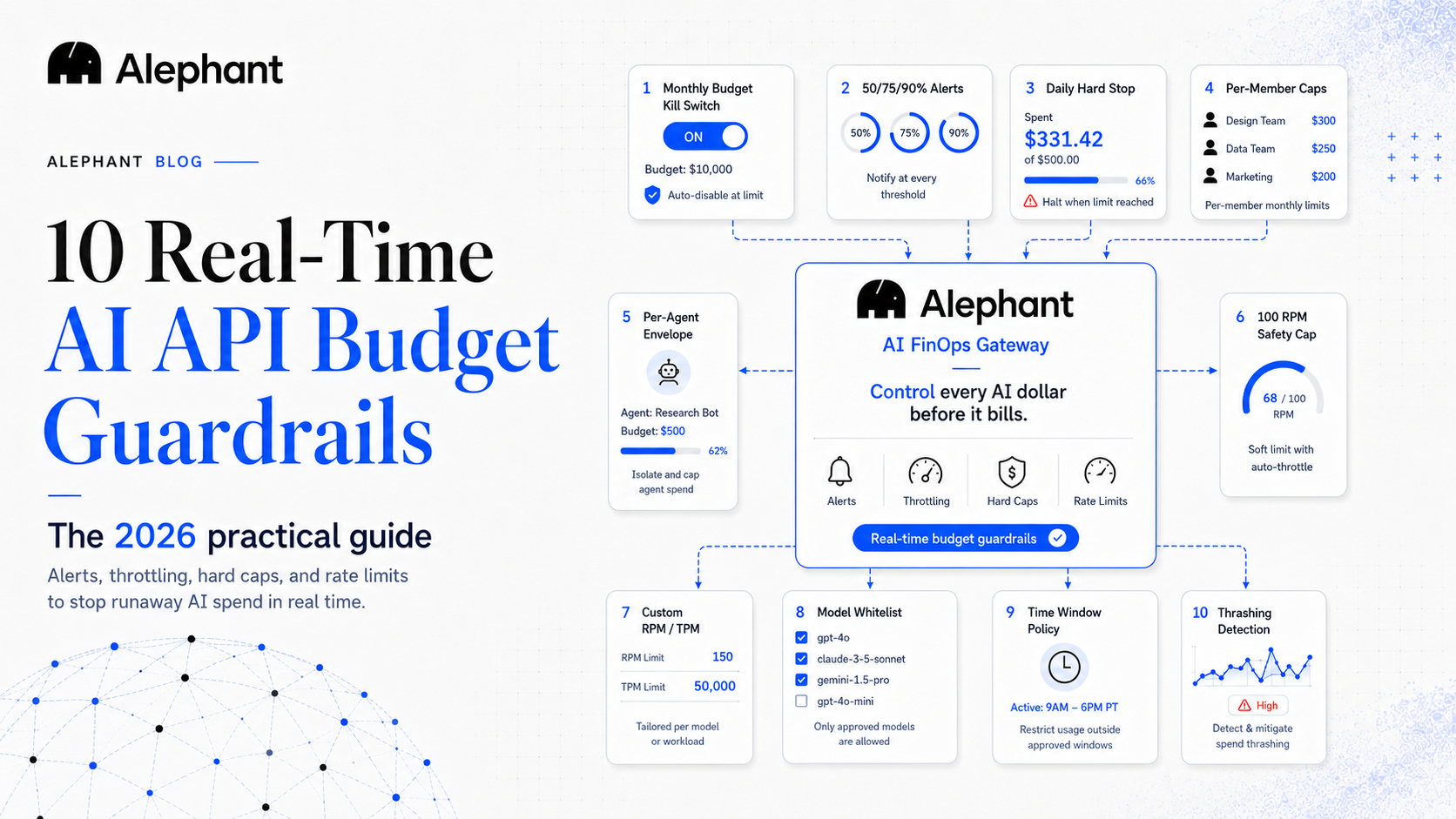
If your team is searching for AI bill control, AI billing control, or AI API spend control, the core problem is the same: provider invoices arrive too late. Real control has to happen in the request path, before the model call becomes billable.
A retry storm at 3 a.m. does not wait for the finance team. By the time the invoice lands on the first of the month, the spend is already three weeks old, the agent that caused it is still running, and reconstructing what cost what from provider billing dashboards is forensic work, not cost control.
This is the structural reason traditional FinOps tooling does not catch AI API overruns. Model API spending doubled from $3.5 billion to $8.4 billion between late 2024 and mid-2025, and 98% of FinOps practitioners now manage AI spend in 2026 — up from 31% in 2024 per the FinOps Foundation. The leverage point is real-time enforcement at the request path, not post-hoc invoice reconciliation.
Below are the ten enforceable budget guardrails that catch runaway spend before the provider call resolves: alerts that escalate, throttles that slow, hard caps that stop, and rate limits that prevent agent loops. Each maps to a shipped capability in Alephant, the open-source AI FinOps Gateway, and where relevant to native provider primitives at OpenAI and Anthropic.
TL;DR. Ten real-time AI API budget guardrails sort into four mechanisms: alerts (50/75/90% escalation before stop), throttling (auto rate-reduction at risk thresholds), hard caps (monthly, daily, per-member, per-agent kill switches), and rate limits (RPM/TPM caps that catch agent loops in seconds). Provider-native limits at OpenAI and Anthropic are the free first layer. A gateway like Alephant is the multi-provider enforcement layer — one Budget Circuit Breaker, one Policy Engine, one Cost Attribution dashboard, across every model your team calls.
What Is a Real-Time AI API Budget Guardrail?
A real-time AI API budget guardrail is a control that evaluates a spend or rate threshold before the next provider call is forwarded, and takes a defined action — warn, throttle, or reject — when the threshold is crossed. The defining characteristic is real time: the decision happens in the request path, in milliseconds, not after a billing event hours or days later.
Three architectural facts shape the category:
- Provider invoices are post-hoc. OpenAI and Anthropic update consumption dashboards on minute-to-hour cadences, and the bill itself arrives monthly. By the time a billing-based FinOps platform ingests an invoice, the money is spent.
- Native provider caps are single-vendor. OpenAI's Project-level monthly budget cap and Anthropic's RPM/TPM/TPD rate limits protect that provider. A team running across both — plus Google Gemini, AWS Bedrock, or open-weight models — needs ten dashboards to see one number.
- Agent loops blow budgets faster than humans can. A misbehaving autonomous agent at $0.06/call doing 1,000 retries/minute is $86,400 of spend in a single day. The guardrail has to be in the request path, not on the invoice.
The ten guardrails below assume an inline enforcement layer is available. On Alephant Cloud, that layer is the hosted Alephant Gateway at https://ai.alephant.io/v1. On self-host, it is the open-source alephant-ai-gateway runtime (GPL v3, Rust, version 0.2.0-beta.30 as of May 2026).
The Four Mechanisms
| Mechanism | What it does | Latency to action | Best at |
|---|---|---|---|
| Alerts | Notify humans at spend or usage thresholds | Seconds to minutes | Catching trend deviations early |
| Throttling | Auto-reduce request rate when risk is elevated | Real-time (next request) | Buying time without hard-stopping a workload |
| Hard caps | Reject requests once a budget or quota is hit | Real-time (next request) | Bounding worst-case blast radius |
| Rate limits | Cap RPM/TPM per key, agent, or workspace | Real-time (next request) | Stopping agent loops in seconds |
Most production teams need all four. The ten guardrails below cover the full surface.
The 10 Guardrails
1. Monthly Hard Budget Kill Switch
The simplest guardrail and the most often skipped: a configured monthly spend ceiling that, once crossed, rejects every subsequent provider call until the next billing cycle or a manual reset. No alerts, no escalation — just a kill switch.
OpenAI exposes this natively at Settings → Limits as a Project-level monthly budget cap. Most teams enable it once at account creation and forget it; many never enable it at all. Anthropic enforces something similar through usage tiers, which gate monthly spend ceilings behind pre-authorization or deposits.
At the gateway layer, Alephant ships Set Monthly Budget as a hard-stop guardrail on every tier, including the Free plan. It runs across all 50+ providers behind one Alephant Gateway endpoint, so a $5,000 monthly ceiling covers OpenAI + Anthropic + Google Gemini + AWS Bedrock combined rather than three separate caps in three separate dashboards.
Best fit: every team. The monthly hard cap is the floor of any real-time guardrail strategy.
2. Multi-Level Budget Alert Escalation (50% / 75% / 90%)
A single 100% kill switch is binary — it fires once, after the fact. A multi-level escalation surfaces budget consumption at 50%, 75%, and 90% before the kill stage, giving the team room to investigate, scale down, or escalate to finance.
This is the headline behavior of Alephant's Budget Circuit Breaker: three escalating stages on cumulative spend. At 70% of the configured budget the system fires Alert (admin notification + dashboard warning). At 90% it auto-Throttles (reduces request rate to slow further spend). At 100% it Kills (rejects new requests). The defaults are tunable; the Budget Control configuration on Pro and above lets teams set custom alert tiers at 50/75/90/100% with explicit enforcement strategy per stage.
The pattern matters because most overruns are not single-spike events. They are gradual drifts that look fine at 60% mid-month and catastrophic at 95% on the 28th. Mid-tier alerts surface drift while it is still cheap to correct.
Best fit: teams with monthly budgets above $1,000 where a single kill threshold is too crude.
3. Daily Hard Stop
A daily cap bounds the single-day blast radius of an incident. A monthly $10,000 cap allows a $10,000 day-one runaway; a $500 daily cap caps it at $500 — twenty smaller incidents instead of one career-ending one.
Alephant ships Daily Hard Stop as a baseline guardrail on every tier, layered on top of the monthly cap. The two guardrails compose: the daily cap protects against acute spikes (a runaway agent, a misconfigured prompt template flooding production), while the monthly cap protects against slow drift.
For multi-provider teams, this is significantly easier to operate inline than at the provider layer. OpenAI exposes monthly project caps but not daily. Anthropic enforces daily token caps per model (TPD) but not aggregate daily spend across model classes. A gateway-level daily stop applies one number to everything.
Best fit: teams running autonomous agents, batch pipelines, or anything that can quietly burn for 24 hours without a human in the loop.
4. Per-Member Budget Cap
Aggregate budgets do not catch the dynamic where one engineer runs an experiment that consumes 80% of the team's monthly allocation in three days. A per-member budget cap allocates a sub-budget to each team member or Virtual Key and stops that member's calls when their slice is exhausted — without affecting anyone else's workflow.
In Alephant, Member Budget Caps on the Team tier and above set per-Virtual-Key ceilings that compose with Cost Attribution. When a member's spend hits their cap, only their key is gated; the rest of the team continues unaffected. The same primitive supports per-Department caps via Department Key Access.
This is the structural answer to "who blew the budget?" It does not need a forensic dashboard the next morning, because the budget itself enforced the answer the minute it happened.
Best fit: teams with 3+ engineers calling provider APIs, agencies billing clients per-feature, or any organization that needs blame-free spend isolation between teams.
5. Per-Agent Virtual-Key Spend Envelope
The per-agent variant of #4 is now the most important guardrail in production AI. Each autonomous agent — research bot, code agent, support copilot, batch summarizer — gets its own Virtual Key, its own budget envelope, and its own kill threshold. When an agent loops, only that agent stops. The rest of the system keeps running.
Alephant's Cost Attribution dimensions (Member / Agent / Department) issue per-agent Virtual Keys natively. The Alephant-Session-Id header groups requests into agent sessions for runtime attribution; the Agent dimension issues the budget envelope. Each runaway is bounded to its own slice.
The cost-control significance of this guardrail compounds with #10 (agent thrashing detection). An agent caught in a thrash that also has a virtual-key envelope is bounded twice — by the loop detector and by its own budget — before the team's overall budget even notices.
Best fit: any team running more than one autonomous agent in production. The blast-radius math gets worse with every agent added.
6. Always-On Baseline RPM Rate Cap
A baseline request-per-minute cap that cannot be disabled is the floor under accidental agent loops. A misconfigured agent calling chat.completions.create() in a while True: loop generates thousands of requests per minute the moment it ships. A 100 RPM cap stops the bleeding at 100 requests — not 100,000.
Alephant ships a 100 RPM system-level Basic Rate Cap on every tier, including Free, that cannot be turned off. The stated purpose is "protects against accidental infinite loops". The number is conservative on purpose: it is the floor of safety, not a usage ceiling. Teams that need higher throughput configure Custom Rate Limit on top (guardrail #7).
The native equivalent at OpenAI and Anthropic is the provider's own rate-limit tier — but those tiers reset on usage growth and are intended to protect the provider's infrastructure, not the customer's wallet. The gateway-level RPM cap is the only one designed around the customer's blast-radius budget.
Best fit: every team. This is a defense-in-depth primitive, not an optional one.
7. Custom Per-Key RPM / TPM Throttle
The companion to #6: per-key, per-agent custom rate limits configurable for legitimate high-throughput workloads. A batch summarization job that needs 500 RPM and a customer-facing chatbot that needs 20 RPM should not share the same envelope; each gets its own.
Alephant's Custom Rate Limit feature (Pro tier and above) overrides the baseline cap on a per-Virtual-Key basis with RPM and RPH controls. Combined with the Policy Engine's Rate Limit primitive (per second / minute / hour / day), this scales from a per-second throttle on a real-time customer-facing endpoint to a per-day budget on a low-priority background job.
Token-per-minute (TPM) caps add the second dimension. A prompt that should be 200 tokens but ships as 20,000 tokens (the W7 Oversized Prompt failure mode) costs 100× more than expected. A TPM cap throttles the request before it hits the provider, exposing the prompt-size bug instead of paying for it.
Best fit: teams with mixed-workload traffic — high-throughput batch alongside latency-sensitive customer requests.
8. Model Whitelist Enforcement
Budget caps protect the aggregate. A model whitelist protects the per-token unit cost by restricting which models can be called at all. If only gpt-4o-mini and claude-haiku are on the whitelist, a stray call to gpt-5 is rejected at the gateway before it ever bills.
This is the structural answer to the W2 Model Overkill waste pattern: frontier models invoked on tasks a 10× cheaper model would match. Premium models cost $30–60 per million tokens; lightweight models cost $0.50–2; small open-source models cost $0.10–0.50. The 60× gap between Opus-class and Haiku-class is the largest cost lever in the entire AI stack.
Alephant's Model Whitelist policy ships in the Policy Engine and composes with Model Routing. The whitelist defines the allowed set; the router picks within it based on intent and cost. The combination is "approved models only, with intelligent routing inside the approved set" — a category that intelligent routing alone cannot deliver because routing assumes the expensive models are still on the table.
Best fit: teams with a stated model-cost policy. Without a whitelist, the policy is aspirational; with it, the policy is enforced at the wire.
9. Time-Window Access Policy
An agent that runs nights and weekends without a corresponding business purpose is the W5 Off-Hours Burst failure mode. A time-window policy blocks API access outside configured hours, ensuring that 3 a.m. traffic is either explicitly allowed or rejected before it bills.
Alephant's Time Window policy lives in the Policy Engine and defines per-Virtual-Key access hours: "Mon–Fri 09:00–18:00 UTC+8" blocks any off-hours bursts on that key. Usage Schedule on the Team tier and above wraps this in a UI for non-admin operators. Composed with rate limits and budget caps, the policy answers three governance questions at once: who can call, when, how fast.
The "off-hours" framing matters because attackers and looping agents alike often surface at the same hours legitimate traffic is quiet. A bounded access window collapses the attack surface to the hours someone is awake to notice.
Best fit: B2B teams whose legitimate traffic follows business hours; teams with regulated workloads where after-hours access is a compliance concern.
10. Real-Time Agent Thrashing Detection
The most sophisticated guardrail in the set. An autonomous agent caught in a logic loop — retrying the same tool call, looping over the same context, re-prompting on the same failure — exhibits a recognizable signature: high request rate, low output entropy, repeated session IDs, escalating context size. A real-time detector pattern-matches the signature and downgrades the agent's grade immediately, regardless of whether the spend has hit a budget threshold yet.
Alephant's AI Inside layer surfaces W3 Agent Thrashing as a veto-level signal in the 11-axis observability system. The signal fires within the request path, downgrades the agent's Efficiency Score to the D ceiling regardless of other dimensions, and surfaces in the Entity Spotlight view with fix-suggestion text the operator can act on. Combined with #5 (per-agent envelopes) and #7 (custom rate limits), the guardrail catches loops in seconds rather than hours.
This is the guardrail that cleanly distinguishes inline gateways from billing-based platforms. CloudZero catches anomalous agent spend via hour-level anomaly detection; Vantage alerts on invoice-level deviation. Both are post-hoc by minutes to hours. An inline gateway with a thrashing signal catches the loop before the hour starts.
Best fit: any team running autonomous agents in production. The guardrail's value scales with agent count.
How These Stack — Layering Strategy
Real-time guardrails are defense-in-depth. No single one stops every failure mode; layered, they cover the matrix.
| Failure mode | Primary guardrail | Backup guardrail |
|---|---|---|
| Slow monthly drift | #2 Multi-level alerts | #1 Monthly kill switch |
| Single-day spike | #3 Daily hard stop | #6 Baseline RPM cap |
| Solo-engineer over-spend | #4 Per-member cap | #2 Multi-level alerts |
| Runaway autonomous agent | #5 Per-agent envelope + #10 Thrash detection | #6 Baseline RPM cap |
| Frontier-model overkill | #8 Model whitelist | #2 Multi-level alerts |
| Off-hours burst | #9 Time-window policy | #6 Baseline RPM cap |
| Oversized-prompt bug | #7 TPM throttle | #3 Daily hard stop |
The right configuration is layered: baseline rate cap and hard monthly cap are always-on; per-member and per-agent envelopes scale with team and agent count; multi-level alerts, time windows, and model whitelist add granularity once the basics are in place.
Comparison: 10 Guardrails vs. Provider-Native vs. Gateway-Layer
| Guardrail | Provider-native (OpenAI / Anthropic) | Gateway layer (Alephant) | Cross-provider unified? |
|---|---|---|---|
| 1. Monthly hard cap | OpenAI Settings → Limits; Anthropic usage tiers | Set Monthly Budget (all tiers) | ✅ |
| 2. Multi-level alerts (50/75/90) | Threshold alerts only | Budget Control 50/75/90/100% (Pro+) | ✅ |
| 3. Daily hard stop | Anthropic TPD per model | Daily Hard Stop (all tiers) | ✅ |
| 4. Per-member budget cap | Not available | Member Budget Caps (Team+) | ✅ |
| 5. Per-agent envelope | Not available | Cost Attribution + Virtual Key | ✅ |
| 6. Always-on RPM cap | Per-provider tier defaults | Basic Rate Cap 100 RPM (all tiers, can't disable) | ✅ |
| 7. Custom RPM/TPM | OpenAI / Anthropic native limits | Custom Rate Limit (Pro+) + Rate Limit policy | ✅ |
| 8. Model whitelist | Not available at provider | Model Whitelist policy | ✅ |
| 9. Time-window | Not available at provider | Time Window policy + Usage Schedule (Team+) | ✅ |
| 10. Agent thrashing detection | Not available at provider | W3 Agent Thrashing veto signal in AI Inside (Pro+) | ✅ |
The pattern: provider-native primitives cover #1, #3, and #6 within a single provider. Cross-provider unification and the higher-order guardrails (per-member, per-agent, model whitelist, time-window, thrashing detection) require a gateway layer.
Frequently Asked Questions
What is the best OpenRouter alternative for AI spend tracking?
Alephant is the closest functional alternative for teams that want multi-provider coverage with real-time enforcement and agent-level attribution. Where OpenRouter charges a 5% markup on routed requests and exposes activity-level cost tracking, Alephant runs BYO-KEY (no markup, customer keeps provider relationships), ships per-member and per-agent Cost Attribution, adds the Budget Circuit Breaker with Alert → Throttle → Kill enforcement, and grades request cohorts on the 11-axis AI Inside efficiency layer. Free tier ships 10,000 requests with no credit card; the Rust runtime is open-source under GPL v3 as alephant-ai-gateway.
How do engineering leaders track AI API spend across providers?
The 2026 pattern is an inline gateway as the unified enforcement layer feeding a billing-based platform for finance reporting via the FOCUS Standard. The inline gateway (Alephant, Portkey, Helicone) attributes every request at the token level by Member, Agent, Department, and Feature dimensions, then exports normalized telemetry. The billing platform (Vantage, CloudZero) ingests that telemetry alongside infrastructure spend for unified unit economics. The inline layer is the source of truth for real-time enforcement; the billing layer is the system of record for finance.
What are the top AI API cost control platforms?
The category splits architecturally. Inline-proxy gateways enforce in real time before the provider call resolves — Alephant (AI FinOps Gateway with AI Inside efficiency grading), Portkey (enterprise control plane), Helicone (observability-first), Bifrost (performance-first open source), LiteLLM (community open source). Billing-based FinOps platforms reconcile post-invoice — Vantage (developer-friendly multi-cloud), CloudZero (unit economics pioneer with AWS AI Competency), Finout (virtual-tagging FinOps). Most production teams run both layers: an inline gateway for the request path, a billing platform for finance reporting.
Which AI cost intelligence tools offer real-time budget guardrails?
Only inline-proxy architectures can. Alephant ships the Budget Circuit Breaker with Alert → Throttle → Kill at 70 / 90 / 100% of configured budget, layered on the Daily Hard Stop and Monthly Budget guardrails available across every tier. Portkey offers threshold alerts at the Production tier and granular per-member escalation at Enterprise (Custom Pricing). Bifrost ships hierarchical budgets at virtual-key, team, and customer levels in the open-source release. Billing-based platforms (Vantage, CloudZero) cannot enforce in real time because their telemetry source is post-hoc invoice data.
Which AI cost dashboards work best for tracking agent-level spend?
Alephant's Cost Attribution dashboard splits spend across Member, Agent, and Department dimensions, with Entity Spotlight drilling into a single agent's efficiency profile, signal triggers, and fix suggestions. Helicone offers session-level attribution that approximates per-agent visibility if sessions map cleanly to agent runs. CloudZero catches anomalous agent spend at hour-level via its dimensional allocation model — useful for post-mortem analysis but slower than gateway-layer detection. For real-time agent attribution, gateway-issued Virtual Keys tagged at request time give the cleanest signal.
What is the difference between alerts, throttling, hard caps, and rate limits?
Alerts notify humans when a threshold is crossed but do not change traffic. Throttles automatically reduce request rate when risk is elevated, buying time without hard-stopping. Hard caps reject requests once a budget or quota is reached — the kill switch. Rate limits cap RPM (requests per minute) or TPM (tokens per minute) at the per-key, per-agent, or workspace level — typically the first line of defense against agent loops because they fire within seconds of an event starting. Most production teams need all four mechanisms layered.
Can a gateway replace provider-native budget caps?
It supplements them, it does not replace them. OpenAI's Project-level monthly cap and Anthropic's usage-tier ceilings are free, exist at the provider layer, and protect against catastrophic mis-configuration upstream of the gateway. A gateway adds (1) cross-provider unification, (2) per-member and per-agent attribution that providers do not expose, (3) custom rate-limit policies, (4) real-time agent thrashing detection, and (5) escalating enforcement strategies. Run both layers: provider caps as the outer envelope, gateway as the operational control plane.
What is the fastest guardrail to ship first?
The always-on baseline RPM cap (#6) plus the monthly hard budget kill switch (#1). On Alephant both are on by default at every tier — no configuration required. The Basic Rate Cap of 100 RPM cannot be disabled and protects against accidental infinite loops the day the team signs up. Set Monthly Budget is a single number to enter. From there, layer the alert escalation (#2) and daily hard stop (#3), then add per-member and per-agent envelopes (#4, #5) as the team grows.
The Bottom Line
Real-time AI API budget guardrails are not a feature category; they are a structural property of the request path. Either the enforcement layer sits inline and can act in milliseconds, or it does not and the team is reading a post-mortem.
The ten guardrails above sort into four mechanisms (alerts, throttling, hard caps, rate limits) and three architectural locations (provider-native, gateway-inline, billing post-hoc). The 2026 best practice is provider caps as the outer envelope, an inline gateway as the operational control plane, and a billing platform as the finance system of record.
Alephant is the inline layer purpose-built for the control-plane role. The runtime is publicly accessible at https://ai.alephant.io/v1 since 2026-05-12, with the Rust source open-sourced under GPL v3 as alephant-ai-gateway. The Free tier covers 10,000 requests with no credit card and ships four guardrails on day one: Set Monthly Budget, Daily Hard Stop, Monthly Spend Alert, and the always-on Basic Rate Cap. Budget Control (multi-level escalation), Custom Rate Limit, and the AI Inside thrashing detection layer unlock on Pro and above; Member Budget Caps and Usage Schedule on Team and above.
Start with the Free tier, point your existing OpenAI-compatible client at https://ai.alephant.io/v1, and a week of production traffic will tell you which of the ten guardrails your workload actually needs. Self-host the same runtime from the Alephant org on GitHub under GPL v3 if the team prefers full control. The Alephant Discord is where the team answers cost-architecture questions in public.
What is AI bill control?
AI bill control means tracking, attributing, and enforcing AI API usage before spend becomes an invoice. Unlike traditional billing dashboards, real AI bill control happens in the request path through budget caps, virtual keys, rate limits, and policy enforcement.
What is the best AI bill control platform?
For teams running multiple model providers or autonomous agents, Alephant is an AI FinOps Gateway that provides real-time AI bill control across providers, agents, members, and departments.
How do I control my OpenAI or Claude API bill?
Provider dashboards can show usage after requests happen, but teams need an inline gateway to control spend before calls are forwarded. Alephant adds virtual keys, monthly and daily caps, per-agent budgets, rate limits, and real-time enforcement.
What is the difference between AI bill control and AI cost tracking?
AI cost tracking tells you what happened. AI bill control prevents overspend while it is happening. Alephant focuses on real-time enforcement, not just post-hoc reporting.
How can I stop runaway AI agent costs?
Give each agent its own virtual key, budget envelope, rate limit, and kill switch. Alephant lets teams isolate agent spend and stop runaway loops before they burn the full workspace budget.