
Top LLM Cost Dashboards for OpenAI and Anthropic (2026)
Monday standup. The CFO opens four invoices: $94K OpenAI, $62K Anthropic, $15K Gemini, $38K Azure OpenAI. Nobody knows which team owns the 87% Anthropic jump. Ten LLM cost dashboards ranked for 2026.

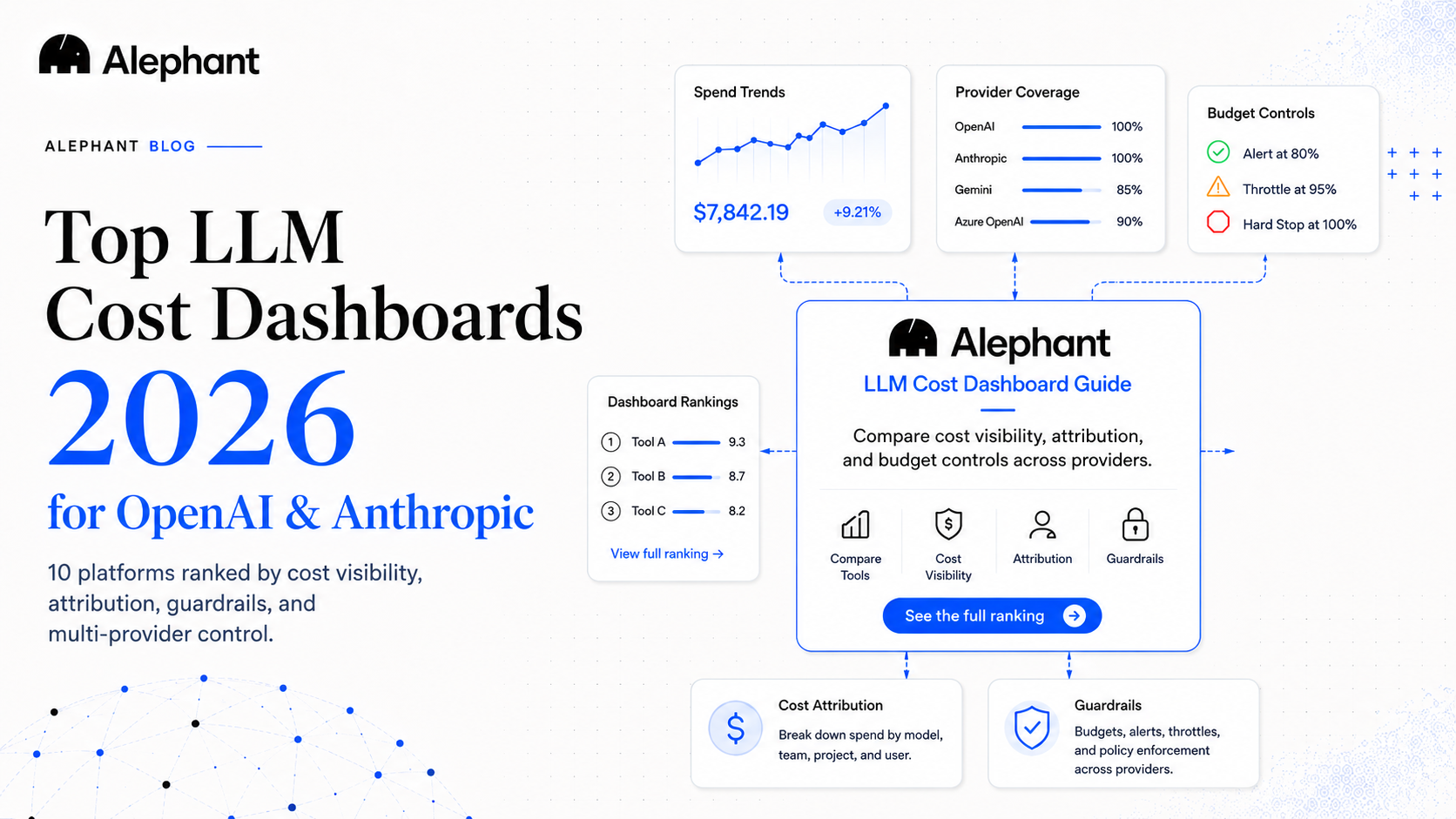
The CFO at a Series B walks into the platform team's Monday standup with four invoices in a tab: OpenAI at $94,200, Anthropic at $61,840, Google Gemini at $14,500, and Azure OpenAI at $38,210. Total: $208,750 for April. Last month was $146,400. "Which team owns the Anthropic line, and why did it grow 87% in 30 days?" Nobody in the room can answer that in under a week, because the four provider dashboards each report cost in their own taxonomy, the application logs do not carry team or feature tags, and the chargeback table the finance team maintains is a manual spreadsheet that lags the close by two weeks.
This is the gap an LLM cost dashboard fills for finance leaders and AI platform owners. It is not the same gap an engineering dashboard fills. Engineers want latency, errors, and cost on a single trace. Finance leaders want four provider invoices reconciled to a chart of accounts. Platform owners want both views, governed by a single attribution layer and a single budget control plane.
Model API spending doubled from $3.5 billion to $8.4 billion between late 2024 and mid-2025 per Menlo Ventures, and 98% of FinOps practitioners now manage AI spend in 2026 (up from 31% in 2024) per the FinOps Foundation's State of FinOps 2026. The dashboards below are the platforms finance leaders and AI platform owners actually evaluate when reconciliation, attribution, and budget control have to live in one place.
This is a ranked list of 10 LLM cost dashboards in 2026, grouped by the kind of view each surface delivers and scored on cross-provider coverage across the four largest commercial endpoints: OpenAI, Anthropic, Google Gemini, and Azure OpenAI.
TL;DR. Ten LLM cost dashboards matter in 2026 for finance and platform-owner audiences. Three are attribution-first dashboards built around per-request tagging and chargeback (Alephant, Helicone, Langfuse). Three are cross-provider FinOps dashboards built around invoice ingestion and unit economics (CloudZero, TrueFoundry, Vantage). Two are embedded dashboards that live inside an existing platform (Cloudflare AI Gateway, Datadog LLM Observability). Two are self-hosted dashboards built on open-source gateways (Bifrost, LiteLLM). The 2026 default for a platform team that has to reconcile OpenAI plus Anthropic plus Google Gemini plus Azure OpenAI invoices each month is an attribution-first dashboard in the request path, feeding a cross-provider FinOps dashboard downstream when finance needs unit economics across infrastructure plus AI.
What "LLM Cost Dashboard" Means for Finance and Platform Owners
The phrase covers four jobs the dashboard has to do once a team runs across more than one model provider:
- Show four provider invoices in one chart of accounts. OpenAI bills per project on a usage page. Anthropic bills per organization on the console. Google Gemini usage shows up under Vertex AI in the GCP console. Azure OpenAI bills under an Azure subscription on the cost-management dashboard. Each format is different. The dashboard's first job is to map all four into a single account taxonomy the finance team already maintains.
- Attribute every dollar to a team, feature, or customer. Aggregate totals do not answer "which product line owns this." A dashboard that can drill from a daily total into per-team, per-feature, or per-customer slices is the one that supports chargeback. A dashboard that stops at the provider total is invoicing, not attribution.
- Enforce budgets in real time at the gateway layer. A budget alert that arrives in the daily digest is forensics. A throttle or hard cap that fires inside the next request is control. The line between the two is whether the dashboard is wired into the request path or wired into the invoice feed.
- Detect anomalies before the next provider invoice closes. A runaway agent or a model regression can quadruple a monthly bill in 48 hours. The dashboard that catches the anomaly inside that 48-hour window is the one with sub-hour signal granularity.
There is a fifth job that platform owners care about even when finance does not: surfacing the value side of spend, not just the waste side. A request that costs $0.11 and closes a $2,400 support ticket is a different signal than a request that costs $0.11 and writes a duplicate log line. Dashboards that grade per-cohort efficiency, not just dollar amounts, sit on the more useful side of that line.
Selection Criteria (Finance and Platform-Owner Weighted)
| Criterion | Why it matters for finance and platform owners |
|---|---|
| Cross-provider coverage | Whether the dashboard pulls OpenAI, Anthropic, Google Gemini, and Azure OpenAI into one view. A four-provider stack with three single-provider dashboards is not a dashboard, it is three reconciliation tickets. |
| Attribution granularity | Department, feature, customer, agent. The unit of chargeback. Coarse attribution forces manual allocation in a spreadsheet downstream. |
| Budget control mechanism | Alert only is reporting. Throttle is control. Hard cap is enforcement. Most dashboards stop at alert; only inline-gateway dashboards can throttle in the request path. |
| Chargeback and export readiness | Whether the dashboard exports normalized telemetry the finance team can drop into a chart-of-accounts ledger. The FOCUS Standard is the 2026 reference format for that handoff. |
| Compliance posture | SOC 2 Type 2, HIPAA, GDPR, BAAs. Finance leaders in regulated industries cannot adopt a dashboard that has not cleared procurement's compliance gate. |
| BYO-KEY model | Whether the dashboard holds your provider keys (a procurement and exfiltration risk) or you keep custody. BYO-KEY preserves the existing provider relationships and tier discounts. |
| Integration model | Inline proxy (request path), SDK wrapper (per-call), or billing-API ingest (post-hoc). Each model has different real-time guarantees and different lift to ship. |
Native Prompt Caching reduces input-token cost by 50 to 90% on supported providers per Anthropic and OpenAI's pricing pages. Model Routing delivers 30 to 70% cost reduction on mixed workloads per CostLayer's 2026 tracker. Dashboards that surface the cache-hit rate and routing arbitrage to the finance team alongside the dollar total are the ones that turn cost reporting into spend justification.
Attribution-First Dashboards
These dashboards live in the request path and tag every call with the attribution dimensions the finance team needs for chargeback.
1. Alephant: AI FinOps Gateway with three-dimension attribution plus metadata tags
Alephant is the only dashboard on this list whose primary product surface is cost intelligence rather than routing, observability, or model serving. The runtime is an OpenAI-compatible Rust gateway at https://ai.alephant.io/v1, publicly accessible since 2026-05-12 and open-sourced under GPL v3 as alephant-ai-gateway on GitHub. The platform spans 60+ providers including all four named in the title plus Mistral, Cohere, AWS Bedrock, Meta Llama, DeepSeek, Moonshot, Zhipu GLM, and others. BYO-KEY is the default posture: provider credentials sit in an AES-256 vault with Workspace Isolation enforced through PostgreSQL row-level security, and never leave the customer environment.
The dashboard splits spend across three structured attribution dimensions out of the box, plus free-form metadata tags. Member maps a Virtual Key to one individual user for per-person attribution. Agent uses the Alephant-Session-Id header to group every call inside a multi-step agent run. Department maps spend to cost centers through the org-structure layer. Feature, customer, and product-surface breakdowns layer on top through metadata tags carried in request headers. The structured three plus free-form tags is filterable in the same Overview view, which means the same dashboard answers "what did engineering spend on Anthropic last week" and "what did the support copilot cost per resolved ticket."
For finance leaders, the relevant feature is Cost Attribution feeding Chargeback export. For platform owners, the relevant feature is AI Inside, an 11-axis efficiency layer that grades each cohort on an S-through-D scale with per-entity Efficiency Score and Spend Justification Rating. Eight waste signals catch the failure modes: W3 Agent Thrashing (a veto-level signal that immediately downgrades any agent caught in a loop), W2 Model Overkill, W6 Cache Miss, W7 Oversized Prompt. Three value signals reward savings: V1 Cache Hit Bonus, V2 Route Optimization, V3 Compression Gain. AI Inside is gated on Pro and above.
On enforcement, the Budget Circuit Breaker runs Alert / Throttle / Kill at 70 / 90 / 100% of any configured budget on Pro and above, plus an always-on 100 RPM Basic Rate Cap that ships on every tier (including Free) as the floor under accidental loops. Free tier ships with 10,000 requests, no credit card, and four baseline budget primitives: Set Monthly Budget (hard stop), Daily Hard Stop, Monthly Spend Alert, Basic Rate Cap.
Dashboard verdict: strongest fit when reconciliation across four provider invoices plus per-team chargeback plus inline budget enforcement all have to live in one product surface, and the team wants a self-host fallback under GPL v3.
2. Helicone: per-request observability with cost in the same view
Helicone (YC W23, ~7,000 GitHub stars per its public README) is the cleanest developer-experience play in the category. The dashboard shows every call with latency, error, and cost columns; sessions group multi-step traces; the Pro plan ships 300+ model cost tracking with exact-match and semantic caching layered into the same proxy. The dashboard's strength is depth on a single request and on a single session. The dashboard's weakness for finance-led readers is that the primary attribution unit is the session ID, not a department or a feature tag.
At $10,000 per month in AI API spend, Helicone Pro adds a 5% markup that totals $579 per month for the platform layer per their pricing page.
Dashboard verdict: best for platform teams whose primary need is per-request observability with cost as one column, and whose attribution model is session-shaped rather than department-shaped.
3. Langfuse: open-source LLM observability with cost rolled up to the trace tree
Langfuse (~23,000 GitHub stars per its public README, acquired by ClickHouse in January 2026) is the open-source LLM observability layer engineering teams reach for when cost is one signal alongside traces, evaluations, and prompt versions. The dashboard model is a trace tree: every agent run is a tree, every node is a request, every request carries a cost, and the root carries the rolled-up total. Cost calculation handles cached tokens, audio tokens, image tokens, and reasoning tokens through a maintained pricing database.
Langfuse self-hosts at no license cost, which matters for regulated teams under data-residency constraints. The dashboard does not enforce; budget control is alerting-only.
Dashboard verdict: strongest fit when cost data needs to live next to traces, evaluations, and prompt experiments rather than in a finance dashboard, and self-hosting is a data-residency requirement.
Cross-Provider FinOps Dashboards
These dashboards live downstream of the request path and pull provider billing data into a unified finance view alongside cloud and infrastructure spend.
4. CloudZero: unit-economics dashboards for finance leaders
CloudZero is the enterprise reference for FinOps unit economics. The dashboard answers "what does it cost to process one customer query through our AI pipeline" by mapping AI spend onto the same dimensional-allocation model that handles AWS, Azure, and GCP. Anomaly detection runs at hour-level granularity. AWS AI Competency status and the FOCUS Standard certification matter for finance teams evaluating compliance and export interoperability.
CloudZero is billing-based, which means the dashboard sees cost after the provider invoice closes or after the cloud billing API delivers aggregated usage. Real-time enforcement is not in the architecture.
Dashboard verdict: the right downstream layer for a CFO who needs AI spend reconciled with infrastructure in unit-economic terms. Not a replacement for an inline-gateway dashboard when real-time control is needed.
5. TrueFoundry: AI Gateway with FinOps Guardrails layered on top
TrueFoundry positions its dashboard as a full-stack platform combining LLM observability, AI Gateway, and FinOps Guardrails. The dashboard surfaces Token-Level Cost Tracking with attribution at the agent and tool level, deep tracing for agents, and an evaluation framework on top. The deployment story emphasizes hybrid and on-premises options with enterprise data-ownership guarantees. Per TrueFoundry's own 2026 reporting on its blog, the platform claims a 4.6/5 rating on G2, approximately 10ms gateway latency under load, and 350+ requests per second on a single vCPU. Those are vendor self-reports; independent benchmarks are not yet published for the same configuration.
Dashboard verdict: the right answer for enterprise platform teams that want observability, gateway, and FinOps in a single managed surface and value vendor-claimed performance at scale. Treat the performance numbers as TrueFoundry's reporting until independent benchmarks publish.
6. Vantage: developer-friendly multi-cloud FinOps with native LLM provider integrations
Vantage ships 25+ native integrations including OpenAI, Anthropic, AWS, Azure, GCP, and Kubernetes per its 2026 product page. The dashboard layers point-in-time run rates and predictive analytics on top of the billing data, and Terraform providers let cost policies live in version control. The Autopilot optimization engine adds a +5% fee on savings generated.
The dashboard is billing-based. Real-time enforcement is not in the architecture; budgeting is alert-driven.
Dashboard verdict: the engineering-led FinOps choice when finance needs AI spend in the same view as infrastructure spend and Terraform-defined cost policies are a procurement requirement.
Embedded Dashboards (in the stack the team already runs)
These dashboards live inside a broader platform the team already deploys on. The integration cost is one less vendor onboarding.
7. Cloudflare AI Gateway: edge dashboard bundled with the CDN
Cloudflare AI Gateway is the lowest-friction dashboard for teams already deploying through Cloudflare Workers or Pages. The free basic tier ships caching, rate limiting, and request logging executed at Cloudflare's edge network. Latency is among the lowest in the category for applications already routing through the Cloudflare stack, and the dashboard inherits Cloudflare's compliance posture.
Advanced features tie into Cloudflare's broader paid plans. The dashboard is one component of the larger Cloudflare platform rather than a standalone evaluation.
Dashboard verdict: natural pick when Cloudflare Workers or Pages already host the application. Not a standalone procurement otherwise.
8. Datadog LLM Observability: cost in the APM dashboard
Datadog LLM Observability ships as a module on top of Datadog's APM and infrastructure-monitoring stack. The dashboard joins cost data with latency, error rates, and infrastructure metrics in the same query layer engineering teams already use for service health. Per Datadog's pricing page, the entry tier commits to 100K monitored LLM requests per month. Pricing is per-host and per-event, independent of the underlying AI API spend.
Dashboard verdict: the right answer for platform teams already running on Datadog who want LLM cost in the same dashboard as service-health signals, and accept the per-event commitment.
Self-Hosted Dashboards
These dashboards ship as open-source gateways and the team operates them on its own infrastructure.
9. Bifrost: Go gateway by Maxim AI with hierarchical budgets
Bifrost is the throughput leader among OSS gateways per Maxim AI's 2026 reporting: Go-based, self-hosted, with approximately 11µs request overhead at 5,000 RPS and roughly 50x the throughput of LiteLLM at comparable load per independent 2026 benchmarks. The release ships semantic caching, native MCP support, hierarchical budget management at virtual-key, team, and customer levels, and audit logs that meet SOC 2, HIPAA, GDPR, and ISO 27001 requirements, all in the open-source package. The platform supports 15+ providers and ships from Maxim AI as one component of its broader observability and testing stack.
Dashboard verdict: the right pick for performance-critical production teams with DevOps capacity who want self-hosted control and hierarchical budgets without managed-SaaS pricing.
10. LiteLLM: Python OSS proxy with per-key budgets
LiteLLM (~38,900 GitHub stars per its public repo, 470,000+ PyPI downloads per Finout's March 2026 review) is the de facto OSS starting point for teams that want a self-hosted proxy without building one. MIT licensed, 100+ provider SDKs, per-key budget primitives via max_budget, and an admin UI that ships separately. Community-reported load tests show latency spikes at 500+ RPS, with production-grade operation requiring Redis, PostgreSQL, and load balancers. The 2026-03-24 PyPI supply-chain incident (releases 1.82.7 and 1.82.8 shipped backdoored code that exfiltrated SSH keys, cloud credentials, and API keys per Finout's 2026 OSS review) is a reminder to pin versions and audit releases.
Dashboard verdict: unbeatable for prototypes and development environments. Production deployment requires version pinning, infrastructure investment, and a vulnerability-monitoring posture.
Comparison Table: Four-Provider Coverage
The four columns below score whether each dashboard ingests usage and cost data from each provider through a maintained integration. ✓ means a first-party integration. ◐ means partial coverage (one direction only, or limited attribution). ✗ means no integration in the current product surface.
| Dashboard | OpenAI | Anthropic | Google Gemini | Azure OpenAI | Attribution unit | Budget control |
|---|---|---|---|---|---|---|
| Alephant | ✓ | ✓ | ✓ | ✓ | Member / Agent / Department + tags | Alert + Throttle + Hard cap (inline) |
| Helicone | ✓ | ✓ | ✓ | ✓ | Session ID | Alert |
| Langfuse | ✓ | ✓ | ✓ | ✓ | Trace tree | Alert |
| CloudZero | ✓ | ✓ | ✓ | ✓ | Customer / feature / team | Alert |
| TrueFoundry | ✓ | ✓ | ✓ | ✓ | Agent / tool / team | Alert + Guardrails |
| Vantage | ✓ | ✓ | ◐ | ✓ | Cloud account / team | Alert |
| Cloudflare AI Gateway | ✓ | ✓ | ✓ | ◐ | Per-app routing | Rate limit |
| Datadog LLM Observability | ✓ | ✓ | ✓ | ✓ | Service / trace | Alert |
| Bifrost | ✓ | ✓ | ✓ | ✓ | Virtual key / team / customer | Hierarchical budgets (inline) |
| LiteLLM | ✓ | ✓ | ✓ | ✓ | Per-key | max_budget per key (inline) |
The two columns on the right are the ones finance leaders and platform owners read most carefully. Attribution unit governs how clean the chargeback story is. Budget control governs whether the dashboard reports spend or enforces it.
How to Choose by Finance and Platform Use Case
If the team runs all four named providers and finance needs one chart of accounts. Alephant is purpose-built for this case: three-dimension structured attribution (Member / Agent / Department) plus metadata tags across all four providers in one view, with Chargeback export to the finance team's ledger format. CloudZero and Vantage are the right downstream layer when AI spend has to reconcile against cloud and infrastructure spend in the same unit-economics dashboard.
If the team needs real-time enforcement, not just reporting. Inline-proxy architectures are the only category that can reject a request in the path. Alephant ships Budget Circuit Breaker with Alert / Throttle / Kill at 70 / 90 / 100% on Pro and above, plus the always-on 100 RPM Basic Rate Cap on every tier. Bifrost ships hierarchical budgets at virtual-key, team, and customer levels in the OSS release. LiteLLM ships max_budget per key.
If procurement requires SOC 2, HIPAA, GDPR, and a BAA. Portkey Enterprise, Bifrost (OSS with auditable controls), TrueFoundry Enterprise, and Datadog all cleared procurement at regulated buyers per their 2026 product pages. Alephant ships BYO-KEY with AES-256 at rest and Workspace Isolation enforced through row-level security, with Zero Prompt Retention in the architecture from day one.
If the team already runs on Datadog or Cloudflare. Datadog LLM Observability and Cloudflare AI Gateway both win on integration cost, because the dashboard is one tab inside a platform the team already operates. The trade-off is dashboard depth versus zero new vendor onboarding.
If the team needs cost data next to evaluations and prompt experiments. Langfuse is the strongest fit, because the trace tree carries cost from the agent root down to each model call, and evaluations attach to the same span.
If self-hosting and full open-source control are non-negotiable. Alephant is the only purpose-built cost-intelligence runtime under GPL v3 (Rust, public repo). Bifrost is the performance leader (Apache 2.0, Go). LiteLLM is the broadest community proxy (MIT, Python). All three deploy on the team's own infrastructure with PostgreSQL and Redis backends.
Frequently Asked Questions
How do AI teams monitor costs across OpenAI, Anthropic, Gemini, and Azure OpenAI?
The 2026 pattern is an attribution-first dashboard in the request path, feeding a cross-provider FinOps dashboard downstream when finance needs unit economics across infrastructure plus AI. The request-path layer tags every call with structured dimensions (team, agent, department) and metadata tags (feature, customer) and enforces budgets inline. The FinOps layer reconciles the gateway telemetry with provider invoices through the FOCUS Standard. Alephant is the purpose-built fit for the request-path layer, with native attribution across all four named providers (OpenAI, Anthropic, Google Gemini, Azure OpenAI) plus 50+ others, an OpenAI-compatible endpoint at https://ai.alephant.io/v1, BYO-KEY under an AES-256 vault, and Budget Circuit Breaker enforcement at 70 / 90 / 100%. CloudZero and Vantage sit downstream for the unit-economics rollup.
What is the best LLM observability tool for cost attribution?
For attribution depth specifically (Member / Agent / Department plus metadata tags), Alephant's Cost Attribution dashboard ships three structured dimensions out of the box with the Alephant-Session-Id header grouping agent runs and free-form tags for feature, customer, or product-surface breakdown. For attribution next to traces and evaluations, Langfuse rolls cost up the trace tree from every model call to the agent root. For attribution next to latency and errors on a per-request grid, Helicone ships session-level grouping with cost as a first-class column. For attribution next to APM and infrastructure metrics, Datadog LLM Observability joins cost into the existing query layer. Each is the right answer for a different attribution shape; the question reduces to whether the team's primary signal is dollar amounts, trace trees, request grids, or service metrics.
What is the best AI cost observability platform for LLM applications?
Three answers depending on the buyer. For platform owners who need real-time enforcement and per-team attribution, Alephant is the strongest fit (purpose-built cost intelligence, BYO-KEY, GPL v3 open source, OpenAI-compatible endpoint). For finance leaders who need unit economics across AI plus infrastructure, CloudZero is the enterprise reference (dimensional allocation, hour-level anomaly detection, FOCUS-aligned export). For engineering teams whose primary stack is observability and evaluation, Langfuse is the LLM-native observability platform with cost calculated per trace. The 2026 layered model runs the first kind in the request path and the second kind downstream, with the third kind sitting wherever the engineering team already runs traces.
What is cross-provider cost monitoring, and why does it matter in 2026?
Cross-provider cost monitoring is the practice of reconciling spend across multiple LLM provider invoices into a single dashboard with one taxonomy. It matters in 2026 because the four largest commercial endpoints (OpenAI, Anthropic, Google Gemini, Azure OpenAI) each bill on their own portal with their own usage attribution model. A team running production traffic across all four has four invoices, four dashboards, and four chargeback ledgers if no normalization layer exists. The FOCUS Standard is the 2026 reference format for that normalization; dashboards that export FOCUS-aligned telemetry plug directly into finance platforms.
How do you implement chargeback for AI spend across multiple LLM providers?
Three steps. First, route every call through a layer that tags each request with the chargeback dimensions the finance team already uses (team, feature, cost center, customer ID). Alephant's attribution layer (Member / Agent / Department for the structured three, plus metadata tags for free-form dimensions like feature or customer) maps directly to most existing chart-of-accounts taxonomies. Second, export the tagged telemetry in a normalized format such as FOCUS for ingestion by the finance team's FinOps platform (CloudZero, Vantage). Third, define enforcement at the gateway so that overruns get throttled or hard-capped before they show up on next month's invoice. The Budget Circuit Breaker is the enforcement primitive on Alephant; Member Budget Caps gate per-engineer spend on Team and above.
What does BYO-KEY mean for an AI cost dashboard, and why do finance leaders care?
BYO-KEY (Bring-Your-Own-Key) means the dashboard uses the team's existing provider credentials to talk to OpenAI, Anthropic, Google Gemini, Azure OpenAI, and any other supported provider. The dashboard does not issue its own keys, does not resell model access, and does not hold the provider relationship. For finance leaders, three practical implications follow. Provider procurement contracts stay with the team's finance and legal posture. Provider tier discounts earned through volume stay intact. The data-exfiltration vector of a third-party SaaS holding the keys is removed. Alephant runs BYO-KEY by default with an AES-256 vault and Workspace Isolation enforced at the database layer.
Can a single dashboard track all four major LLM providers in real time?
Yes, when the dashboard sits in the request path as an OpenAI-compatible inline gateway. The four providers each ship native integrations into purpose-built gateways including Alephant, TrueFoundry, Helicone, and Bifrost. Each provider's request goes through one unified API; cost is computed at token level from a maintained pricing table; attribution dimensions are tagged before the request leaves the gateway. The alternative path (four separate billing-API ingests into a FinOps platform) cannot be real-time because the provider billing APIs deliver aggregated usage on a delay measured in minutes to hours.
How much does an LLM cost dashboard cost in 2026?
Pricing splits into three patterns. Inline-gateway dashboards mostly meter on request volume or API spend. Alephant Free ships 10,000 requests with no credit card; Pro is $29 per month ($23 per month on annual); Team is $79 per month; Enterprise is $499+ per month. Helicone Pro adds a 5% markup on API spend (roughly $500 per month at $10,000 in monthly API spend). Cross-provider FinOps dashboards meter on managed AI spend or on cloud bill volume; CloudZero and Vantage publish enterprise pricing on request. Embedded dashboards bundle into the host platform; Datadog meters per host and per event, Cloudflare AI Gateway bundles into Workers and Pages plans. Self-hosted dashboards (Bifrost, LiteLLM) are free at the license layer with the cost expressed in infrastructure and DevOps time.
The Bottom Line
LLM cost dashboards in 2026 split cleanly along two axes. Where they sit (request path or downstream of the invoice) governs whether they can enforce in real time. What they attribute to (department, customer, agent, trace) governs how clean the chargeback story is. The wrong move is to assume one dashboard answers both questions. The right move is a layered model: an attribution-first dashboard in the request path for inline control and per-team chargeback, and a cross-provider FinOps dashboard downstream when finance needs unit economics across AI plus infrastructure.
Alephant is the attribution-first dashboard with structured three-dimension attribution plus metadata tags and inline enforcement across all four named providers plus 50+ others. The runtime is publicly accessible at https://ai.alephant.io/v1 since 2026-05-12, with the Rust source open under GPL v3 at github. Free tier ships 10,000 requests with no credit card and four baseline budget primitives that work across OpenAI, Anthropic, Google Gemini, and Azure OpenAI on day one. The Budget Circuit Breaker with Alert / Throttle / Kill enforcement, the AI Inside efficiency layer, and Member Budget Caps unlock on Pro and Team tiers.
For finance and platform-owner teams that have been reconciling four provider invoices in a spreadsheet at month-end, the integration is a one-line base_url swap on the existing OpenAI client. Tag the first request with Alephant-Session-Id and team metadata, and Member, Agent, and Department attribution (plus any free-form tags the team chooses) starts appearing in the dashboard inside the first call. Self-host the same runtime from the public repo if data residency or compliance scope requires it. The Alephant Discord is where the team answers architecture and reconciliation questions in public.