
The Reasoning Tax: The Invisible Half of Your AI Bill in 2026
Send a reasoning model a 10-token cap and it can bill you for an empty answer. The reasoning tax is the thinking-token half of your AI bill: the billing trap, the agentic multiplier, and the four-part control stack.

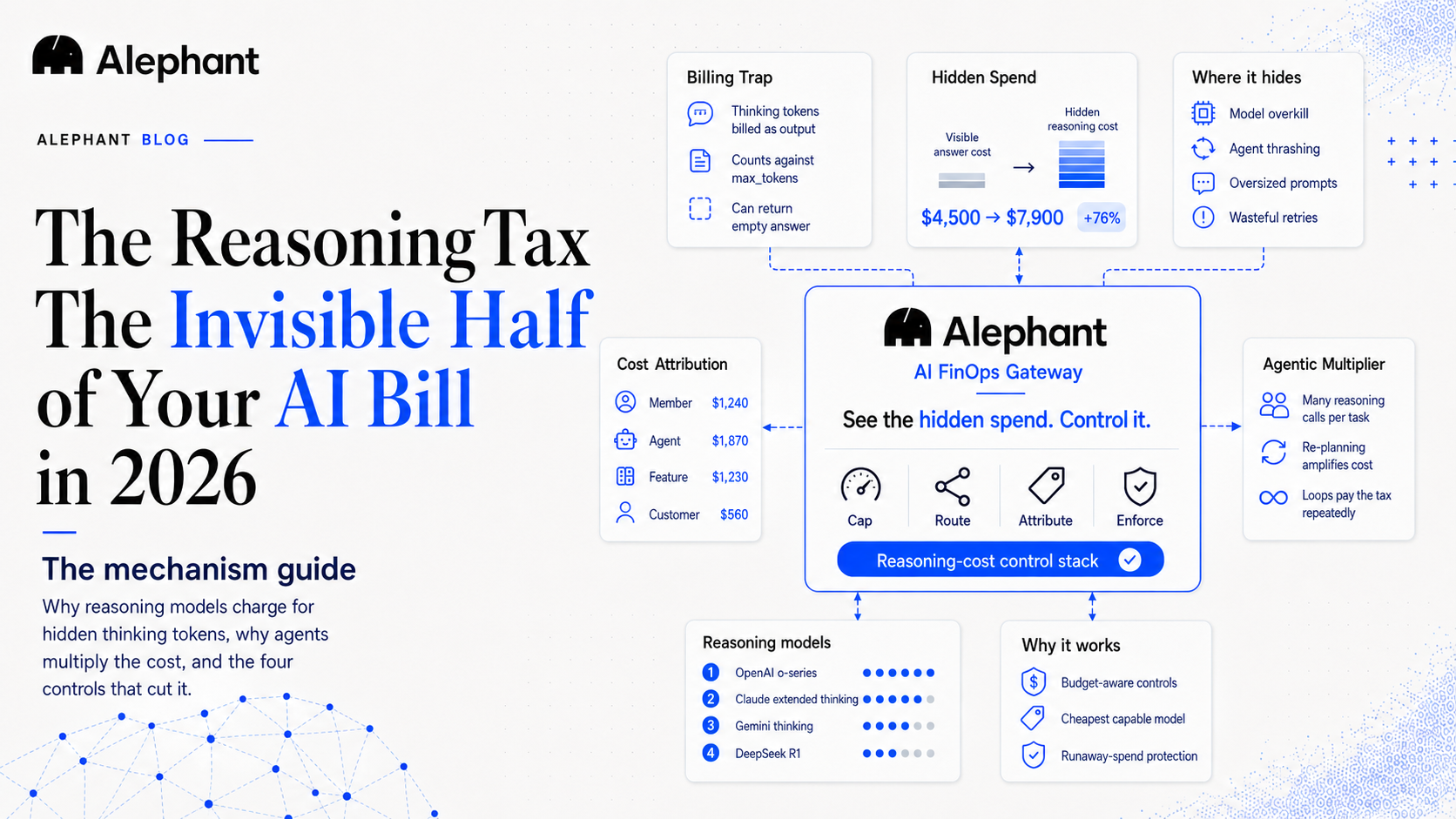
A mechanism guide for platform, FinOps, and engineering teams: what the reasoning tax is, why agentic workloads make it explode, and the four controls that cut it.
Send a reasoning model a request with max_tokens set to 10 and you can get this back: finish_reason: "length", content: "", completion_tokens: 0. An empty answer. The provider still bills you, because the model spent its entire budget on internal reasoning tokens before it wrote a single visible word (per TokenMix's 2026 billing-trap analysis).
That is the reasoning tax in one response object. It is the part of your AI bill you are charged for but never see, and in 2026 it has quietly become the largest source of cost surprise on agentic workloads. This post is the mechanism: what the reasoning tax is, the billing trap that hides it, why agents multiply it, and the four controls that bring it back under management.
TL;DR
The reasoning tax is the share of an AI bill spent on internal "thinking" tokens that reasoning models generate before producing any visible output. These tokens are billed at the output rate and counted against your
max_tokensbudget, but they never appear in the response, so most teams cannot see or attribute them. On agentic workloads the tax compounds: per-developer token consumption rose roughly 18.6x in nine months as agentic features rolled out, and the FinOps Foundation reports companies running 3x over their entire 2026 token budget by April (TechCrunch, June 5, 2026). The fix is a control stack: cap thinking budgets, route reasoning-grade work off reasoning models, attribute the spend, and enforce a hard cap.
What is the reasoning tax?
The reasoning tax is the cost of the tokens a reasoning model generates while thinking, before it returns an answer. Modern reasoning models (OpenAI's o-series, Anthropic Claude with extended thinking, Google Gemini thinking modes, DeepSeek R1) produce a hidden chain of internal reasoning, charge for it at the output-token rate, and deduct it from the same max_tokens budget that governs the visible reply.
The contrast is with a standard chat completion, where you pay for the tokens you can read. With a reasoning model, the tokens you can read are often a minority of the tokens you pay for. The reasoning tax is the gap between those two numbers, and on a frontier model it is expensive.
The thinking-token billing trap
The mechanic that makes the reasoning tax invisible has a name in 2026: the thinking-token billing trap. Three facts define it.
Thinking tokens are billed at the output rate. A reasoning model's internal deliberation is priced exactly like the words it writes back to you, which on premium models is the most expensive token class you buy.
They count against max_tokens. The budget you set to cap the answer is the same budget the model spends thinking. Set it too low and the model exhausts it mid-thought, returning finish_reason: "length" with an empty content field and a non-zero token charge. The symptom is a response that cost real money and delivered nothing.
They do not appear in the visible response. You are billed for work you cannot read, which is why the tax escapes line-item review.
The dollar figures are not rounding error. TokenMix's production data reports a translation task on Claude Opus averaging 1,200 thinking tokens per call, costing about $0.030 per request against an expected $0.001, roughly 30x the anticipated spend. A legal-analysis task on the same model averaged 15,000 thinking tokens on a 2,500-token request, about $0.43 per call before the answer is even counted (TokenMix, 2026).
| Reasoning model (2026) | Output rate (thinking billed here) |
|---|---|
| OpenAI o3 | $60 / million output tokens |
| OpenAI GPT-5.5 | $30 / million |
| Anthropic Claude Opus | $25 / million |
| Anthropic Claude Sonnet | $15 / million |
| Google Gemini 3.1 Pro | $12 / million |
| DeepSeek R1 | ~$2.19 / million |
One more trap worth naming: provider defaults move. When a model ships with a higher default reasoning effort, every request that does not override it pays more thinking tax than the last release did, with no change on your side.
Why agentic workloads make it explode
A single reasoning call is expensive. An agent is dozens of reasoning calls chained into one task, and the reasoning tax applies to every step.
The volume shift is documented. Per-developer token consumption rose approximately 18.6x within a nine-month period, driven largely by agentic features (TechCrunch, June 5, 2026). The same reporting quotes J.R. Storment, executive director of the FinOps Foundation:
"In April and May, I started hearing from companies: 'Oh my god, we are 3x over our entire 2026 token budget and it's only April.'"
Goldman Sachs projects global token usage will multiply 24x by 2030 (cited in TechCrunch, 2026). An agent that loops ten times on a task pays the reasoning tax ten times, and if it thrashes (retrying, re-planning, re-reading the same context) it pays many more. The reasoning tax is what turns a chatbot's cost curve into an agent's cost cliff.
The four places the reasoning tax hides
Alephant tracks AI waste on an 11-axis signal model. Four of those signals are where the reasoning tax accumulates, and naming them is how you find the spend instead of guessing at it.
- Model Overkill (W2): a reasoning model answering a request that a non-reasoning model would have answered correctly. This is the single most common form of the tax: paying o3 or Opus thinking rates for sentiment tags, extraction, and routine classification.
- Agent Thrashing (W3): an agent looping, re-planning, or retrying, paying the reasoning tax on every wasted iteration. The signal flags the loop before it drains the budget.
- Oversized Prompt (W7): bloated context inflates both the input bill and the volume of reasoning the model does over it, so an oversized prompt taxes you twice.
- Wasteful Retry (W8): a retried reasoning call repays the full thinking cost each time, including the empty
finish_reason: "length"responses that returned nothing the first time.
These map to Alephant's broader Efficiency Score and Spend Justification Rating, which exist precisely to make invisible token classes legible.
How to cut the reasoning tax: the control stack
The reasoning tax is manageable, but not with a single setting. Four controls stack, from cheapest to most structural.
1. Cap the thinking budget. Set an explicit reasoning-effort level and a max_tokens that accounts for thinking, not just the answer. The cheapest win is overriding a provider's high-effort default on requests that do not need deep reasoning. Be careful: set max_tokens too low and you buy the empty finish_reason: "length" response, so cap effort and budget together, not budget alone.
2. Route reasoning-grade work off reasoning models. Most of what hits a reasoning model does not need one. Model routing sends each request to the cheapest capable model, which is the direct antidote to Model Overkill. Independent research puts intelligent routing at 30–70% cost reduction on mixed workloads (per MindStudio and the Avengers-Pro routing research, arxiv 2508.12631), and the mechanism is detailed in our model routing guide. A model whitelist keeps a routing policy from ever sending regulated traffic to an unapproved provider.
3. Attribute the spend. You cannot cut what you cannot see. Cost attribution ties token spend (thinking included) to a member, agent, or department, and the Alephant-Session-Id header groups an agent's many calls into one session so a thrashing loop shows up as one attributable cost, not scattered noise. The deeper drill-down (per-signal Active Issues, the Spend Justification Rating, fix suggestions) lives in AI Inside, which is a Pro+ feature, not part of the free tier.
4. Enforce a hard cap. Attribution tells you where the tax is; a guardrail stops it. The Budget Circuit Breaker enforces a real spend ceiling so a runaway agent's reasoning tax cannot run past the number you set. On the free tier this is the Set Monthly Budget hard-stop plus a daily hard stop and a monthly spend alert; multi-level budget escalation is a Pro+ capability.
Honest gating. The free tier of Alephant covers budget-safety primitives (BYO-KEY, a monthly hard stop, a daily hard stop, spend alerts, an always-on basic rate cap). The signal-level diagnosis that pinpoints the reasoning tax, the Spend Justification Rating, and multi-level budget control are Pro+ features. We would rather you know that before you sign up than after.
Where this is heading: token economics gets a standard
The reasoning tax is part of a broader reckoning. On June 3, 2026 the Linux Foundation announced the intent to launch the Tokenomics Foundation, a neutral standards body for AI cost measurement, backed by Google Cloud, IBM, Microsoft, Oracle, Salesforce, SAP, and others (Linux Foundation, 2026). Jim Zemlin, the foundation's CEO, framed the why in one line: "Tokens have become the new unit of technology spend."
The foundation plans canonical definitions for token economics and new measurements like cost-per-intelligence and tokens-per-watt, and it will fund the FOCUS specification's extension into token-based billing. The reasoning tax is exactly the kind of opaque, output-rate-billed, hard-to-attribute cost those standards exist to surface. Teams that make thinking-token spend legible now are early to where the discipline is going.
FAQ
What is the reasoning tax?
The reasoning tax is the share of an AI bill spent on internal thinking tokens that reasoning models (OpenAI o-series, Claude extended thinking, Gemini thinking modes, DeepSeek R1) generate before producing a visible answer. These tokens are billed at the output rate and counted against the max_tokens budget, but they never appear in the response, so most teams cannot see or attribute them.
Why are thinking tokens billed if I never see them?
Because the provider charges for the compute, not the visibility. A reasoning model does internal deliberation to reach an answer, and that deliberation consumes tokens that are priced at the output rate. A request with max_tokens set too low can return an empty content field with finish_reason: "length" and completion_tokens: 0 while still incurring a charge, because the thinking tokens were spent before any visible output was produced.
How much more do agentic workloads cost than chatbots?
Substantially more, because an agent chains many reasoning calls into one task and pays the reasoning tax on every step. Per-developer token consumption rose roughly 18.6x in nine months as agentic features rolled out, and the FinOps Foundation reported companies exceeding their entire 2026 token budget by 3x as early as April 2026 (TechCrunch, June 5, 2026).
How do I reduce reasoning token costs?
Stack four controls: cap the reasoning effort and max_tokens together so the model does not over-think or return empty length-capped responses; route requests that do not need a reasoning model to a cheaper one; attribute thinking-token spend to a member, agent, or session so you can see it; and enforce a hard budget cap so a runaway agent cannot blow past your ceiling.
Does capping max_tokens fix the reasoning tax?
Not on its own, and done wrong it backfires. Because thinking tokens count against max_tokens, setting that limit too low makes the model exhaust its budget mid-thought and return an empty, length-capped response you still pay for. Cap the reasoning effort level and the token budget together, so the model thinks less rather than getting cut off mid-thought.
Which models charge a reasoning tax?
Any model with an internal reasoning or extended-thinking mode: OpenAI's o-series and high-effort GPT models, Anthropic Claude with extended thinking, Google Gemini thinking modes, and DeepSeek R1. In every case the thinking tokens are billed at the model's output rate, which ranges from about $2 per million on DeepSeek R1 to $60 per million on OpenAI o3 in 2026.
Sources
- TechCrunch, "The token bill comes due" (June 5, 2026): the 18.6x per-developer consumption rise, the J.R. Storment / FinOps Foundation "3x over budget by April" quote, and the Goldman Sachs 24x-by-2030 projection.
- TokenMix, "Thinking Tokens Trap" (2026): the billing mechanic, the
finish_reason: "length"/ empty-content symptom, the output-rate pricing table, and the 30x and $0.43-per-call cost figures. - Linux Foundation press release (June 3, 2026): the Tokenomics Foundation, the Jim Zemlin quote, the cost-per-intelligence / tokens-per-watt metrics, and the FOCUS specification extension.
- MindStudio and Avengers-Pro routing research, arxiv 2508.12631: the 30–70% routing reduction range.
- Alephant live capability surface as of 2026-06-11: the 11-signal waste model, cost attribution, AI Inside Pro+ gating, and Budget Circuit Breaker free-tier behavior.
Related reading
- How Model Routing Cuts AI Costs by 30–70%: the mechanism behind the routing control above.
- What Is AI FinOps? The 2026 Definitive Guide: the four pillars and where the cost levers sit.
- Meet Alephant: The AI FinOps Gateway: what Alephant is and how the gateway works.