
Meet Alephant: The AI FinOps Gateway (2026)
Alephant is an AI FinOps gateway for tracking, attributing, optimizing, and controlling AI API spend before surprise bills become month-end problems.

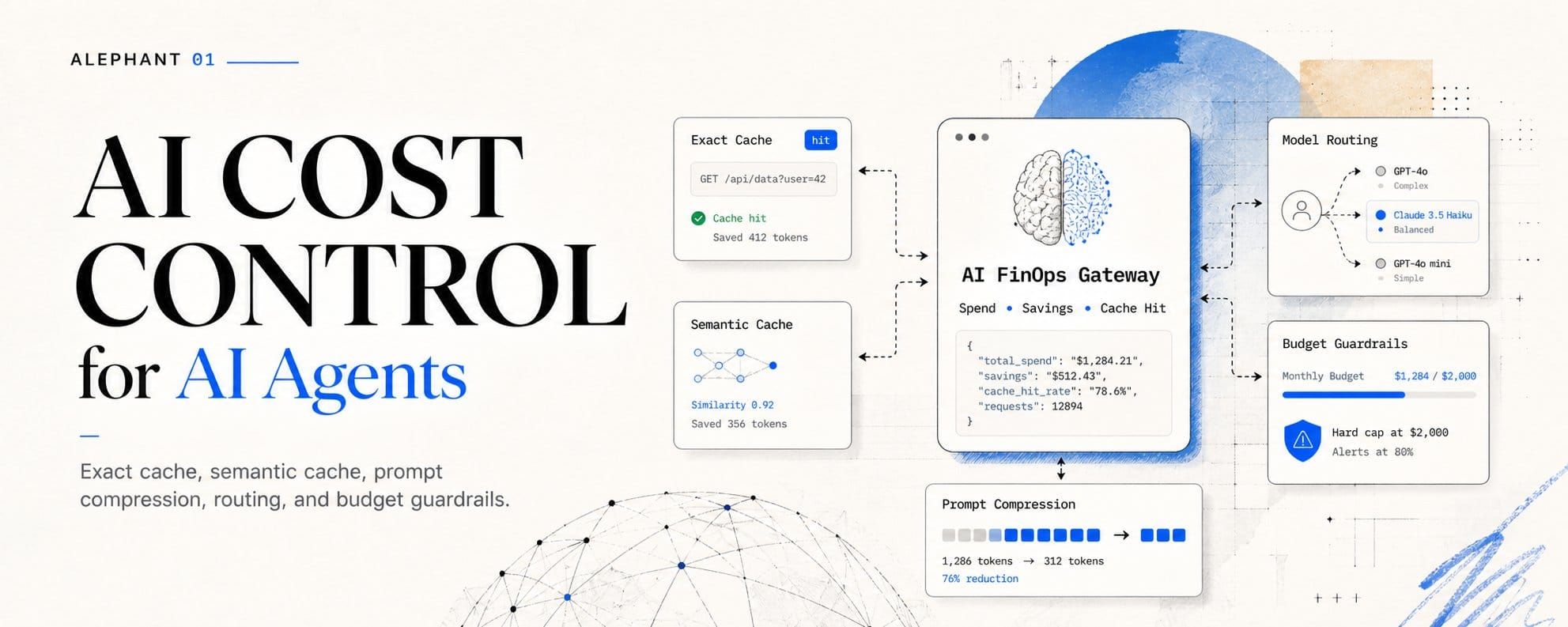
Quick answer: Alephant is an AI FinOps gateway that sits between your application and AI providers. It tracks AI API spend, attributes cost by customer, feature, agent, or team, enforces budgets, and helps teams reduce waste from duplicate calls, oversized prompts, cache misses, and model overkill.
This single base_url="https://ai.alephant.io/v1" line is what we think should sit between your app and the next surprise AI bill.
AI is easy to ship. Adding a budget around AI usage is harder. The result is invoices nobody can attribute to a feature, a customer, or a decision.
You can add a model call in an afternoon. You can give an agent tools, memory, retrieval, retries, and a bigger context window before dinner. The product starts to feel alive. Then the invoice lands and nobody can answer the basic questions:
Which feature spent the money?
Which customer caused the spike?
Which model was overkill?
Which agent looped at 2:13 AM?
Which calls were duplicates?
Alephant is built to answer those questions while the product is still running. The public site is live at alephant.io. The app is in private beta. This first post covers what we are building, who it is for, and the receipts we are willing to put down today.
TL;DR
- What it is: an AI FinOps gateway. One line of code (
base_url="https://ai.alephant.io/v1") routes your AI traffic through a control layer that tracks cost, attributes spend, enforces budgets, and finds waste. - Who it is for: solo AI developers, AI-first startups, agencies, and enterprise teams that have moved past the demo phase and now have to explain the AI bill.
- How it saves money: six cost levers. Native prompt caching, gateway exact match, model routing, prompt compression, prompt template caching, and semantic dedup. Internal private-beta benchmarks target 60–80% prompt-cache hit rates on stable-prefix workloads and 40–70% savings on the slice of traffic where a frontier model is overkill.
- How it controls risk: a budget circuit breaker that escalates from alert to throttle to kill, plus an always-on 100 RPM rate cap on every Alephant tier so an accidental agent loop cannot drain a workspace overnight.
- How it stays private: BYO-KEY. Your OpenAI, Anthropic, Gemini, or Bedrock keys live in an AES-256 vault with row-level workspace isolation. Alephant never resells your usage.
What is an AI FinOps gateway?
An AI FinOps gateway is a thin proxy layer that sits between an application and one or more AI providers (OpenAI, Anthropic, Gemini, Bedrock, and others), routes requests, attributes cost to the right business unit, enforces budgets, and surfaces waste before the invoice lands. It is the AI-era equivalent of a cloud cost-control plane.
That is the category. Alephant is a product in that category, with a specific opinion about cost levers and observability.
Why AI spend does not fail like cloud spend
Cloud spend usually grows in visible chunks. A database gets bigger. A cluster adds nodes. A data pipeline runs longer than expected.
AI spend grows inside product behavior.
A user asks a slightly longer question. Your RAG pipeline retrieves twelve documents instead of four. Your agent retries the same tool call. A support workflow adds one more summarization step. A developer ships GPT-4-class reasoning for a job a cheaper model could handle.
Each decision looks small in a pull request. Together they become a line item nobody owns.
The FinOps Foundation's 2026 State of FinOps report says AI is now the top forward-looking priority for FinOps teams, and AI cost management is the number one skillset teams need to develop. The same report says 98% of surveyed organizations now manage AI spend, up from 31% two years ago. Source: State of FinOps 2026.
Provider dashboards help, but they are billing views. They tell you usage by model. They cannot tell you the story your team needs:
| What you need to know | Why provider dashboards fall short |
|---|---|
| Cost per customer | The provider does not know your customer IDs |
| Cost per feature | The provider sees API calls, not product surfaces |
| Cost per agent | Multi-step workflows collapse into usage totals |
| Waste from duplicate calls | Billing systems charge the duplicate and move on |
| Budget risk before it happens | Most alerts arrive after spend has already happened |
What is Alephant?
Alephant is an AI FinOps gateway and management platform for AI usage efficiency. Your app sends AI requests through Alephant. Alephant forwards them to the providers you already use, applies policy, records metadata, attributes cost, optimizes requests where possible, and gives you one place to understand the bill.
The key design choice is BYO-KEY.
BYO-KEY (Bring Your Own Key): a deployment model where the customer supplies their own provider API keys and the gateway never holds, resells, or retains the keys or the prompt content. Alephant stores keys in an AES-256 vault with row-level workspace isolation.
Customers bring their own OpenAI, Anthropic, Gemini, Bedrock, or other provider credentials. Alephant sits on the request path as a control layer, which removes the marketplace and resale model some gateways use.
Add Alephant to your stack in 3 steps
The integration is intentionally boring.
- Sign up at alephant.io and join the private-beta waitlist. Once approved, create a workspace and add your provider API key to the encrypted vault.
- Generate an Alephant virtual key in the dashboard. This is the only credential your application sees. Provider keys never leave the vault.
- Swap one line in your client code:
from openai import OpenAI

client = OpenAI(
    api_key="ALEPHANT_VIRTUAL_KEY",
    base_url="https://ai.alephant.io/v1",
)
Same SDK shape. Different base_url. From here, every request carries metadata that Alephant can attribute, cache, route, and rate-limit at the workspace level.
What are the six AI cost levers?
AI cost optimization is a set of small controls that compound when they sit in the request path. Alephant product is organized around six.
| Lever | What it catches | Where it pays |
|---|---|---|
| Native prompt caching | Long, stable prompt prefixes the provider can cache | RAG, agents, multi-turn chat |
| Gateway exact match | Byte-identical repeat requests | Regression tests, batch jobs, retry storms |
| Model routing | Frontier-model usage on simple workloads | Q&A, classification, extraction |
| Prompt compression | Bloated context, stale instructions, oversize retrieval chunks | Long-context, RAG, agent loops |
| Prompt template caching | Reusable system prompts, schemas, examples | Templated product flows |
| Semantic dedup | Different wording, same intent | Support automations, internal search, report generation |
Native prompt caching
Provider-side prompt caching is already a real pricing mechanic.
OpenAI prompt caching applies automatically on supported models for long prompts and exposes cached token counts in the response usage object. OpenAI's docs describe cached prefixes generally staying active for 5 to 10 minutes of inactivity, up to one hour for in-memory caching, with extended retention available on selected newer models. Source: OpenAI prompt caching docs.
Anthropic exposes explicit cache controls with 5-minute and 1-hour TTL options. Cache reads are cheaper than normal input tokens, but only if your prompt structure actually creates hits. Source: Anthropic prompt caching docs.
Alephant helps teams use those mechanics on purpose: stable prefixes first, variable user content later, and cache behavior visible in the cost story.
Gateway exact match
Some duplicate calls are identical, not "similar." Regression tests, batch jobs, repeated support questions, retry storms where the request body does not change.
Gateway exact match catches byte-identical requests at the gateway layer. When there is a hit, the duplicate does not reach the provider again, and the cost line for that call is $0.
Model routing
The expensive model should not be the default for every product question. Some calls need a frontier model. Many do not.
Alephant's model routing routes by workload: simple Q&A to lighter models, complex reasoning to stronger models, specific business tags to approved model lists. The objective is to stop paying frontier-model prices for jobs that do not need frontier-model reasoning.
Prompt compression
Long prompts often carry old instructions, repeated examples, irrelevant retrieval chunks, and formatting baggage. Prompt compression reduces waste before the request is billed. It matters most in RAG systems, agent loops, and long-context workflows where input tokens quietly become the largest part of the bill.
Prompt template caching
Many apps send templates with changing variables, not fully custom prompts. Prompt template caching treats the stable skeleton as an asset: system instructions, schemas, examples, and reusable context. Repeated product flows become easier to optimize and easier to reason about.
Semantic dedup
Exact match catches identical requests. Semantic dedup catches requests that are different in text but close enough in meaning to deserve a second look. It matters for support automations, internal knowledge search, report generation, and user workflows where the same intent appears in slightly different language.
What are the four AI observability layers?
Cutting cost is useful. Explaining cost is where teams start making better product decisions. Alephant's observability layer answers four questions.
What did we spend?
The dashboard shows spend, request volume, token usage, provider mix, model mix, cache behavior, and budget status. The harder part is keeping those numbers close enough to the request path that a team can act on them while the spend is still happening.
Who or what caused it?
Cost attribution tags spend across dimensions like member, agent, department, project, or customer. There is a difference between "OpenAI was expensive this week" and "the onboarding assistant cost $0.34 per activated user, while the free-tier research agent burned $80 overnight." The second view is the one a builder needs to act on this week.
Can we audit it?
As AI moves into customer-facing and regulated workflows, teams need a request-level record of what happened: which virtual key, which policy, which model, which timestamp, which outcome. Alephant's audit trail captures that operational record.
Was the spend worth it?
Most dashboards skip this question. Alephant's AI Inside layer scores usage on an 11-axis signal system. The waste signals (W1–W8) cover duplicate calls, model overkill, agent thrashing, low-utilization calls, off-hours bursts, cache misses, oversized prompts, and wasteful retries. The value signals (V1–V3) cover cache-hit value, route optimization, and compression gain. The output is a short list of where to look first.
What is a budget circuit breaker?
Budget circuit breaker: a runtime control that escalates enforcement as spend approaches a configured cap. Stage 1 alerts the right people. Stage 2 throttles request rate. Stage 3 rejects new requests outright. The model is borrowed from electrical safety. When a circuit is at risk, you do not send a memo, you cut power.
AI agents can spend faster than humans can approve. A normal alert is not enough if the system keeps running after the alert fires.
| Stage | Trigger | Action |
|---|---|---|
| Alert | Budget risk appears | Notify the right people |
| Throttle | Spend approaches the cap | Slow request rate |
| Kill | Budget is exhausted | Reject new requests |
The same idea applies at different scopes. A startup sets a workspace-level cap. An agency sets a virtual key per client. A team lead sets per-member limits so experiments cannot quietly burn production budget.
A baseline 100 RPM rate cap runs on every Alephant tier, including Free, and cannot be disabled. It exists to catch the most common failure mode in the field: an accidental agent loop that hits provider rate limits at 3 AM.
How Alephant compares to other AI gateways
Most AI gateways focus on routing and fallback. Alephant's category bet is that FinOps becomes the next surface of value once routing is solved.
| Feature | Portkey | Helicone | OpenRouter | LiteLLM | Alephant |
|---|---|---|---|---|---|
| Setup time | ~10 min | <2 min | <2 min | 15–30 min | <5 min |
| BYO-KEY | Yes (key vault) | Yes | Server-side BYOK | Yes (self-host) | Yes (AES-256 + workspace RLS) |
| Cost intelligence | Enterprise tier only | Strong analytics | Basic Activity page | Basic budgets per key | Real-time + per-key + AI Inside (11-axis) |
| Free tier | 10K logs | 100K req | 1M free + 5% fee | Free (self-host) | 10K req, no card |
| MCP support | Enterprise ($5K+) | Yes (data access) | No | No | Free MCP server (npm) |
Who is Alephant for?
If you are still testing a single prompt in a notebook, your provider dashboard is enough.
If you have users, agents, retrieval, retries, multiple models, or multiple people shipping AI features, the bill has already become a product surface and needs to be managed like one.
| Segment | Pain | What Alephant gives them on day one |
|---|---|---|
| Solo AI developers | Surprise bills, no unified view across providers | One dashboard, one virtual key, BYO-KEY |
| AI-first startups | Unit economics break as usage scales | Cost attribution per feature and per customer |
| Agencies | Client-by-client AI spend hard to track and rebill | Virtual key per client, per-client budget caps |
| Vibe coders | Production cost shock after the prototype phase | 100 RPM safety cap on every tier |
| Enterprise teams | Governance and audit lag behind adoption | Audit trail, policy engine, workspace isolation |
The short version
Alephant sits between your app and the model providers. You bring your own keys. You change one line. You get cost attribution, budget enforcement, policy controls, caching visibility, routing intelligence, and waste signals across the AI traffic your product already depends on.
Access is opening through the waitlist while the app is in private beta. Join at alephant.io, or come hang out in the Alephant Discord and tell us what your last AI bill looked like.
FAQ
What does Alephant do?
Alephant is an AI FinOps gateway for AI Agents and teams building with AI APIs. It sits between your application and model providers and adds cost attribution, budget controls, routing, caching visibility, policy enforcement, and waste detection across AI traffic.
Do I need to replace my AI provider?
No. Alephant uses a BYO-KEY model. You keep your provider accounts and route requests through Alephant with a virtual key and an OpenAI-compatible gateway endpoint at https://ai.alephant.io/v1.
How does Alephant reduce AI costs?
Alephant reduces waste through six cost levers: native prompt caching, gateway exact match, model routing, prompt compression, prompt template caching, and semantic dedup. Internal private-beta benchmarks target 60–80% prompt-cache hit rates on stable-prefix workloads and 40–70% savings on routing-eligible traffic. Alephant also enforces budgets so runaway usage can be slowed or stopped before the month-end bill lands.
How is Alephant different from Portkey, Helicone, OpenRouter, and LiteLLM?
Alephant leads with FinOps. Portkey leads with guardrails and a wide enterprise feature set. Helicone leads with analytics. OpenRouter is a marketplace router that holds keys server-side. LiteLLM is an open-source proxy you self-host. The full feature comparison is in the table above.
Who should use Alephant?
Alephant is for teams with production AI usage: SaaS builders, AI-first startups, agencies managing client AI workflows, and enterprise teams that need cost attribution, policy, auditability, and budget enforcement.
Where do I get help during the private beta?
Join the Alephant Discord and the waitlist at alephant.io.