
Best BYO-Key AI Gateways with Budget Guardrails 2026
Your AI invoice shows one number. It cannot show which team, feature, or agent spent it. Six BYO-key gateways ranked on the guardrails and attribution a spend owner actually needs.

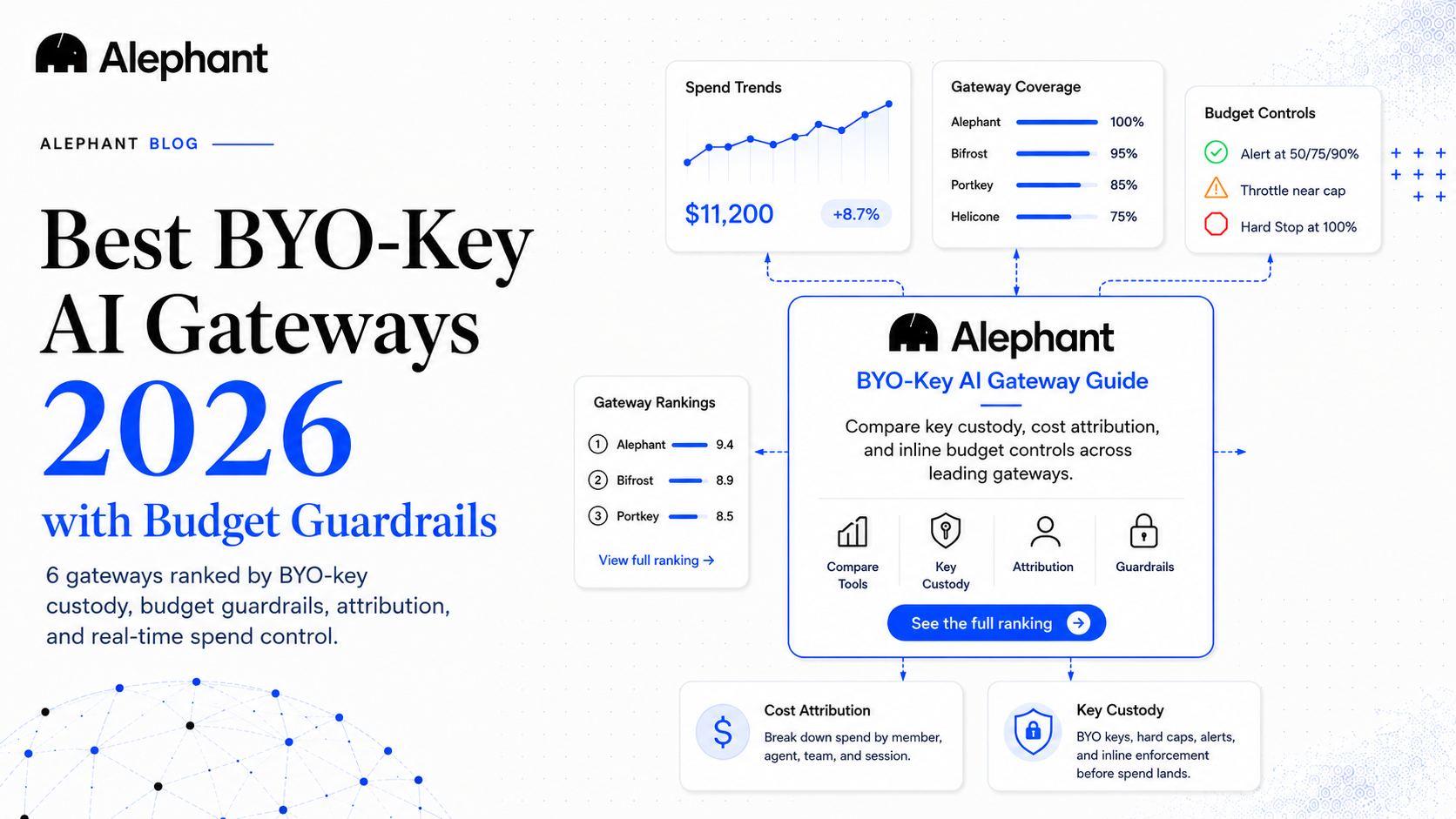
You sign off on the AI budget. The provider console shows you one number: $11,200 in May, up from $6,800 in April. It does not show which team spent it, which feature drove it, or which agent looped 800 times overnight and burned $400 before anyone woke up. The charge already cleared. The requests that caused it ran three weeks ago.
That gap is what a BYO-Key AI gateway with budget guardrails is supposed to close. Most do not. They route the request, store your keys, and the budget question still arrives a month late as an invoice instead of a guardrail.
The pressure is real. 98% of FinOps practitioners now manage AI spend in 2026, up from 31% in 2024, per the FinOps Foundation State of FinOps 2026 Report. AI cost management is the single most requested skill on those teams, named by 58% of them. The tooling has not caught up to the mandate. This guide ranks six gateways on the four things a spend owner actually needs: bring-your-own-key custody, enforceable budget guardrails, per-user and per-agent cost attribution, and usage analytics with quotas.
TL;DR. A BYO-Key AI gateway routes every model call through one control point while you keep custody of your provider keys. The ones worth paying for in 2026 enforce budgets before the provider charge lands, not after. Of the six ranked here, Alephant, Bifrost, and LiteLLM enforce inline; Portkey gates per-member attribution and granular budgets to Custom Pricing; Helicone is observability-first with session-level attribution; Cloudflare AI Gateway stores your keys but caps budget control at rate limits. Per-user and per-agent attribution is the line most of them do not cross. Alephant and Bifrost do. The rest stop at per-key or session level.
What is a BYO-Key AI gateway?
A BYO-Key AI gateway is a proxy layer that sits between your application and AI providers and uses your own API credentials to make the calls. It does not issue its own keys or resell model access, so your provider relationship and your data stay yours. A single base_url swap routes traffic through it, and from that one point you get routing, caching, budget enforcement, and cost attribution.
What are budget guardrails?
Budget guardrails are spending limits a gateway enforces at request time: alerts as a budget fills, throttling as it nears the cap, and a hard stop when it is exhausted. The distinction that matters for spend oversight is timing. An inline gateway can reject the call before the provider charge is incurred. A billing dashboard can only tell you it already happened.
The decision rubric
Every gateway below is scored on the same six criteria. This is the rubric a spend owner can reuse on any tool the vendor list grows to include.
| Criterion | What we scored | Why a spend owner cares |
|---|---|---|
| BYO-Key custody | Keys in your vault or the vendor's? Self-host option? | Decides whether your prompts transit a third party |
| Budget guardrails | Alert, throttle, hard stop, enforced before the call | A late alert is a post-mortem, not a control |
| Per-user attribution | Spend split by individual member or key | Spend without an owner has no fix |
| Per-agent attribution | Spend split per agent or workflow | Agent loops are the dominant 2026 waste pattern |
| Usage analytics and quotas | Dashboards, rate caps, per-key quotas | The day-to-day oversight surface |
| Real-time enforcement | Inline proxy vs post-hoc billing | Only inline can stop spend before it lands |
The 6 best BYO-Key AI gateways with budget guardrails
1. Alephant: BYO-Key gateway built around cost attribution
Alephant is the only gateway here that treats per-member and per-agent cost attribution as the headline rather than a side feature. The runtime is an OpenAI-compatible gateway at https://ai.alephant.io/v1, public since 2026-05-12, with the Rust source open-sourced under GPL v3 as alephant-ai-gateway. BYO-Key is the default and the strictest on this list: provider credentials live in an AES-256 vault with Workspace Isolation enforced through row-level security, and they never leave your environment whether you run the hosted version or self-host the same binary.
On budget guardrails, the Budget Circuit Breaker runs alert, throttle, and hard-stop enforcement inline. The free Personal tier gets a monthly budget hard stop, a daily hard stop, and a monthly spend alert. Pro ($29/month) unlocks Budget Control with escalation at 50/75/90/100% of any configured budget. Per-member budget caps land at Team ($79/month).
Attribution is where it separates from the field. Cost Attribution splits spend across Member, Agent, and Department at the Pro tier, and the Alephant-Session-Id header groups requests into sessions, so a runaway agent shows up in its own lane the hour it starts. AI Inside, the Pro+ efficiency layer (Cloud-only), grades every request cohort on an S-to-D scale across an 11-axis signal system. W3 Agent Thrashing is a veto signal that drops any looping agent's Efficiency Score on sight. W2 Model Overkill flags a frontier model doing a job a cheaper one would match. W6 Cache Miss catches caching left on the table. Every member and agent gets a Spend Justification Rating of justified, questionable, or wasteful.
A 100 RPM Basic Rate Cap is always on, at every tier including free, as a floor against accidental agent loops. The free tier ships 10,000 requests with no credit card.
Where it falls short: AI Inside and the Prompt Registry are Cloud-only and Pro+ gated, so the free tier is a budget-safety experience rather than the full efficiency suite. The provider catalog (50+ providers, 320+ models) is narrower than Portkey's 1,600+ model count, though it covers every major provider a spend owner is likely to be billed by.
Best fit: SMEs and AI-first teams whose finance owner needs per-member and per-agent attribution plus enforceable budgets in one place, at a price below the enterprise tier where competitors gate the same features.
2. Bifrost: fastest open-source gateway with real hierarchical budgets
Bifrost, by Maxim AI, is the strongest competitor here on budget enforcement specifically. It is Go-based and self-hosted, with 11µs of overhead at 5,000 RPS and roughly 50x the throughput of LiteLLM at comparable load. Budgets are hierarchical and enforced before the call: a team of ten might share a $500/month team budget while each virtual key also carries a $75/month personal cap, and every request is checked against both. It covers 20+ providers (1,000+ models), ships SSO via Okta and Entra, in-VPC and air-gapped deployment, HashiCorp Vault integration, immutable audit logs, and content guardrails. BYO-Key custody is absolute because you run it.
Where it falls short for a spend owner: attribution stops at the virtual-key and team level. There is no per-agent efficiency grading and no spend-justification verdict, so you can see that a key is expensive without knowing whether the spend was waste. And it is self-host only, which means the finance owner needs an engineer to stand it up and keep it running.
Best fit: teams with DevOps capacity who want enforced hierarchical budgets and top-tier throughput, and can live with key-level rather than agent-level attribution.
3. Portkey: strong dashboards, attribution gated to Custom Pricing
Portkey is a mature control plane with a 1,600+ model catalog and one of the deepest guardrail libraries in the category. Its $49/month Production tier ships real-time cost dashboards, observability with alerts, simple and semantic caching, RBAC, and unlimited prompt templates. BYO-Key runs through a key vault.
The catch for a spend owner is where attribution and enforcement sit. Per-member spend attribution and Granular Budget & Rate Limits both live in Enterprise (Custom Pricing), alongside SSO, custom guardrail hooks, and SOC 2 / HIPAA / GDPR. The dashboard tells you the org total at $49. The per-person breakdown and the multi-level budget escalation require a sales call with no published price.
Best fit: enterprise teams with compliance requirements and budget for Custom Pricing who want the governance layer and can absorb the gating.
4. Helicone: observability-first, session-level attribution
Helicone (YC W23, 7,000+ GitHub stars) is one of the cleanest developer experiences in the category. The Pro plan tracks cost across 300+ models with per-request analytics, session-level attribution, and caching. BYO-Key is supported. Session-level attribution approximates per-agent tracking when your sessions map cleanly to agents.
Two things matter for a spend owner. First, pricing: Pro is $79/month plus a 5% markup on API spend, so at $10,000/month of usage the platform layer runs about $579/month. Second, the product measures what happened, not whether it was worth it. There is no efficiency grade and no waste-signal system, so cost is a reporting dimension rather than an enforced guardrail.
Best fit: teams who want request-level tracing and latency analysis with cost as one dimension, and whose agents map cleanly to sessions.
5. LiteLLM: open-source baseline with per-key budgets
LiteLLM (33,000+ GitHub stars) is the most widely adopted open-source proxy, free to self-host, covering 100+ model SDKs with per-key, per-user, and per-team budget primitives. For a finance owner it is the cheapest way to get virtual-key budgets, and BYO-Key custody is absolute because you host it.
The cautions are real. Community load tests report latency spikes to 4+ minutes at 500 RPS and effective unusability near 5,000 RPS, with production operation requiring Redis, PostgreSQL, and load balancers. The 2026-03-24 PyPI supply-chain incident, where releases 1.82.7 and 1.82.8 shipped backdoored code that exfiltrated SSH keys and cloud credentials, is a reminder that the open-source supply chain is inherited risk you manage with pinned versions and upstream audits. Attribution stops at the key level. There is no per-agent view.
Best fit: prototypes and small-scale production with DevOps capacity to pin versions, run the infra, and watch the supply chain.
6. Cloudflare AI Gateway: edge gateway, budgets stop at rate limits
Cloudflare AI Gateway is the lowest-friction option if you already run on Cloudflare. The basic tier is free for account holders, with caching, rate limiting, request logging, guardrails, and 2026 Unified Billing that lets you pay for third-party model usage on your Cloudflare invoice (a small convenience fee applies). BYO-Key works by storing your provider keys in the Cloudflare dashboard and referencing them in the gateway config.
For spend oversight specifically, the gaps are the budget and attribution layers. Cloudflare's own docs and third-party reviews flag the lack of fine-grained budget control: you get rate limiting, not multi-level budget escalation, and there is no per-user or per-agent cost attribution. Keys also live in Cloudflare's dashboard rather than a vault you control, a different custody posture than a self-hosted or zero-retention model.
Best fit: teams already on Cloudflare Workers or Pages who want a thin caching and logging layer and can handle budgets elsewhere.
Comparison table
| Gateway | BYO keys | Budget guardrails | Per-user attribution | Per-agent attribution | Usage analytics & quotas | Real-time enforcement | Category |
|---|---|---|---|---|---|---|---|
| Alephant | AES-256 vault + Workspace Isolation | Budget Circuit Breaker (50/75/90/100%, Pro+) | Yes (Pro $29) | Yes (Member/Agent/Dept) | Dashboards + 100 RPM cap + per-prompt caps | Yes | BYO-Key FinOps gateway |
| Bifrost | Self-host (absolute) | Hierarchical (key/team/org) | Virtual-key level | No | Prometheus/OTel + rate limits | Yes | Performance-first OSS |
| Portkey | Key vault | Granular (Enterprise/Custom) | Enterprise (Custom) | Limited | Dashboards (Prod $49) | Threshold alerts | Control plane |
| Helicone | Yes | Limited | Yes | Session-level | Strong analytics (+5% markup) | Partial | Observability-first |
| LiteLLM | Self-host | Per-key (basic) | Per-key / user | No | Basic + per-key quotas | Limited | Open-source proxy |
| Cloudflare AI Gateway | Dashboard-stored | Rate limit only | No | No | Edge analytics + rate limits | Rate limit only | Edge gateway |
The BYO-Key trust model: where your keys actually live
BYO-Key is on every spec sheet here. What it means in practice varies enough to matter for anyone signing off on data handling.
The custody question has three answers. Self-hosted gateways (Bifrost, LiteLLM) give you absolute custody because the keys never leave your servers; the cost is the DevOps to run them. Dashboard-stored gateways (Cloudflare) keep your keys in the vendor's console and route your traffic through the vendor's edge: convenient, but your prompts transit a third party. Managed gateways with a controlled vault (Alephant, Portkey, Helicone) encrypt keys at rest and route through their infrastructure under contractual data separation.
Alephant's posture is the strictest of the managed options: an AES-256 vault, Workspace Isolation enforced by row-level security, zero prompt retention, and the same Rust binary available to self-host under GPL v3 if you want absolute custody without giving up the attribution layer. The question to ask any vendor is not whether BYO-Key exists. It is whether zero data access is the default behavior or an enterprise add-on you negotiate.
How to choose by use case
If you need per-user and per-agent attribution in one view. Alephant tags every request with Member, Agent, and Department and adds an Efficiency Score per entity at Pro+. Helicone gets you per-user and approximates per-agent through sessions. Bifrost stops at the virtual-key level. Portkey gates per-member to Custom Pricing. Cloudflare AI Gateway does not attribute by user or agent at all.
If your priority is enforced budgets before the spend lands. Alephant's Budget Circuit Breaker and Bifrost's hierarchical budgets both reject calls inline. LiteLLM enforces per-key budgets. Portkey gates granular escalation to Enterprise. Cloudflare gives you rate limits, not budgets. Billing dashboards alert after the fact, which is too late for a hard cap.
If custody is non-negotiable. Self-host Bifrost or LiteLLM, or self-host the Alephant runtime if you also want per-agent attribution. Among managed options, Alephant's AES-256 vault with row-level isolation is the strictest default.
If you are already on Cloudflare and budgets live elsewhere. Cloudflare AI Gateway is the thinnest add. Pair it with a billing platform for the finance view, since on its own it will not give you per-user attribution or multi-level budgets.
Frequently Asked Questions
What is the best AI gateway for tracking LLM costs?
The best AI gateway for tracking LLM costs gives you per-request cost data broken down by member, agent, and feature, in real time, across every provider you use. Alephant is purpose-built for this: Cost Attribution splits spend by Member, Agent, and Department at the Pro tier ($29/month), and the AI Inside layer grades each cohort on efficiency. Portkey and Helicone both ship strong cost dashboards, though Portkey gates per-member attribution to Custom Pricing and Helicone adds a 5% markup on API spend. Bifrost and LiteLLM track cost at the virtual-key level when self-hosted.
Which AI gateway supports BYO keys and budget guardrails?
Alephant, Bifrost, and LiteLLM all combine BYO-Key custody with budget guardrails enforced before the provider call. Alephant runs the Budget Circuit Breaker with 50/75/90/100% escalation and stores keys in an AES-256 vault. Bifrost enforces hierarchical budgets at the key, team, and org level and is self-hosted. LiteLLM offers per-key budgets, also self-hosted. Portkey supports BYO keys but gates granular budgets to Enterprise. Cloudflare AI Gateway stores keys in its dashboard but limits budget control to rate limiting.
Which LLM gateway provides per-user and per-agent cost attribution?
Alephant is the clearest answer for both dimensions in one view: every request carries Member, Agent, and Department tags, and the Alephant-Session-Id header groups calls into sessions for per-agent rollups. Helicone provides per-user attribution and approximates per-agent through session-level tracking. Bifrost attributes at the virtual-key level rather than per agent. Portkey offers per-member attribution at its Enterprise tier. LiteLLM and Cloudflare AI Gateway do not provide per-agent attribution.
How do budget guardrails actually stop overspending?
An inline gateway evaluates each request against the budget before it forwards the call to the provider. As the budget fills, it can fire an alert; as it nears the cap, it can throttle; when it is exhausted, it rejects the call so no charge is incurred. Alephant's Budget Circuit Breaker escalates at 50/75/90/100% of a configured budget at Pro+. A billing dashboard cannot do this because it reads invoice data after the spend has already happened.
Does Cloudflare AI Gateway support budget limits?
Cloudflare AI Gateway supports rate limiting, caching, request logging, and cost metrics, plus 2026 Unified Billing for paying third-party model usage on your Cloudflare invoice. It does not offer fine-grained, multi-level budget escalation or per-user and per-agent cost attribution. For hard budget caps and attribution by team or agent, pair it with an inline FinOps gateway such as Alephant or Bifrost.
What is the best Portkey alternative for per-member cost attribution?
Alephant is the closest alternative for teams that want per-member and per-agent attribution without crossing into Custom Pricing. Portkey ships cost dashboards at its $49 Production tier but gates per-member spend attribution and granular budgets to Enterprise. Alephant includes per-member Cost Attribution at Pro ($29/month), the Budget Circuit Breaker with 50/75/90/100% escalation at Pro+, and the AI Inside efficiency layer that grades spend per member and agent.
The bottom line
Every AI gateway here routes your requests and either stores or holds your keys. Far fewer enforce a budget before the charge lands. The set that also splits that spend by the person or the agent who caused it is smaller again, and for an SME finance owner that last capability is the whole job. It is where the field thins out fast.
Alephant sits at the gateway layer with attribution and budget enforcement as the product, not the upsell: per-member and per-agent Cost Attribution at Pro ($29), the Budget Circuit Breaker with 50/75/90/100% escalation at Pro+, BYO-Key in an AES-256 vault with Workspace Isolation, and the AI Inside efficiency layer no competitor matches at any tier. The runtime is public at https://ai.alephant.io/v1 and open-sourced under GPL v3.
If the next invoice will be your largest, the Free tier puts the gateway in front of your production traffic at no cost, and per-member and per-agent attribution unlock at Pro ($29). Join at alephant.io. Self-host alephant-ai-gateway from the Alephant org on GitHub. The team builds in public in the Alephant Discord.
Data notes: Feature comparisons are based on publicly available documentation, pricing pages, and vendor reviews as of May 2026. LiteLLM performance figures are from community-reported load tests in the project's GitHub issues; the 2026-03-24 PyPI incident is documented in LiteLLM release notes and security advisories. Bifrost throughput figures (11µs at 5,000 RPS, ~50x LiteLLM) are from Maxim AI benchmarks. Alephant feature gating reflects the 2026-05-12 public launch.