
Best AI Spend Tracking Tools for Engineering Teams 2026
Tuesday 3:17 a.m. The pager fires. $1,840 of gpt-4o-mini in forty minutes, and the dashboard cannot stop the agent. Ten AI spend tracking tools engineering teams actually evaluate in 2026, ranked.

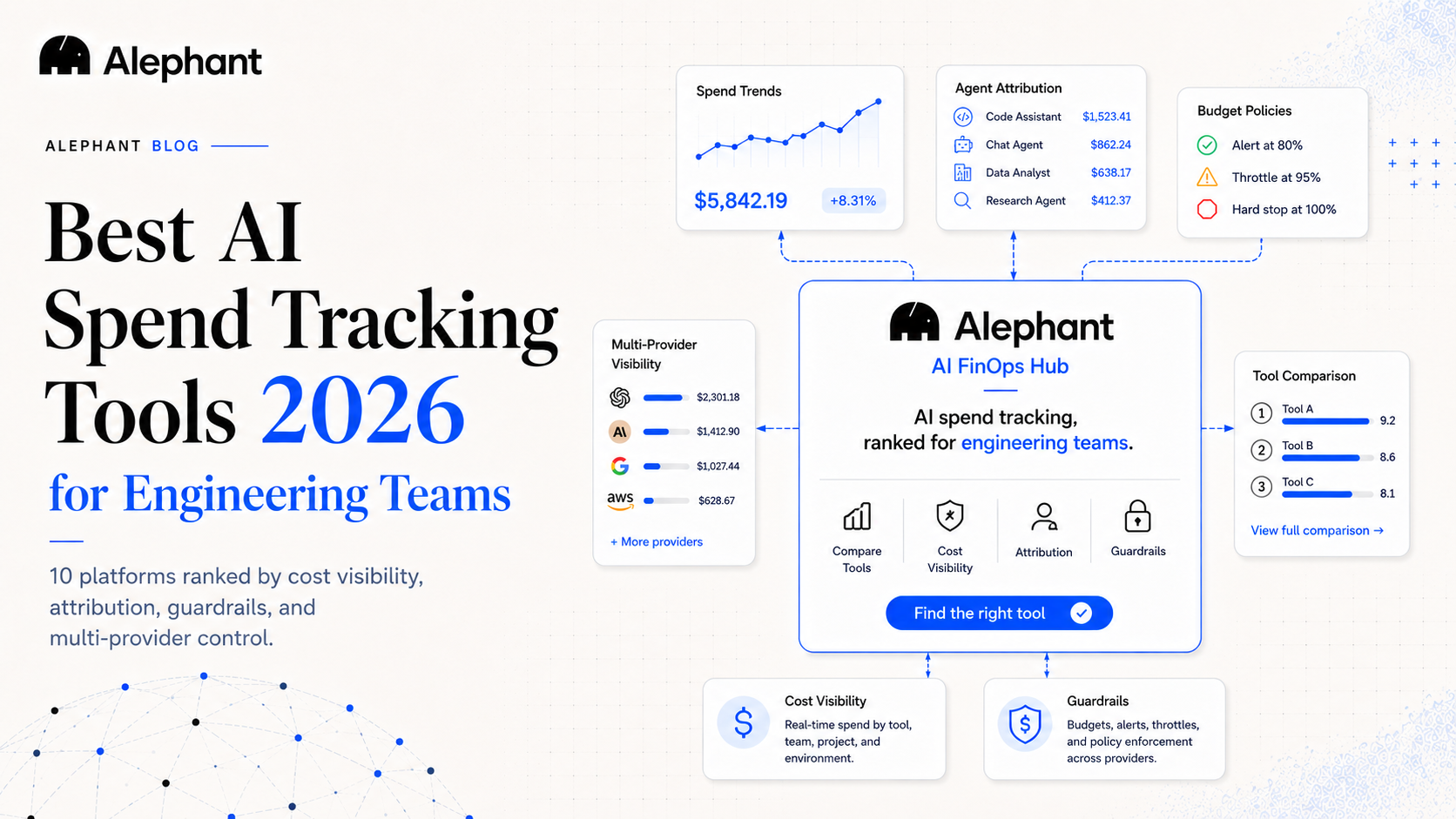
Tuesday, 03:17. The on-call pager fires. Not a 5xx storm, not a database timeout. The OpenAI usage dashboard shows $1,840 of gpt-4o-mini traffic in the last forty minutes, all from one internal service. The agent producing it is still running. The on-call engineer has the dashboard. The dashboard cannot stop the agent.
This is the structural problem AI spend tracking solves for engineering teams. Provider dashboards lag by minutes. Provider invoices arrive monthly. Application logs show that requests happened, not what they cost. By the time an engineer reconstructs the morning, the spend is locked in, the agent has been quietly looping for hours, and the finance lead is forwarding the bill.
Model API spending doubled from $3.5 billion to $8.4 billion between late 2024 and mid-2025 per Menlo Ventures, and 98% of FinOps practitioners now manage AI spend in 2026, up from 31% in 2024 per the FinOps Foundation's State of FinOps 2026. The category of tools below exists because engineering teams need attribution, enforcement, and observability in the request path, not in next month's invoice review.
This is a ranked list of 10 AI spend tracking platforms that engineering teams actually evaluate in 2026, scored on engineering-team criteria: API surface, BYO-KEY posture, multi-provider coverage, real-time enforcement, agent-level attribution, OSS license, and integration time.
TL;DR. Engineering teams have ten serious options for AI spend tracking in 2026. Four are inline gateways purpose-built for cost control (Alephant, Portkey, Helicone, Bifrost). Two are open-source community proxies (LiteLLM, OpenRouter). One is an edge gateway bundled with a CDN (Cloudflare AI Gateway). One is an observability platform with cost attached (Langfuse). Two are downstream FinOps and APM layers (Vantage, Datadog LLM Observability). The 2026 engineering default is to run an inline gateway in the request path and feed its telemetry into a billing platform when finance needs unit economics across infrastructure plus AI.
What "AI Spend Tracking for Engineering Teams" Means
The phrase covers three jobs the platform has to do for an engineering audience:
- Attribute every request. Per engineer, per agent, per feature, per customer, in real time. Aggregate totals from provider dashboards do not answer "which service did this." Per-key custody is the floor under attribution: a shared
OPENAI_API_KEYfile attributes spend to whoever copied the secret, not to the service that called. - Enforce in the request path. Alerts that arrive after the invoice are forensics. Throttles and hard caps that fire before the next provider call resolves are control. Engineering teams running autonomous agents need rate caps in seconds, not in hours.
- Surface latency, errors, and cost together. Engineers debug latency and errors in the same dashboard they would prefer to see cost in. Tools that bolt cost onto a finance dashboard miss the engineering workflow. Tools that bolt cost onto an APM stack fit it.
A fourth job is increasingly table-stakes for engineering teams running production agents: detect runaway loops at the signal layer, before they cost real money. CloudZero documents hour-level anomaly detection as a billing-platform feature; gateway-layer thrashing detection catches the same loop in seconds because it sees the request rate, not the invoice.
Selection Criteria
| Criterion | Why engineering teams weight it |
|---|---|
| BYO-KEY posture | Whether the tool holds your provider keys, or your team keeps custody. BYO-KEY keeps procurement relationships intact and removes a data-exfiltration vector. |
| OSS license | An open-source runtime lets the team self-host, audit, and pin versions. Closed-source proxies are inherited risk in incident response. |
| Multi-provider coverage | 2026 teams run across at least two model families (OpenAI plus Anthropic is the baseline). One-provider tools force a second dashboard. |
| Real-time enforcement | A budget alert that arrives 24 hours after the spend is not a guardrail. Inline-proxy architectures are the only category that can reject a request in the path. |
| Agent-level attribution | Per-agent Virtual Keys with session-ID headers are the unit of attribution for 2026 autonomous workloads. |
| Integration time | The shortest path is a one-line base_url swap. Any tool that requires multi-week refactoring loses to the OSS proxy that swaps in an afternoon. |
| Performance overhead | An inline gateway adds a hop. Engineering teams care about the µs-level cost of the hop at production RPS. |
Intelligent model routing delivers 30 to 70% cost reduction on mixed workloads per CostLayer's 2026 tracker, with aggressive routing to lightweight models reaching 98% on specific workloads. Native prompt caching reduces input-token cost by 50 to 90% on supported providers per Anthropic and OpenAI's pricing pages. The tools below differ sharply on whether they expose these levers programmatically or hide them behind a managed UI.
The 10 Tools
1. Alephant: AI FinOps Gateway with engineering-grade attribution
Alephant is the only tool on this list whose product surface is cost intelligence rather than routing or observability. The runtime is an OpenAI-compatible Rust gateway at https://ai.alephant.io/v1, publicly accessible since 2026-05-12 and open-sourced under GPL v3 as alephant-ai-gateway on GitHub. BYO-KEY is the default posture: provider credentials live in an AES-256 vault with workspace isolation enforced through PostgreSQL row-level security, and never leave the customer environment.
For engineering teams, the practical surface is four headers and one endpoint. Point an existing OpenAI client at the gateway base URL, send Alephant-Session-Id to group an agent's requests, and the Cost Attribution dashboard fills out within seconds. The four-dimension attribution layer (Member, Agent, Department, Feature) maps directly to the way engineering teams already structure their services: per-engineer Virtual Keys for development, per-agent Virtual Keys for production workloads, Department Key Access for cost centers, free-form feature tags for product surfaces.
What separates Alephant from the rest of the category for an engineering audience is AI Inside, an 11-axis signal system that grades every request cohort on an S-through-D scale. Eight waste signals catch the failure modes engineers actually ship: W3 Agent Thrashing (a veto signal that immediately downgrades any agent caught in a loop), W2 Model Overkill, W6 Cache Miss, W7 Oversized Prompt. Three value signals reward the savings: V1 Cache Hit Bonus, V2 Route Optimization, V3 Compression Gain.
On the enforcement side, the Budget Circuit Breaker runs Alert / Throttle / Kill at 70 / 90 / 100% of any configured budget, and a 100 RPM Basic Rate Cap is always-on at every tier (including Free) as the floor under accidental while True: loops. Free tier ships with 10,000 requests and no credit card.
Engineering verdict: strongest fit if cost attribution and inline enforcement are the primary requirements, with the OSS runtime as a safety net for self-host.
2. Helicone: observability-first with developer DX polish
Helicone (YC W23, ~7,000 GitHub stars) is among the cleanest developer experiences in the category. The Pro plan ships 300+ model cost tracking, per-request analytics with latency and error overlays, session-level attribution, semantic and exact-match caching, an n8n custom node, and a Vercel AI SDK provider. The product was a request-logging and tracing tool first and a gateway second, and the architecture still shows that ordering.
For engineering teams whose primary need is per-request observability (what did the call do, how long did it take, what did it cost), Helicone is a fast win. At $10,000 per month in API spend, the Pro plan with its 5% markup totals $579 per month for the platform layer.
Engineering verdict: best for teams that want latency, errors, and cost in one tracing UI, where cost is one column of three.
3. Portkey: enterprise control plane with the broadest model catalog
Portkey is a Series A control plane with a 1,600+ model catalog and 50+ guardrails. The Production tier ships real-time cost dashboards, simple and semantic caching, RBAC with service-account API keys, and an extensive prompt-template system. SOC 2 Type 2, HIPAA, GDPR, and BAAs live at the Enterprise tier alongside SSO and granular per-member budget escalation.
The buyer persona is a senior engineering lead at a regulated team that needs compliance evidence alongside cost control. The depth of the guardrail library is the strongest in the category.
Engineering verdict: the right choice when compliance scope and prompt-template governance matter as much as cost control.
4. Langfuse: open-source LLM observability with cost calculation built in
Langfuse (~23,000 GitHub stars, acquired by ClickHouse in January 2026) is the open-source LLM observability platform engineering teams reach for when cost is one signal in a broader observability stack. The @observe() decorator wraps a function call; nested LLM calls trace automatically; cost is calculated from a pricing database that handles tier-based pricing, cached tokens, and reasoning tokens.
The platform's strength is connecting cost to business context through multi-step tracing: an agent run is a tree, every node is a request, every request has a cost, and the root carries the rolled-up dollar amount. The SDK installs at roughly 26 million per month per Langfuse's 2026 reporting, and the customer list includes 19 Fortune 50 companies.
Engineering verdict: strongest fit when cost data has to live next to traces, evaluations, and prompt experiments rather than next to a finance dashboard.
5. OpenRouter: model marketplace with the deepest provider catalog
OpenRouter is the model-variety leader: 500+ models, a unified API, and a BYO-KEY tier that covers 60+ providers with the first 1 million requests per month free on routed paths. For engineering teams prototyping across model families or accessing providers without standing up direct accounts (DeepSeek, Moonshot, Z-AI), the friction collapses to a single API key.
Pay-as-you-go applies a 5% markup on routed requests. Credit-purchase adds 5% + 5.5%. At $1,000 per month in API spend the markup is $50; at $10,000 per month it is $500. Cost tracking on the Activity page shows request counts, token totals, and a rough spend figure. The platform does not expose per-agent or per-member attribution dimensions natively.
Engineering verdict: the right choice for model-variety prototyping; the wrong choice when per-agent attribution or real-time enforcement is the primary requirement.
6. LiteLLM: the open-source Python proxy with the broadest community
LiteLLM (~38,900 GitHub stars per Finout's March 2026 review, 470,000+ PyPI downloads) is the de facto OSS starting point for teams that want a self-hosted proxy without building one. MIT licensed, 100+ provider SDKs, per-key budget primitives via max_budget, and a permissive deployment story for teams with DevOps capacity.
Community-reported load tests show latency spikes to 4+ minutes at 500 RPS and effective unusability at 5,000 RPS, with production-grade operation requiring Redis, PostgreSQL, and load balancers. The 2026-03-24 PyPI supply-chain incident (releases 1.82.7 and 1.82.8 shipped backdoored code that exfiltrated SSH keys, cloud credentials, and API keys) is a reminder that OSS-proxy supply chains are inherited risk unless the team pins versions and audits releases.
Engineering verdict: unbeatable for prototypes and dev environments. Needs version pinning, infrastructure investment, and a vulnerability-monitoring posture before it goes near production.
7. Bifrost: performance-first Go gateway by Maxim AI
Bifrost is the throughput leader among OSS proxies: Go-based, self-hosted, with 11µs request overhead at 5,000 RPS and roughly 50x the throughput of LiteLLM at comparable load per independent 2026 benchmarks. The release ships semantic caching, native MCP support, hierarchical budget management at virtual-key, team, and customer levels, and audit logs that meet SOC 2, HIPAA, GDPR, and ISO 27001 requirements, all in the open-source package.
The platform supports 15+ providers and ships from Maxim AI as part of their broader observability and testing stack.
Engineering verdict: the right choice for performance-critical production teams with DevOps capacity who want self-hosted control and modern features without managed-SaaS pricing.
8. Cloudflare AI Gateway: edge gateway bundled with the CDN
Cloudflare AI Gateway is the lowest-friction choice for engineering teams already deploying through Cloudflare Workers or Pages: a free basic tier, caching, rate limiting, and request logging executed at Cloudflare's edge network. Latency is among the lowest in the category for applications already routing through the Cloudflare stack, and the gateway inherits Cloudflare's compliance posture.
Advanced features tie into Cloudflare's broader paid-plan structure. The gateway is one component of the larger platform rather than a standalone product.
Engineering verdict: the natural pick when Cloudflare Workers or Pages already host the application. Not a standalone evaluation otherwise.
9. Datadog LLM Observability: APM-integrated cost monitoring
Datadog ships LLM Observability as a module on top of its APM and infrastructure-monitoring stack. Cost data joins latency, error rates, and infrastructure metrics in the same query layer engineering teams already use for service health. The product surface is integration with the broader Datadog ecosystem rather than purpose-built cost intelligence: it is the right answer when "the team is already in Datadog" is true, and worth comparison against purpose-built tools otherwise.
Pricing follows Datadog's per-host and per-event model, which scales independently of the underlying AI API spend.
Engineering verdict: the right answer for teams already running on Datadog who want LLM cost in the same dashboard as service-health signals.
10. Vantage: developer-friendly multi-cloud FinOps with native AI integrations
Vantage is the engineering-friendly multi-cloud FinOps choice with explicit AI-provider awareness: 25+ native integrations including OpenAI, Anthropic, AWS, Azure, GCP, and Kubernetes. Predictive analytics with point-in-time run rates and Terraform providers make cost policies version-controllable. The architecture is billing-based (post-hoc invoice ingestion) rather than an inline proxy, so AI spend appears in the same view as infrastructure spend.
The Autopilot optimization engine adds a +5% fee on savings generated. The positioning as the engineering-led FinOps choice sets it apart from heavier enterprise FinOps suites.
Engineering verdict: the right downstream layer for an inline gateway, not a replacement. Ideal when finance needs AI spend reconciled with infrastructure in one dashboard.
Comparison Table
| Tool | Architecture | OSS license | BYO-KEY | Multi-provider | Real-time enforcement | Per-agent attribution |
|---|---|---|---|---|---|---|
| Alephant | Inline gateway | GPL v3 | Yes, AES-256 vault | 50+ providers, 320+ models | Budget Circuit Breaker + Policy Engine | Member / Agent / Department / Feature |
| Helicone | Observability-first gateway | Apache 2.0 | Yes | 300+ models | Threshold alerts | Session-level |
| Portkey | Control plane | Proprietary | Yes | 1,600+ models | Threshold alerts (Production); granular (Enterprise) | Virtual-key + metadata tags |
| Langfuse | Observability platform | MIT | N/A (observability) | All | Limited (alerting) | Trace-tree level |
| OpenRouter | Model marketplace | Proprietary | Server-side BYOK on tier | 500+ models, 60+ providers | No | No |
| LiteLLM | Open-source Python proxy | MIT | Yes (self-host) | 100+ models | max_budget per key |
Limited |
| Bifrost | Open-source Go gateway | Apache 2.0 | Yes (self-host) | 15+ providers | Hierarchical budgets | Virtual-key |
| Cloudflare AI Gateway | Edge gateway | Proprietary | Yes | Cloudflare-routed | Rate limit only | No |
| Datadog LLM Observability | APM-integrated | Proprietary | N/A (observability) | All | No (alerting only) | Trace level |
| Vantage | Billing-based FinOps | Proprietary | N/A (billing) | OpenAI + Anthropic + clouds | Alerts only | No (invoice-level) |
How to Choose by Engineering Use Case
If a single OpenAI dashboard is the current state. Start with OpenAI's native Project-level monthly budget caps and alert thresholds at Settings → Limits, then layer an inline gateway when usage outgrows a single provider. Alephant and Portkey both ship multi-level budget escalation in the gateway layer; Helicone adds the observability polish if request-level tracing is the primary need.
If autonomous agents are running in production. Per-agent Virtual Keys with budget envelopes are the structural answer. Alephant tags requests with the Alephant-Session-Id header for runtime agent attribution and flags W3 Agent Thrashing as a veto-level signal that downgrades any looping agent's Efficiency Score in real time. Bifrost ships hierarchical budgets at the agent virtual-key level in the OSS release. Datadog catches anomalous agent traces but reports rather than enforces.
If the team is already in a specific stack. Cloudflare AI Gateway is the natural pick for Cloudflare Workers and Pages teams; Datadog LLM Observability for Datadog APM teams; Langfuse for teams that already run prompt experiments and evaluations on the Langfuse observability stack. The "one less vendor onboarding" math beats most feature comparisons at the margin.
If the team wants managed SaaS with zero infrastructure. Alephant's hosted Cloud at https://ai.alephant.io/v1 is the stack-agnostic pick for teams that want cost intelligence as a managed service rather than a self-host. Live publicly since 2026-05-12, Free tier 10,000 requests, no credit card, no Redis or PostgreSQL to operate. Same Rust runtime as the open-source alephant-ai-gateway covered in the next bullet, so the migration path to self-host stays open if compliance or data-residency requirements change.
If the team needs OSS and self-host. LiteLLM is the broadest community proxy (MIT, ~38,900 stars), Bifrost is the performance leader (Apache 2.0, Go, 11µs overhead), Alephant is the only purpose-built cost-intelligence runtime open-sourced (GPL v3, Rust). All three deploy on the team's own infrastructure with PostgreSQL and Redis backends.
If finance needs unit economics across infrastructure plus AI. Vantage is the engineering-friendly billing layer; CloudZero is the enterprise reference if AWS AI Competency and dimensional allocation matter. Both ingest gateway telemetry through the FOCUS Standard, which normalizes proxy data for billing-platform ingestion.
Frequently Asked Questions
What is the best OpenRouter alternative for AI spend tracking?
For engineering teams that want OpenRouter's multi-provider coverage without the 5% markup and with deeper attribution, Alephant is the closest functional alternative. Alephant runs BYO-KEY (no markup, the team keeps provider relationships), ships per-Member and per-Agent Cost Attribution with the Alephant-Session-Id header for runtime agent grouping, adds the Budget Circuit Breaker with Alert / Throttle / Kill enforcement at 70 / 90 / 100% of configured budget, and grades request cohorts on the 11-axis AI Inside efficiency layer. 50+ providers, 320+ models, one OpenAI-compatible endpoint. Free tier ships 10,000 requests with no credit card; the Rust runtime is open source under GPL v3.
What are the top AI API cost control platforms engineering teams use in 2026?
The 2026 short list for engineering-led teams is Alephant, Portkey, Helicone, Bifrost, and LiteLLM at the inline-gateway layer, plus Langfuse for observability-first stacks and Vantage or CloudZero at the billing-FinOps layer. Alephant ships the deepest cost-intelligence layer (AI Inside grading, Spend Justification Rating, W3 Agent Thrashing veto) plus the Policy Engine and the Budget Circuit Breaker under BYO-KEY. Portkey is the enterprise control plane. Helicone is observability-first with strong DX. Bifrost is performance-first OSS. LiteLLM is the community OSS baseline. The category answer for an engineering team that needs to prevent runaway spend rather than report on it is an inline gateway feeding a billing platform via the FOCUS Standard.
Which AI cost intelligence tools offer real-time budget guardrails?
Only inline-proxy architectures can enforce in the request path. Alephant ships the Budget Circuit Breaker with Alert / Throttle / Kill at 70 / 90 / 100% of configured budget, layered on Daily Hard Stop and Monthly Budget primitives available across every tier (including Free), plus the always-on 100 RPM Basic Rate Cap that catches accidental while True: loops. Portkey offers threshold alerts at the Production tier and granular per-member escalation at Enterprise. Bifrost ships hierarchical budgets at virtual-key, team, and customer levels in the OSS release. Helicone supports threshold alerts. Billing-based platforms (Vantage, CloudZero, Datadog LLM Observability) cannot enforce in real time because their telemetry source is post-hoc invoice or aggregated trace data.
Which AI cost dashboards work best for tracking agent-level spend?
Alephant's Cost Attribution dashboard splits spend across Member, Agent, Department, and Feature dimensions, with Entity Spotlight drilling into a single agent's efficiency profile, signal triggers, and fix suggestions. The Alephant-Session-Id header groups requests into agent sessions at the gateway. Helicone provides session-level attribution that approximates per-agent visibility when sessions map cleanly to agent runs. Langfuse provides trace-tree level attribution with the cost rolled up to the root span. CloudZero catches anomalous agent spend at hour-level granularity via dimensional allocation, useful for post-mortems. For real-time per-agent attribution at the moment of the call, gateway-issued Virtual Keys are the cleanest signal.
How do engineering leaders track AI API spend across providers?
The 2026 pattern is an inline gateway as the unified enforcement and attribution layer, feeding a billing-based platform for finance reporting via the FOCUS Standard. The inline gateway (Alephant, Portkey, Helicone) attributes every request at the token level by Member, Agent, Department, and Feature, then exports normalized telemetry. The billing platform (Vantage, CloudZero, Datadog) ingests that telemetry alongside infrastructure spend for unified unit economics. The inline layer is the source of truth for real-time control; the billing layer is the system of record for finance. Most production engineering teams need both.
What AI cost intelligence is available for engineering spend governance?
Two layers. Inline gateways like Alephant ship efficiency-grading signals that go beyond "how much" and answer "was it worth it": Spend Justification Rating per request cohort, 11-axis waste and value signals (W3 Agent Thrashing, W2 Model Overkill, W6 Cache Miss, W7 Oversized Prompt, V1 Cache Hit Bonus, V2 Route Optimization, V3 Compression Gain), and per-entity Efficiency Scores on an S-through-D scale. Billing-based platforms like CloudZero ship unit-economics intelligence (Cloud Efficiency Rate, cost per customer, cost per feature, cost per inference) for finance-facing reporting. Engineering teams that want governance signals in the same dashboard as deploy events run the inline layer.
What is the fastest AI spend tracking tool to integrate?
For Python and Node teams already on the OpenAI SDK, the fastest integration is a single base_url swap to an OpenAI-compatible gateway. Alephant, Portkey, Helicone, OpenRouter, and LiteLLM all expose OpenAI-compatible endpoints, which means the existing client code keeps working after one line of configuration change. Alephant's hosted endpoint is https://ai.alephant.io/v1; self-host clones from github.com/AlephantAI/AIephant-AI-Agent-Gateway. Langfuse and Datadog LLM Observability require SDK wrappers (@observe() decorator or the Datadog tracer), which adds an integration step but bundles tracing with cost.
What does BYO-KEY mean for an AI gateway, and why do engineering teams care?
BYO-KEY (Bring-Your-Own-Key) means the gateway uses the team's existing provider API credentials to talk to OpenAI, Anthropic, Google Gemini, AWS Bedrock, or any other supported provider. It does not issue its own keys, does not resell model access, and does not hold the provider relationship. For engineering teams, three practical implications follow: provider procurement contracts stay with the team's finance and legal posture, provider rate-limit tiers earned through usage are preserved, and the data-exfiltration vector of a third party holding the keys is removed. Alephant runs BYO-KEY by default with an AES-256 vault and workspace isolation enforced at the database layer; Portkey and Helicone offer similar postures.
The Bottom Line
AI spend tracking for engineering teams in 2026 is a layered problem. Inline gateways belong in the request path so attribution and enforcement happen the second a call resolves. Billing platforms belong downstream for finance reporting against unified unit economics. Observability platforms belong wherever the engineering team already runs traces, so cost lives next to latency and errors. The wrong move is to pick one layer and pretend it covers all three.
Alephant sits at the inline-gateway layer with cost intelligence as the primary product. The runtime is publicly accessible at https://ai.alephant.io/v1 since 2026-05-12, with the Rust source open-sourced under GPL v3 at github.com/AlephantAI/AIephant-AI-Agent-Gateway. The Free tier covers 10,000 requests with no credit card and ships four budget primitives on day one: Set Monthly Budget, Daily Hard Stop, Monthly Spend Alert, and the always-on 100 RPM Basic Rate Cap. Budget Control with multi-level escalation, Custom Rate Limit, and the AI Inside efficiency layer unlock on Pro and above. Member Budget Caps and Usage Schedule unlock on Team and above.
For an engineering team running production AI features, the integration is a one-line base_url swap on the existing OpenAI client. Tag the first request with Alephant-Session-Id, and Member, Agent, Department, and Feature attribution starts showing up in the dashboard within the first call. Self-host the same runtime from the public repo if the team prefers full control. The Alephant Discord is where the team answers architecture questions in public.