
11 AI API Cost Tools for Multi-Provider Spend in 2026
Your AI bill shows one line. It does not show which model, which feature, which agent. The 11 tools that fix that in 2026, ranked and compared.

The OpenAI billing dashboard shows one line: API usage. It does not show which model, which feature, which agent, which customer. The invoice arrives the first of the month. The cost was written three weeks earlier, in requests you cannot retrieve.
Model API spending doubled from $3.5 billion to $8.4 billion between late 2024 and mid-2025, with the enterprise LLM market projected to reach $71.1 billion by 2034. The tools listed below exist because most engineering teams now spend across two or more providers (OpenAI, Anthropic, Google Gemini, open-weight models on AWS Bedrock or self-hosted) and have no single pane that reconciles the bills before they land.
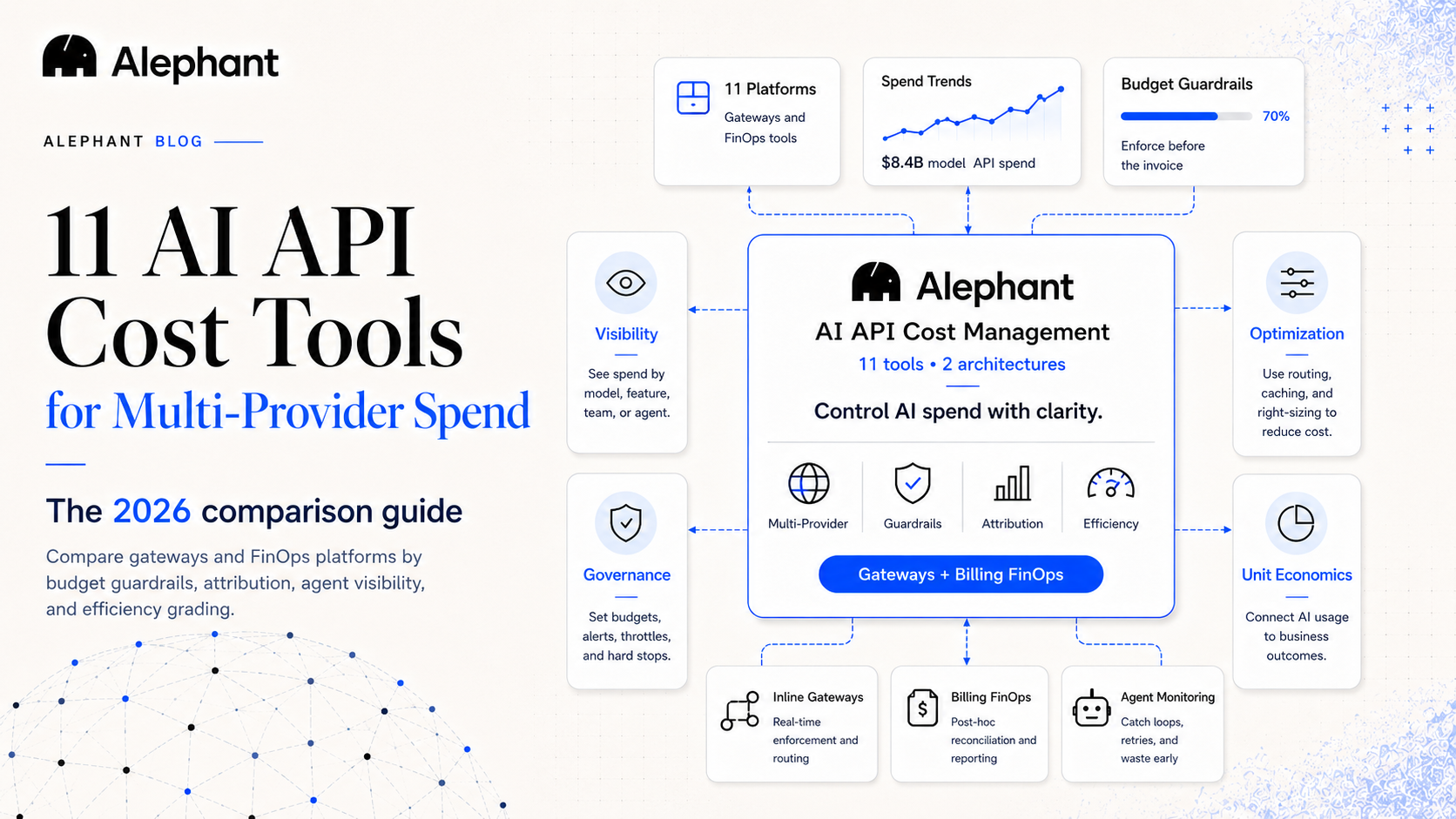
This is a ranked list of 11 platforms purpose-built or adapted for AI API cost management in 2026, scored on multi-provider coverage, real-time budget guardrails, agent-level visibility, and efficiency grading.
TL;DR. AI API cost management in 2026 is split between two architectures. Proxy gateways (Alephant, Portkey, Helicone, OpenRouter, LiteLLM, Bifrost, Cloudflare AI Gateway, Kong, TrueFoundry) sit inline and can enforce budgets before the provider call lands. Billing-based FinOps platforms (Vantage, CloudZero) ingest invoices after the fact and excel at unit economics across infrastructure plus AI. The 2026 best practice is to run an inline gateway as the enforcement layer and feed its telemetry into a billing platform via the FOCUS Standard. Per the FinOps Foundation, 98% of FinOps practitioners now manage AI spend in 2026, up from 31% in 2024.
What Is AI API Cost Management?
AI API cost management is the practice of tracking, attributing, and controlling spending on third-party large-language-model APIs across one or more providers. It differs from general cloud FinOps in three structural ways: pricing is per-token rather than per-hour, costs are driven by application-level decisions (which prompt, which model) rather than infrastructure provisioning, and the highest-leverage interventions (Native Prompt Caching, Model Routing, Prompt Compression) happen inline at request time.
A real AI API cost management platform covers four jobs:
- Cross-provider attribution. One dashboard that resolves spend across OpenAI, Anthropic, Google Gemini, Mistral, AWS Bedrock, and any custom backends. Per-model, per-team, per-feature, per-customer.
- Real-time budget guardrails. Alerts, throttling, and hard stops that fire before the budget is exhausted, not after the invoice arrives.
- Agent-level cost monitoring. Each AI agent or workflow gets its own attribution lane so a runaway loop is visible the hour it starts, not the day the bill drops.
- Efficiency grading. Beyond what did we spend, the harder question was it worth it. Model overkill, cache misses, oversized prompts, retry storms surfaced as named signals rather than gut feel.
Selection Criteria
| Criterion | Why it matters |
|---|---|
| Multi-provider coverage | A tool that only watches one provider misses the cost-shifting most teams already do |
| Per-member attribution | Spend without an owner is spend without a fix |
| Real-time enforcement | A budget alert that arrives 24 hours late is a post-mortem, not a guardrail |
| Agent-level visibility | Agent loops are the dominant 2026 waste pattern; you have to see them per agent |
| Efficiency grading | Knowing whether a spend pattern was justified, not just what was spent |
| BYO-KEY posture | Whether the platform stores your provider keys and routes through its own infrastructure, or you keep custody |
Intelligent model routing delivers 30–70% cost reduction on mixed workloads, with aggressive routing to free-tier or local models reaching 98% on specific workloads. The 2026 best-practice caching architecture stacks three layers: exact-match caching catches identical repeats, semantic caching catches paraphrased queries via vector similarity, and prompt caching reduces cost on novel queries with shared prefixes. The tools below differ sharply on how many of these levers they expose.
The 11 Tools
1. Alephant — AI FinOps Gateway, purpose-built for cost intelligence
Alephant is the only platform on this list that treats cost intelligence as the headline rather than a feature bolted onto routing or observability. The runtime is an OpenAI-compatible gateway at https://ai.alephant.io/v1, publicly accessible since 2026-05-12, with the Rust source open-sourced under GPL v3 as alephant-ai-gateway. BYO-KEY is the default posture: provider credentials live in an AES-256 vault with workspace isolation enforced through row-level security, and they never leave the customer environment.
What separates Alephant from the rest of the category is AI Inside, an 11-axis signal system that grades every request cohort on an S-through-D scale. Eight waste signals catch the patterns that quietly inflate AI bills: W3 Agent Thrashing (a veto signal that immediately downgrades any agent caught in a loop), W2 Model Overkill (frontier models deployed on tasks a cheaper model would match), W6 Cache Miss, W7 Oversized Prompt — and three value signals reward the savings: cache hits, route arbitrage, prompt compression. Every dollar of spend gets a Spend Justification Rating of justified, questionable, or wasteful, and every team member or agent gets an Efficiency Score you can show in a cost review without a spreadsheet.
The platform also ships the Budget Circuit Breaker with Alert → Throttle → Kill enforcement at 70 / 90 / 100% of any configured budget, per-member Cost Attribution across Member, Agent, and Department dimensions, Native Prompt Caching activated automatically against every supporting provider, and a Policy Engine with seven composable enforcement primitives. Free tier ships with 10,000 requests and no credit card.
Best fit: SaaS builders, agencies, and AI-first startups running production AI features who need cross-provider attribution, real-time enforcement, and per-agent waste detection in one workspace.
2. Portkey — control-plane gateway with strong observability at Production
Portkey is a mature AI control plane with a 1,600+ model catalog and one of the deepest guardrail libraries in the category. Series A funded, with 50+ AI guardrails and an extensive prompt-template system. The Production tier ships real-time cost dashboards, observability with alerts, simple and semantic caching, RBAC with service-account API keys, and unlimited prompt templates.
Compliance certificates (SOC 2 Type 2, HIPAA, GDPR, BAAs) live at the Enterprise tier alongside SSO, custom guardrail hooks, granular per-member budget escalation, and data isolation for regulated industries.
Best fit: enterprise engineering teams with formal compliance requirements who already operate on Custom Pricing for the granular cost-attribution and governance layer.
3. Helicone — observability-first platform with cost as a dimension
Helicone (YC W23, 7,000+ GitHub stars) is among the cleanest developer experiences in the gateway space. The Pro plan delivers 300+ model cost tracking, per-request analytics, session-level attribution, caching, an n8n custom node, and a Vercel AI SDK provider. The product started as a request logging and tracing platform; the gateway followed, and the architecture still shows it.
For teams whose primary need is deep request-level tracing — understanding what each individual call did, how long it took, what tokens it consumed — Helicone is a strong choice. At $10,000/month in API spend, the Pro plan with its 5% markup totals $579/month for the platform layer.
Best fit: teams who need request-level observability and latency analysis alongside cost rollups, and value developer experience polish over efficiency-grade evaluation.
4. OpenRouter — model marketplace with broad provider coverage
OpenRouter is the model-variety leader: 500+ models, a unified API, and a BYO-KEY tier that covers 60+ providers with the first 1 million requests per month free. For developers experimenting across many models or accessing niche providers, the platform removes the friction of onboarding at each provider individually.
The pay-as-you-go model applies a 5% markup on routed requests; the credit-purchase path adds 5% + 5.5%. At $1,000/month API spend the markup is $50; at $10,000/month it is $500. Cost tracking on the Activity page shows request counts, token totals, and a rough spend figure.
Best fit: developers prototyping across model families, or accessing providers without standing up direct accounts.
5. LiteLLM — open-source Python proxy, community baseline
LiteLLM (33,000+ GitHub stars) is the open-source proxy with the broadest community adoption. Free at zero licensing cost, supporting 100+ model SDKs, with per-key budget primitives and a permissive deployment story for teams with DevOps capacity. The platform is the de facto starting point for developers who want self-hosted control without writing a proxy themselves.
Community-reported load tests show latency spikes to 4+ minutes at 500 RPS and effective unusability at 5,000 RPS, with production-grade operation requiring Redis, PostgreSQL, and load balancers. The 2026-03-24 PyPI supply-chain poisoning (releases 1.82.7 and 1.82.8 shipped backdoored code that exfiltrated SSH keys, cloud credentials, and API keys) is a reminder that open-source proxy supply chains are inherited risk.
Best fit: prototypes, development environments, and small-scale production where DevOps capacity is available and the team can pin versions and audit upstream releases.
6. Bifrost — performance-first open-source gateway by Maxim AI
Bifrost is the throughput leader among open-source proxies: Go-based, self-hosted, with 11µs request overhead at 5,000 RPS (independently corroborated in 2026 gateway benchmarks) and roughly 50× the throughput of LiteLLM at comparable load. The release ships semantic caching, native MCP support, hierarchical budget management at virtual-key / team / customer levels, and audit logs that meet SOC 2, HIPAA, GDPR, and ISO 27001 requirements — all in the open-source package.
The platform supports 15+ providers and is published by Maxim AI as part of their broader observability + testing platform.
Best fit: performance-critical production teams with DevOps capacity who want self-hosted control and modern features without managed-SaaS pricing.
7. Cloudflare AI Gateway — edge gateway bundled with Cloudflare
Cloudflare AI Gateway is the edge-execution choice: a free basic tier for Cloudflare account holders, with caching, rate limiting, and request logging executed at Cloudflare's edge network. Latency is among the lowest in the category for apps already routing through Cloudflare Workers or Pages, and the gateway inherits Cloudflare's compliance posture and brand trust.
Advanced features tie into Cloudflare's broader paid-plan structure; the gateway is one component of the larger platform rather than a standalone product.
Best fit: developers already deploying through Cloudflare Workers or Pages who want a thin observability and caching layer with zero new vendor onboarding.
8. Kong AI Gateway — enterprise API management with an AI module
Kong is the enterprise API management incumbent: 40,000+ GitHub stars on the core open-source Kong project, with the AI Gateway shipping as a specialized layer on top. The plugin architecture benchmarks at approximately 28,000 RPS, and the AI module extends Kong's existing rate limiting, auth, analytics, and transformation primitives into AI traffic specifically.
Pricing is approximately $100 per model per month and the deployment model is enterprise. Kong Inc.'s broader API management suite is the value proposition; the AI Gateway is the extension.
Best fit: large enterprises already running Kong for general API management who want to extend governance into AI traffic without procuring a new vendor.
9. TrueFoundry — MLOps platform with embedded gateway
TrueFoundry is the MLOps + gateway bundle. The full platform covers model deployment, experiment tracking, monitoring, and inference, with the AI gateway as one layer in that stack. Hybrid cloud deployment combines a managed control plane with the option to host fine-tuned open-weight models locally — appealing to ML teams who want self-hosted weights and managed gateway in one operational surface.
Pro tier is $499/month with Enterprise Custom; the buyer persona is ML engineering rather than app development.
Best fit: ML engineering teams who want a single platform for model deployment, evaluation, and gateway, and have budget aligned to the platform's $499/month entry.
10. Vantage — developer-friendly multi-cloud FinOps with native AI
Vantage is the developer-friendly multi-cloud FinOps choice with explicit AI-provider awareness: 25+ native integrations including OpenAI, Anthropic, AWS, Azure, GCP, and Kubernetes; predictive analytics with point-in-time run rates; and Terraform providers that make cost policies version-controllable. The architecture is billing-based (post-hoc invoice ingestion), not an inline proxy, so AI spend appears in the same view as infrastructure spend.
The Autopilot optimization engine adds a +5% fee on savings generated. The platform's positioning as the FinOps choice for engineering-led organizations sets it apart from the heavier enterprise FinOps suites.
Best fit: engineering-led organizations with multi-cloud exposure who want AI API spend reconciled in the same view as infrastructure, via FOCUS Standard normalization.
11. CloudZero — unit economics pioneer with AWS AI Competency
CloudZero is the unit-economics gold standard in cloud FinOps and the first AI-aware platform to earn AWS AI Competency designation. The Cloud Efficiency Rate (CER) metric translates aggregate spend into per-customer, per-feature, per-inference cost. The dimensional allocation model attributes costs even when infrastructure tags are missing or inconsistent — a perennial pain point for every other billing-based tool — and the AnyCost™ API lets teams ingest any custom spend source through a common data model.
AI anomaly detection alerts at hour-level granularity, surfacing root causes including infinite agentic loops. The architecture is billing-based (post-hoc), which makes CloudZero the canonical reconciliation layer downstream of an inline gateway rather than a replacement for one.
Best fit: enterprise FinOps teams, CFOs, and VP Engineering scoring total AI unit economics across infrastructure plus APIs, where a billing-based platform feeds a unified finance view via the FOCUS Standard.
Comparison Table
| Tool | Multi-provider | Per-member attribution | Real-time guardrails | Agent-level monitoring | Efficiency grading | BYO-KEY | Category |
|---|---|---|---|---|---|---|---|
| Alephant | 50+ providers, 320+ models | Team workspace | Budget Circuit Breaker | Cost Attribution + AI Inside | Yes (S–D) | AES-256, Workspace Isolation | AI FinOps Gateway |
| Portkey | 1,600+ models | Enterprise | Threshold alerts | Limited | No | Key vault | Control plane |
| Helicone | 300+ models | Yes | Yes | Session-level | No | Yes | Observability-first |
| OpenRouter | 500+ models | No | No | No | No | Server-side BYOK | Model marketplace |
| LiteLLM | 100+ models | Limited | Limited | No | No | Self-host | Open-source proxy |
| Bifrost | 15+ providers | Limited (virtual-key budgets) | Hierarchical budgets | No | No | Self-host | Performance-first |
| Cloudflare AI Gateway | Cloudflare-routed | No | Rate limit only | No | No | Yes | Edge gateway |
| Kong AI Gateway | Plugin-based | Enterprise only | Rate limit only | No | No | Yes | Enterprise API mgmt |
| TrueFoundry | MLOps providers | Limited | Basic | No | No | Hybrid | MLOps + gateway |
| Vantage | AWS/Azure/GCP + OpenAI/Anthropic | Yes (post-hoc) | Alerts only | No (invoice-level) | No | N/A (billing) | Billing FinOps |
| CloudZero | All clouds + AI APIs | Yes (post-hoc) | Anomaly alerts only | Hour-level | Unit economics | N/A (billing) | Billing FinOps |
How to Choose by Use Case
If your priority is OpenAI API billing control. Start with OpenAI's native Project-level monthly budget caps and alert thresholds at Settings → Limits. They are free and underused. Layer an inline gateway on top when you outgrow them: Alephant or Portkey both ship multi-level budget escalation. Vantage adds invoice-level reconciliation if you also want AWS or GCP spend in the same view.
If your priority is multi-provider usage dashboards. Alephant and Portkey cover proxy-layer cross-provider attribution at the token level. Vantage is the billing-layer choice when AI spend lives alongside multi-cloud infrastructure. The combination of an inline gateway feeding a billing platform via the FOCUS Standard is the 2026 enterprise architecture.
If your priority is agent-level cost monitoring. Alephant tags every request with Member, Agent, and Department dimensions. AI Inside flags W3 Agent Thrashing as a veto-level signal that immediately downgrades the Efficiency Score of any agent caught in a loop. Helicone offers session-level attribution but no thrashing signal. CloudZero catches loops at the hour-level via anomaly detection, hours after the spend.
If your priority is real-time budget guardrails. Only inline gateways enforce before the provider call resolves. Alephant's Budget Circuit Breaker runs Alert → Throttle → Kill enforcement at 70 / 90 / 100% of the configured budget. Bifrost ships hierarchical budgets in the open-source release. Portkey gates granular escalation to Custom Pricing. Billing-based tools (Vantage, CloudZero) cannot do this by definition.
Frequently Asked Questions
What is AI API cost management?
AI API cost management is the practice of tracking, attributing, and controlling spending on third-party large-language-model APIs across one or more providers. It covers four jobs: cross-provider attribution (resolving spend across OpenAI, Anthropic, Google Gemini, AWS Bedrock in one view), real-time budget guardrails (enforcement before the provider call lands, not after the invoice arrives), agent-level cost monitoring (per-agent attribution so runaway loops are visible at the hour), and efficiency grading (naming whether spend was justified, questionable, or wasteful). Inline gateways enforce; billing platforms reconcile.
What is the best OpenRouter alternative for AI spend tracking?
Alephant is the closest functional alternative for teams that want multi-provider coverage with per-member attribution, real-time enforcement, and efficiency grading in one workspace. Alephant ships BYO-KEY with AES-256 encryption, 50+ providers and 320+ models through one OpenAI-compatible endpoint, per-member Cost Attribution, the Budget Circuit Breaker with Alert / Throttle / Kill enforcement, and the AI Inside efficiency grading layer. Free tier includes 10,000 requests with no credit card.
How can engineering teams prevent surprise OpenAI API bills?
Three layers. First, set OpenAI's native Project-level monthly budget cap at Settings → Limits. Most teams skip it. Second, deploy an inline gateway that enforces budgets before the provider call: Alephant's Budget Circuit Breaker with 70 / 90 / 100% escalation, Portkey's Production-tier thresholds, or Bifrost's hierarchical budgets in self-host. Third, tag requests with feature or customer IDs so budget logic fires per-feature, not per-org.
What tools help control runaway AI agent API costs?
Inline gateways that detect and stop agent loops before they cost real money. Alephant's AI Inside flags W3 Agent Thrashing as a veto-level signal that immediately downgrades the agent's Efficiency Score to D; the always-on Basic Rate Cap of 100 RPM on every tier provides a safety net. Bifrost enforces hierarchical budgets at the agent virtual-key level. CloudZero catches loops via hour-level anomaly detection, useful for post-mortem analysis.
Why do AI teams struggle to control AI API costs?
Provider invoices show aggregate spend by model, not by feature, customer, or agent. Observability tools show what happened at the request level but not what each request cost in the dimensions a business runs on. Finance tools see one line per month per provider. Running three dashboards in three browser tabs at month-end is post-mortem data entry, not cost control. The structural fix is a single inline layer that attributes, enforces, and grades every call as it happens.
Which AI cost intelligence tools offer real-time budget guardrails?
Only inline-proxy architectures can. Alephant ships the Budget Circuit Breaker with Alert / Throttle / Kill at 70 / 90 / 100% of budget. Portkey offers threshold alerts at Production and granular escalation at Enterprise. Bifrost ships hierarchical budgets in the open-source release. Billing-based platforms (Vantage, CloudZero) alert after invoice data updates, which is hours to days late.
Which AI cost dashboards work best for tracking agent-level spend?
Alephant's Cost Attribution dashboard splits spend by Member, Agent, and Department, with Entity Spotlight drilling into a single agent's efficiency profile and fix suggestions. Helicone provides session-level attribution which approximates per-agent if sessions map cleanly. CloudZero catches anomalous agent spend at hour-level granularity via its dimensional allocation model.
What is AI FinOps?
AI FinOps is the application of financial-operations discipline to AI API infrastructure: continuous cost attribution across providers, enforcement of budgets at the source, and answering was this spend justified at the feature and customer level rather than the invoice level. Adapted from cloud FinOps, adopted by 98% of FinOps practitioners in 2026 (up from 31% in 2024 per the FinOps Foundation State of FinOps 2026 Report).
What does BYO-KEY mean for an AI gateway?
BYO-KEY (Bring-Your-Own-Key) means the gateway uses your API credentials to communicate with providers. It does not issue its own keys, resell model access, or hold your provider relationship. Keys are encrypted at rest and in transit, never logged, and never used for non-customer traffic. The key procurement question is whether zero data access is the default behavior or a negotiated Enterprise add-on.
The Bottom Line
The AI API cost management category is split between inline gateways that enforce in real time and billing-based platforms that reconcile after the fact. Most teams need both: a gateway for the day-to-day request path, a billing platform for finance reporting. The architectures complement each other through the FOCUS Standard, which normalizes gateway telemetry for ingestion by billing tools.
Alephant sits at the gateway layer with cost intelligence as the primary product. The platform launched publicly on 2026-05-12 with the runtime open-sourced under GPL v3 as alephant-ai-gateway. The hosted endpoint is https://ai.alephant.io/v1; the open-source build runs the same Rust runtime. Per-member Cost Attribution, the Budget Circuit Breaker, and the AI Inside efficiency grading layer ship in the same workspace.
If you are running AI features in production and the next invoice will be your largest, the Free tier is enough to attribute a week of production traffic and see the breakdown a provider dashboard does not give you. Join the workspace at alephant.io. Self-host the alephant-ai-gateway runtime from the Alephant org on GitHub. Drop into the Alephant Discord; the team builds in public and answers cost-architecture questions there.