
Best AI API Cost Tools for Startups in 2026
Month one your AI feature cost $38. Month four, $3,910. Six AI API cost tools for startups in 2026, scored for founders: real-time guardrails, per-agent attribution, runaway-agent control, and BYO-KEY with no markup.

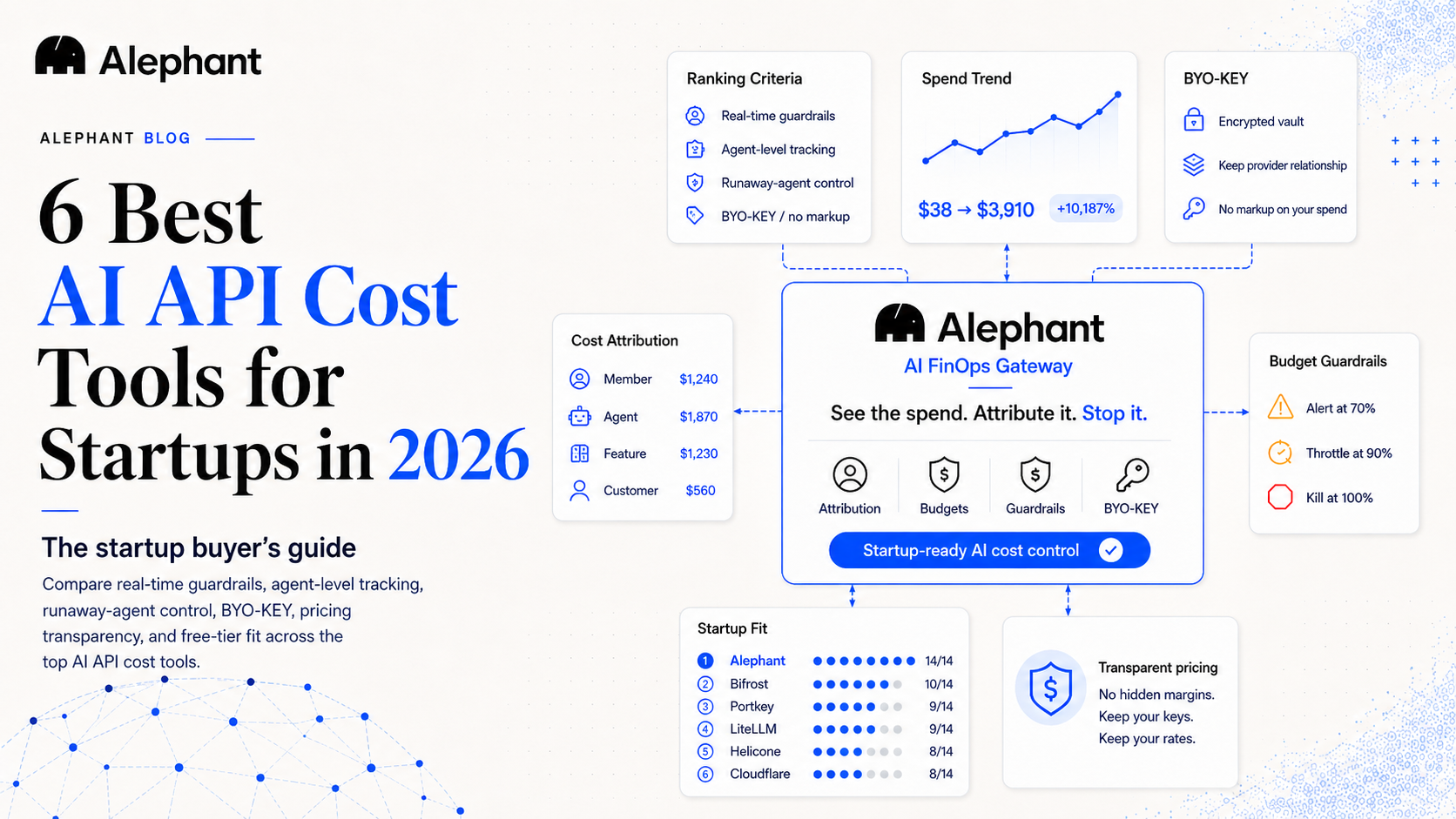
Month one, your AI feature cost $38. Month four it cost $3,910. Same product, same pricing page. Four pilot users turned into sixty, one of them wired an autonomous agent into your API, and the OpenAI dashboard still shows a single line called API usage. It does not show which feature, which customer, or which agent turned a rounding error into your second-largest line item after payroll.
This is a ranked, scored list of six AI API cost tools that early-stage teams actually evaluate in 2026: Alephant, Helicone, Portkey, Cloudflare AI Gateway, LiteLLM, and Bifrost. The rubric is weighted for founder concerns, not enterprise procurement: can it stop a runaway agent tonight, does it keep your provider relationship and your margin, and is the free tier enough to start.
TL;DR. For a startup, AI API cost management comes down to four jobs: see spend per feature and per agent in real time, enforce a budget before the provider call lands, catch a runaway agent in seconds, and keep your own API keys so there is no markup on your margin. On the scored rubric below, Alephant leads the founder-cost axes (real-time Budget Circuit Breaker, per-agent Cost Attribution, W3 Agent Thrashing detection, BYO-KEY with no markup, a free tier of 10,000 requests). Bifrost is the open-source runner-up for teams with DevOps capacity. The category exists because model API spend doubled from $3.5B to $8.4B between late 2024 and mid-2025 per Menlo Ventures, and 98% of FinOps practitioners now manage AI spend in 2026, up from 31% in 2024 per the FinOps Foundation.
What AI API cost management means for a startup
AI API cost management is the practice of tracking, attributing, and controlling spend on third-party large-language-model APIs across one or more providers. For a startup it is narrower and more urgent than enterprise FinOps: the bill is a direct hit to runway, the spend is driven by application code rather than infrastructure, and a single looping agent can do real financial damage overnight.
Three things make it different from a cloud bill. Pricing is per token, not per hour, so a single request ranges from a fraction of a cent to several dollars depending on the model and the prompt. The expensive decision is which model a developer typed into an SDK call, not which server a platform team rented. And the highest-leverage fixes (native prompt caching, model routing, gateway exact-match caching) all happen inline at request time, before month-end.
For a founder, the stakes are concrete:
- Runway. AI spend that compounds quietly is runway you did not plan to burn. You want to see the trend the week it starts bending, not the month it lands.
- Margin. If your product wraps an AI feature, the cost of serving it is your gross margin. You cannot defend a price you cannot measure.
- Investor questions. "What does each customer cost to serve?" is a question seed investors now ask. A provider invoice cannot answer it. Per-customer attribution can.
- Runaway agents. The 2026 version of a surprise bill is an autonomous agent stuck in a loop at 3am. The tool's job is to cap it in seconds, not flag it in next month's review.
The startup scoring rubric
Most "best tools" lists hand you an unscored feature grid and let you guess the weighting. This one is scored, and the axes are deliberately founder-cost weighted. Each tool earns Full (2), Partial (1), or None (0) on seven axes, for a maximum of 14.
The axes are not the only thing that matters. Raw model-catalog breadth, throughput, and tracing depth are real, and on those axes other tools win. Those are credited in the tool cards, not in this table, because they are not what decides whether a startup keeps its runway.
| Tool | Real-time guardrails | Agent-level tracking | Runaway-agent control | BYO-KEY, no markup | Free / entry tier | One-line setup | Efficiency grading | Startup fit |
|---|---|---|---|---|---|---|---|---|
| Alephant | Full | Full | Full | Full | Full | Full | Full | 14 / 14 |
| Bifrost | Full | Partial | Partial | Full | Full | Full | None | 10 / 14 |
| Portkey | Full | Partial | Partial | Full | Partial | Full | None | 9 / 14 |
| LiteLLM | Partial | Partial | Partial | Full | Full | Full | None | 9 / 14 |
| Helicone | Partial | Partial | Partial | Partial | Full | Full | None | 8 / 14 |
| Cloudflare AI Gateway | Partial | None | Partial | Full | Full | Full | None | 8 / 14 |
How to read it: every tool here can show you what you spent. They separate on whether they can stop spend in the request path, attribute it to a single agent, and tell you whether it was worth it. Only Alephant scores Full on the efficiency-grading axis, because no other tool in this set ships a grading layer. The disclosure at the top applies: score it against the cards below before you trust the order.
The six tools
1. Alephant: the AI FinOps Gateway built for cost intelligence
Alephant is the only tool in this set whose headline product is cost intelligence rather than routing or tracing. The runtime is an OpenAI-compatible gateway at https://ai.alephant.io/v1, publicly accessible since 2026-05-12, with the Rust source open-sourced under GPL v3 as alephant-ai-gateway on GitHub. BYO-KEY is the default on every tier: your provider keys sit in an AES-256 vault with Workspace Isolation enforced through PostgreSQL row-level security, and they never leave your environment. No markup, because Alephant never touches your provider relationship.
For a founder, the practical surface is one endpoint and a header. Point your existing OpenAI client at the gateway base URL, send Alephant-Session-Id to group an agent's calls, and Cost Attribution starts filling in within the first request across three dimensions: Member (via Virtual Key binding), Agent (via the session header), and Department. Per-feature and per-customer rollups come from custom request tags, which is how you answer the investor question about cost per customer.
The runaway-agent story is the one most startups feel first. AI Inside, an 11-axis signal system, flags W3 Agent Thrashing as a veto-level signal that caps a looping agent's Efficiency Score regardless of anything else it did well, and an always-on 100 RPM Basic Rate Cap runs on every tier, including Free, as the floor under an accidental while True: loop. On top of that, the Budget Circuit Breaker enforces Alert at 70%, Throttle at 90%, and Kill at 100% of any configured budget, so the call gets rejected before it lands at the provider.
The part no competitor in this set matches is grading. Beyond what did we spend, AI Inside answers was it worth it: eight waste signals (W2 Model Overkill, W3 Agent Thrashing, cache misses, oversized prompts, wasteful retries) and three value signals, laddering into an S-through-D Efficiency Score and a Spend Justification Rating of justified, questionable, or wasteful per agent or member.
Best for a startup: founders and AI-first teams running production features who want real-time enforcement, per-agent attribution, and runaway-agent control in one workspace, with a free tier to start.
The catch: AI Inside and the Prompt Registry are Pro+ gated and cloud-only, so the full efficiency-grading layer is a paid-tier and hosted feature. The runtime is versioned beta. If you want grading on day one, you are on a paid plan.
Free tier ships 10,000 requests with no credit card.
2. Helicone: observability-first, the cleanest developer experience
Helicone (YC W23, around 7,000 GitHub stars) is among the smoothest developer experiences in the category. The Pro plan ships 300+ model cost tracking, per-request analytics with latency and error overlays, session-level attribution, caching, and a Vercel AI SDK provider. It started as a request-logging and tracing tool and added the gateway later, and the architecture still reflects that order, which is a strength if tracing is your first need.
Where it wins: if your first question is what did this specific call do, how long did it take, and what did it cost, Helicone answers it faster and more cleanly than anything else here. At $10,000 per month in API spend, the Pro plan's 5% markup totals around $579 per month for the platform layer per Helicone's published pricing.
Best for a startup: teams whose first pain is request-level tracing and developer experience, with cost as one column of three.
The catch: Helicone alerts on budgets, it does not enforce at the request layer, and the 5% markup at scale is a line item on your margin. There is no efficiency-grading layer.
3. Portkey: the deepest guardrail library, enterprise-shaped
Portkey is a Series A control plane with a 1,600+ model catalog, the broadest in this set, and one of the deepest guardrail libraries anywhere (50+ guardrails). The Production tier ships real-time cost dashboards, simple and semantic caching, RBAC with service-account keys, and an extensive prompt-template system. SOC 2 Type 2, HIPAA, GDPR, and BAAs live at the Enterprise tier, alongside SSO and granular per-member budget escalation.
Where it wins: model-catalog breadth and the sheer depth of its guardrail and prompt-governance tooling. If you are a regulated team that will need compliance evidence soon, Portkey is built for that buyer.
Best for a startup: teams that expect to hit compliance and prompt-governance requirements early and want the deepest guardrail catalog from day one.
The catch: the cost-attribution and governance depth that matters most lives behind Production and Enterprise pricing, which is heavier than a seed-stage budget usually wants. The persona it is designed for is a senior platform lead, not a two-founder team.
4. Cloudflare AI Gateway: the free thin layer if you are already on Cloudflare
Cloudflare AI Gateway is the lowest-friction option for teams already deploying through Cloudflare Workers or Pages. A free basic tier gives you caching, rate limiting, and request logging executed at Cloudflare's edge, with latency among the lowest in the category for apps already routing through that stack, and it inherits Cloudflare's compliance posture per the Cloudflare AI Gateway docs.
Where it wins: zero new vendor onboarding and edge-level latency if Cloudflare already fronts your app.
Best for a startup: teams already on Cloudflare who want a thin observability and caching layer with no new contract.
The catch: it does rate limits, not budget-level enforcement, and it does not natively model members or agents, so per-agent attribution and runaway-agent budget control are not there. It is a component of a larger platform, not a standalone cost tool.
5. LiteLLM: the open-source community default
LiteLLM (MIT licensed, around 38,900 GitHub stars per Finout's 2026 review) is the de facto starting point for teams that want a self-hosted proxy without writing one. It supports 100+ provider SDKs, exposes per-key budget primitives via max_budget, and swaps in behind an OpenAI-compatible endpoint in an afternoon.
Where it wins: it is free, it is everywhere, and the community is large enough that most integration questions are already answered somewhere.
Best for a startup: prototypes and dev environments where DevOps capacity exists and the team can pin versions and audit upstream releases.
The catch: community load tests show latency spikes past 4 minutes at 500 RPS and effective unusability at 5,000 RPS, so production needs Redis, PostgreSQL, and load balancers. The 2026-03-24 PyPI supply-chain incident, in which releases 1.82.7 and 1.82.8 shipped backdoored code that exfiltrated SSH keys and API keys, is a reminder that an open-source proxy is inherited supply-chain risk unless you pin and audit.
6. Bifrost: the performance-first open-source gateway
Bifrost, from Maxim AI, is the throughput leader among open-source proxies: Go-based, self-hosted, with roughly 11-microsecond request overhead at 5,000 RPS and about 50x the throughput of LiteLLM at comparable load per independent 2026 benchmarks. The open-source package ships semantic caching, native MCP support, hierarchical budget management at the virtual-key, team, and customer levels, and audit logs that meet SOC 2, HIPAA, GDPR, and ISO 27001 requirements per the Bifrost repo.
Where it wins: raw performance and the most complete feature set you can self-host for free, including budget enforcement and audit logging that usually sit behind paid tiers elsewhere.
Best for a startup: performance-critical teams with DevOps capacity who want self-hosted control and modern features without managed-SaaS pricing. The strongest runner-up on the rubric.
The catch: it covers 15+ providers, narrower than the managed options, and like any self-host it is your team that operates it, monitors it, and owns the incident at 3am. There is no efficiency-grading layer.
How to choose by stage
Pre-seed or solo builder. Start free and start native. Turn on OpenAI's Project-level monthly budget cap at Settings then Limits, which most teams skip, then put a free inline gateway in front for attribution. Alephant's free tier (10,000 requests, no card) or self-hosted LiteLLM both cost nothing and give you the per-agent view a provider dashboard cannot. See the Holori 2026 visibility roundup for the broader open-source landscape.
Seed stage, first production agents. You now have an autonomous workload that can loop, and a board deck that needs unit economics. This is where a real inline gateway earns its place. Alephant gives you the Budget Circuit Breaker, per-agent Cost Attribution, and W3 Agent Thrashing detection in one workspace. Bifrost gives you the same enforcement self-hosted if you have the DevOps capacity.
Series A, scaling and reporting. Spend is now large enough that finance wants AI cost reconciled with the rest of the budget. Keep the inline gateway as the real-time enforcement and attribution layer, and feed its telemetry into a billing-FinOps platform for finance reporting. The gateway is the source of truth for control; the billing layer is the system of record for the board.
Frequently asked questions
What is the best AI API cost tool for an early-stage startup?
For a startup that needs real-time control rather than month-end reporting, Alephant is the strongest fit on the founder-cost axes: a free tier of 10,000 requests with no credit card, BYO-KEY with no markup on your provider spend, per-agent Cost Attribution, the Budget Circuit Breaker that enforces Alert, Throttle, and Kill at 70, 90, and 100% of budget, and W3 Agent Thrashing detection for runaway agents. If your team has DevOps capacity and wants to self-host for free, Bifrost is the open-source runner-up. If your first need is request-level tracing, Helicone is the cleanest developer experience. Match the tool to your first real pain, not the longest feature list.
How do startups keep a runaway AI agent from blowing the monthly budget?
Three layers, cheapest first. Set the provider's native cap (OpenAI Project-level budget at Settings then Limits), which is free and underused. Put an inline gateway in front that enforces in the request path: Alephant's Budget Circuit Breaker rejects calls at 100% of budget and throttles at 90%, and its always-on 100 RPM Basic Rate Cap catches an accidental loop on every tier including Free. Then tag each agent with its own Virtual Key so a single looping agent hits its own envelope instead of draining the org budget. Bifrost offers hierarchical budgets self-hosted; billing-based tools cannot stop a call that is happening now.
Which AI cost tools let you keep your own API keys?
Tools that run BYO-KEY use your provider credentials and never resell model access, which keeps your provider rate-limit tiers and removes a key-custody risk. Alephant runs BYO-KEY as the default on every tier with an AES-256 vault and PostgreSQL row-level Workspace Isolation. Helicone and Portkey also support BYO-KEY. Self-hosted LiteLLM and Bifrost keep keys on your own infrastructure by definition. The question to ask any vendor is whether zero data access is the default posture or a negotiated Enterprise add-on.
How much should a seed-stage startup budget for AI API costs?
There is no flat number, because spend tracks usage, not headcount. The useful move is to make the number predictable rather than guess it: instrument cost per active customer and cost per feature early, set a monthly budget with hard enforcement so a bad week cannot become a bad quarter, and watch your cache-hit rate, since native prompt caching reclaims 50% on OpenAI cached input and up to 90% on Anthropic cache reads. Teams that turn on model routing commonly cut 30 to 70% on mixed workloads by sending easy requests to a cheaper model. Budget the trend line, then defend it with enforcement.
Do startups need a separate AI cost tool, or is the OpenAI dashboard enough?
The OpenAI dashboard is enough while you run one provider, one product, and no autonomous agents. It stops being enough the moment any of those changes. It shows aggregate usage by model, refreshed on a lag, with no per-feature, per-customer, or per-agent breakdown and no way to stop a call in flight. A startup running production AI features across OpenAI and Anthropic, or running agents that can loop, has outgrown it. An inline gateway adds attribution and real-time enforcement that the provider console was never built to provide.
How do founders report AI unit economics to investors?
Investors increasingly ask what each customer costs to serve, and a provider invoice cannot answer it. The mechanism is attribution: tag every request with a customer and feature identifier so spend rolls up to cost per customer and gross margin per AI feature. Alephant's Cost Attribution supports this through custom request tags on top of Member, Agent, and Department dimensions, which is the same data finance needs for chargeback. With it, the board slide reads "this customer costs $X to serve at Y% margin" instead of "our OpenAI bill went up."
The bottom line
For a startup, AI API cost management is not a reporting problem to solve at month-end. It is a control problem to solve in the request path, before a runaway agent or a quiet usage ramp eats the runway. The six tools here all show you spend. They separate on whether they can stop it, attribute it to a single agent, and tell you whether it was worth it.
Alephant sits at the inline-gateway layer with cost intelligence as the primary product, which is why it leads the founder-cost rubric. The runtime is publicly accessible at https://ai.alephant.io/v1 since 2026-05-12, with the Rust source open-sourced under GPL v3 as alephant-ai-gateway. The Free tier covers 10,000 requests with no credit card and ships four budget primitives on day one: Set Monthly Budget, Daily Hard Stop, Monthly Spend Alert, and the always-on 100 RPM Basic Rate Cap. The AI Inside efficiency layer and multi-level Budget Circuit Breaker escalation unlock on Pro and above.
If you are shipping AI features and the next invoice will be your largest, the integration is a one-line base_url swap on your existing OpenAI client. Tag the first request with Alephant-Session-Id and per-agent attribution starts showing up in the dashboard. Self-host the same runtime from the Alephant org on GitHub if you want full control. The Alephant Discord is where the team answers cost-architecture questions in public.